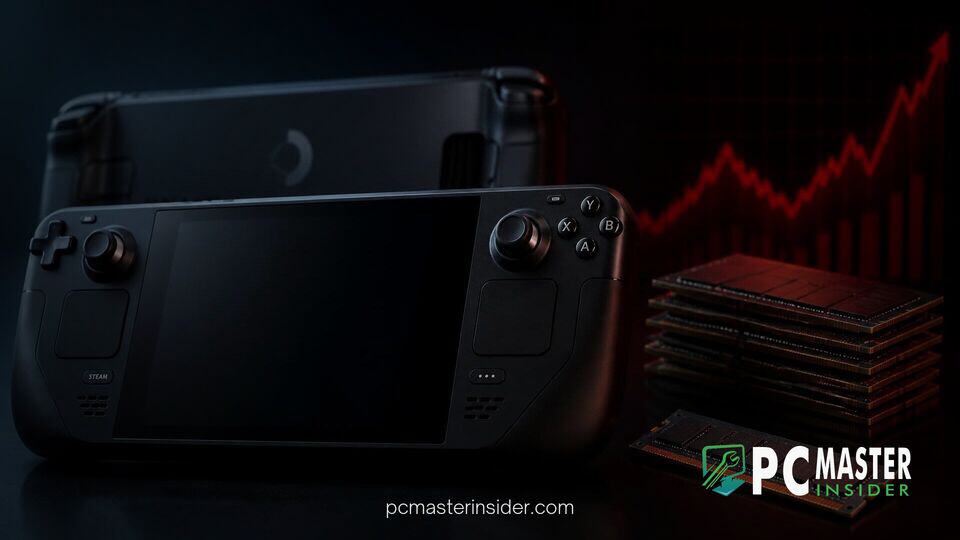
Valve has confirmed that its overarching development strategy for the Steam Deck 2 remains intact despite persistent DRAM supply constraints across the globe. While rising memory prices have altered release logistics across the broader tech landscape, Valve insists it will not compromise on its hardware goals for its next flagship handheld.
Speaking in a recent interview, Valve software developers Pierre-Loup Griffais and Jeff Leinbaugh explained that the hardware team is still waiting to deliver a full generational upgrade rather than an incremental revision. Although supply chain volatility could influence when the device arrives on store shelves, the fundamental product vision has not shifted.
Valve Steam Deck 2 RAM Crisis and Hardware Goals
Navigating the valve steam deck 2 ram crisis requires balancing high performance goals against steep manufacturing costs. Valve developer Pierre-Loup Griffais clarified that memory price surges have not forced the company to lower its specifications or trim features. Instead, Valve maintains that any true successor to the original device must deliver a noticeable, multi-fold jump in computational capability before taking shape as a consumer product.
Valve Reaffirms Handheld Hardware Strategy
Valve has taken a distinct approach to product iterations compared to traditional hardware vendors. Rather than adopting a annual refresh schedule, the company prefers long product cycles focused on stability and developer optimization. In celebrating major milestones, such as when Valve celebrates 30 years in PC gaming, the company has repeatedly highlighted how platform consistency benefits both game developers and players.
Griffais reiterated that the team is focused on delivering a uniform user experience. "We've talked before about how we want to make sure there's a very delineated performance improvement for something like a future Steam Deck, and I think we're still looking at it in the same way," Griffais stated. "It's just a matter of looking at the current conditions and seeing how and when we can deliver something like that."
Generational Performance Target Preserved
The decision to hold out for a true generational leap means Valve is avoiding minor processor updates. Competitors in the portable market frequently release annual revisions powered by incremental System-on-Chip (SoC) updates. However, Valve's internal engineering benchmarks require a much larger leap in thermal efficiency and graphical throughput before slapping a number two on the chassis.
Software optimization remains a critical pillar of this strategy. Valve continues to refine SteamOS and its Proton compatibility layer, ensuring existing handhelds run demanding PC titles smoothly. For players encountering boot issues with third-party digital storefronts, learning how to fix Steam games failing to launch on secondary launchers can resolve common software roadblocks on handheld environments.
Impact of Soaring Memory Costs
The global memory shortage has created unprecedented pricing pressure across the entire tech sector. Surging demand for high-bandwidth memory in enterprise data centers has constrained the global supply of LPDDR5 and LPDDR5X chips, driving up unit costs for consumer electronics. This component crisis previously forced Valve to adjust pricing structures for its existing hardware catalog, pushing up the cost of its OLED handheld configurations.
Memory inflation has similarly influenced Valve's newest platform debuts. The standalone Valve Steam Frame VR headset entered the market at a premium price point of $1,059, reflecting how volatile component prices affect new product lines. Because handheld gaming PCs rely heavily on fast unified memory shared between the CPU and GPU, high DRAM prices directly impact the price-to-performance ratio Valve can offer.
Market Context and Future Portable Gaming Roadmap
The portable PC ecosystem has expanded rapidly over the past several years. Rival manufacturers have flooded the market with high-end handhelds featuring power-hungry chips and high-refresh-rate displays. At the same time, software compatibility continues to evolve as companies streamline launcher requirements, similar to how Ubisoft eliminates mandatory Connect launcher requirements in select Steam trials.
Hardware trends on the broader Steam platform showcase how rapidly baseline performance requirements are rising. As documented when the AMD Radeon RX 9070 XT topped the Steam Hardware Survey, desktop gamers are continuously pushing graphical targets higher. For a handheld to target modern PC releases, high-speed unified memory is non-negotiable, explaining why Valve is willing to wait out current market turbulence rather than launch a underpowered or overpriced handheld.
Ultimately, Valve's stance signals patience. By refusing to dilute the specifications of the Steam Deck 2, the company ensures that when its next-generation handheld finally arrives, it will offer a true generational upgrade without forcing consumers to pay inflated prices for compromised hardware.