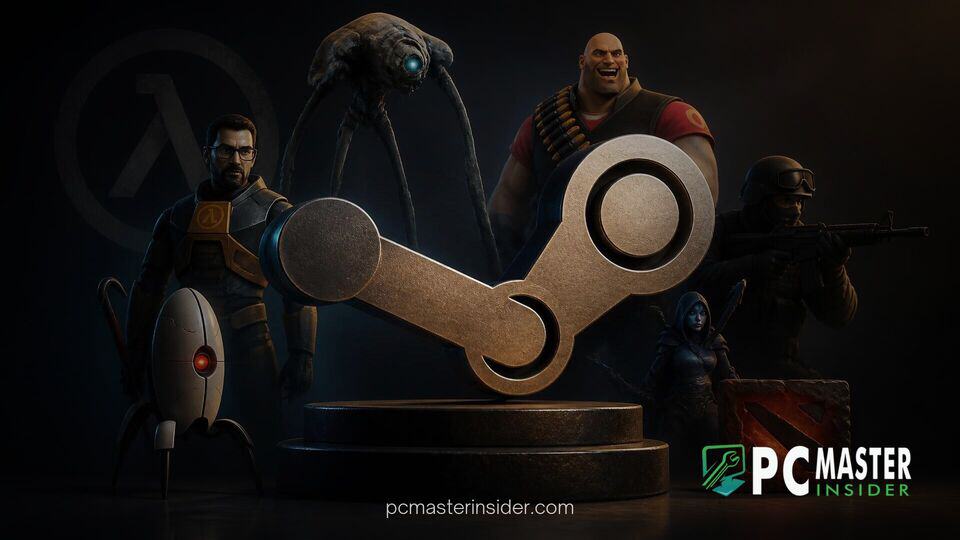
Valve Corporation has reached a major milestone, officially celebrating its 30th anniversary. Founded in late August 1996, the Bellevue, Washington-based company has transformed from an ambitious independent development studio into the dominant ecosystem leader of modern PC gaming.
Over the past three decades, Valve has reshaped how video games are designed, distributed, and experienced globally. Beyond creating critically acclaimed software, the organization built the infrastructure that defines contemporary digital storefronts and pioneered open hardware initiatives for desktop and handheld environments.
From Half-Life to Steam: Valve Marks 30 Years
Looking back at valve 30th anniversary pc gaming history, the studio established a reputation for pushing technological boundaries right from its inception. The company was formed by former Microsoft engineers Gabe Newell and Mike Harrington on August 24, 1996. Utilizing their background in operating system development and software engineering, the founders set out to create high-concept interactive entertainment.
Their debut project, the 1998 first-person shooter Half-Life, completely upended traditional game design. Prior to its release, narrative delivery in action titles was often relegated to static text displays or disconnected cinematic sequences. Half-Life integrated uninterrupted, first-person storytelling directly into real-time gameplay, combining environmental puzzle-solving, sophisticated artificial intelligence, and physical interactions within a seamless world.
Founding and Early Breakthroughs
Following the widespread success of Half-Life, Valve embraced community development tools, laying the groundwork for some of the most enduring franchises in interactive entertainment history. The studio released official software development kits that allowed modders to modify its game engines. This decision directly led to the birth of Counter-Strike, which began as a community-created mod before Valve acquired the property and brought its creators into the company.
Similar trajectories led to the expansion of Valve's internal software library with titles like Day of Defeat and Team Fortress. By fostering third-party talent, Valve established a development model that prioritized player creativity and competitive multiplayer design.
In 2004, the release of Half-Life 2 set another benchmark for physics-based gameplay, character animation, and environmental immersion through its proprietary Source Engine. Alongside groundbreaking single-player releases like Portal and cooperative experiences such as Left 4 Dead, Valve secured its standing as one of the premier software developers in the industry.
For players interested in exploring the evolution of the platform over the decades, checking out valve 30th anniversary pc gaming history books and collectibles offers detailed insights into how these early milestones were achieved.
How Steam Transformed Digital Distribution
While Valve's game releases earned critical acclaim, its launching of the Steam platform in September 2003 fundamentally altered the commercial landscape of the entire video game industry. Originally introduced as a mandatory utility to streamline patch deployment and anti-cheat measures for Valve titles, Steam quickly expanded into a universal digital storefront for third-party publishers.
At a time when physical retail stores dictated PC software distribution, Steam established a direct digital bridge between creators and consumers. The platform introduced centralized game libraries, cloud save synchronization, automatic background updates, and integrated social features that made managing PC titles vastly more convenient.
Over the years, Steam democratized game publishing by providing independent developers with access to a global audience. Features like the Steam Workshop simplified mod installation, while seasonal store sales transformed purchasing habits across the global gaming community. Today, Steam accounts for the overwhelming majority of digital PC game sales worldwide, consistently hosting tens of millions of concurrent users online.
Hardware Era and the Future of SteamOS
In its third decade, Valve shifted a significant portion of its research and development toward hardware engineering and open-source software compatibility. After early experiments with living-room initiatives, the company made substantial strides in virtual reality with the release of the Valve Index headset and the critically lauded flagship VR title Half-Life: Alyx in 2020.
The company achieved another major breakthrough with the launch of the Steam Deck handheld PC in 2022. Built upon SteamOS, an Arch Linux-based operating system utilizing the Proton compatibility layer, the device demonstrated that high-end PC games could run efficiently on portable, Linux-based architecture without requiring native Windows ports.
Valve's continued investment in hardware and software integration has reinvigorated handheld computing and encouraged wider adoption of Linux-friendly development practices across the games industry. Through flat organizational structures and a unique focus on long-term infrastructure over short-term publishing cycles, Valve remains an influential force in personal computing.
As Valve enters its fourth decade, its combination of digital distribution dominance, hardware innovation, and classic software franchises ensures that its influence on PC gaming will continue to shape the medium for years to come.