
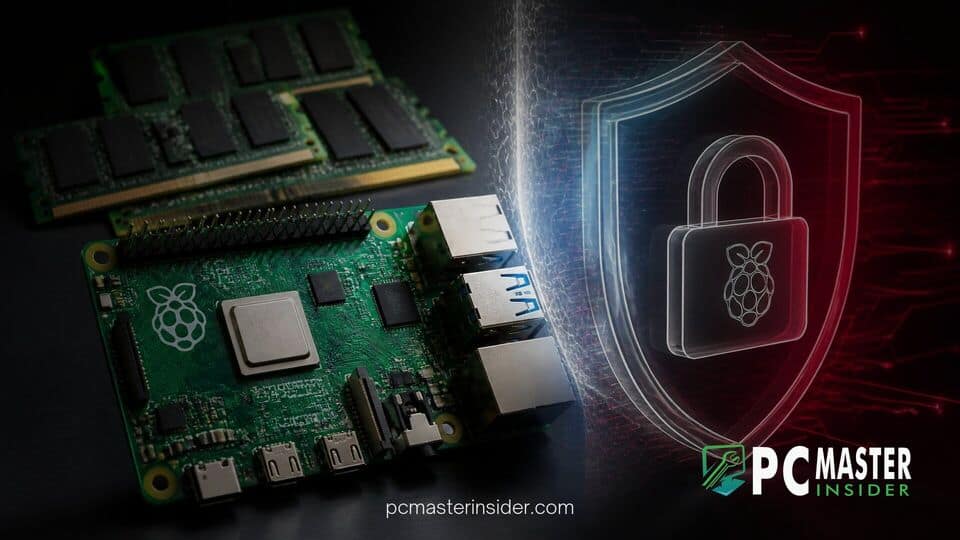
Raspberry Pi engineers have officially confirmed that company firmware restricts single-board computers to their original factory memory configurations. The restriction prevents physical RAM chip upgrades and repairs in order to stop fraudulent third-party resales and support burdens.
While the hardware lockdown protects unsuspecting buyers from tampered devices, it effectively blocks legitimate DIY enthusiasts and repair technicians from replacing or expanding soldered memory ICs on affected boards.
Raspberry Pi Details Firmware Lock on Memory Configurations
Raspberry Pi has confirmed that its official firmware enforces a strict memory configuration check during the boot sequence . The focus on a raspberry pi firmware ram upgrade lock gained renewed attention following discussions on the official Raspberry Pi forums and developer community channels . When a board boots, the system firmware checks the attached SDRAM against configuration settings recorded in the System on Chip (SoC) One-Time Programmable (OTP) memory . If the detected capacity or hardware profile does not match the factory record, the system halts and throws a boot error, such as code 9 SDRAM mismatch .
Reasoning Behind the Factory Capacity Restrictions
The core rationale for the restriction centers on preventing marketplace fraud perpetrated by unauthorized hardware resellers . Raspberry Pi engineer and forum moderator PhilE explained that certain third parties were buying low-capacity models, desoldering the original memory packages, and attaching higher-capacity RAM chips of unverified origin . These modified boards were then resold as genuine higher-tier factory units at inflated market prices .
According to the company, these modified boards were never validated for long-term electrical or thermal stability . When the unverified memory ICs failed or caused system crashes, confused consumers directed their customer support requests and complaints back to Raspberry Pi rather than the resellers who altered the hardware . By locking the hardware boot sequence to match the original factory specifications, the company eliminates the commercial incentive for reseller tampering .
Impact on DIY Modders and Hardware Repairs
The firmware verification rules extend beyond simple capacity checks. To accommodate various memory suppliers across different manufacturing runs, the firmware records specific memory attributes, including density, timing profiles, and component organization . As a result, replacing a damaged memory package with an identical-capacity chip sourced from another Raspberry Pi board can still trigger a boot error if the embedded attributes do not match precisely .
How the Memory Mismatch Prevents Board Booting
The validation routine occurs early in the startup process. During initial bootloader execution, the system compares the physical memory parameters against the internal OTP register settings . If any discrepancies are found, execution stops before the operating system kernel can initialize. While experienced hardware modders possess the specialized hot-air desoldering equipment required to swap Ball Grid Array (BGA) memory packages, the software lock renders such physical modifications ineffective under standard firmware .
Community Response and Broader Implications
Members of the hardware maker and open-source communities have expressed mixed reactions to the confirmation. While many acknowledge the genuine problem posed by predatory resellers, critics argue that a hard boot lock penalizes legitimate repair efforts and advanced tinkering . Hardware advocates, including prominent technology modders, suggested that implementing a software warranty bit or a one-time status flag would have warned users of modified hardware without permanently disabling the device .
Reports indicate that these firmware verification routines were quietly integrated into EEPROM release builds starting in late 2024 . Users seeking to maintain hardware repairability on older setups must rely on legacy firmware images, though doing so prevents access to recent performance fixes and stability updates .
In summary, Raspberry Pi prioritizes ecosystem reliability and protection against reseller fraud by enforcing strict memory configuration locks at the firmware level. While the policy successfully curbs fraudulent market practices, it establishes a firm boundary that limits component-level modification for the broader maker community.