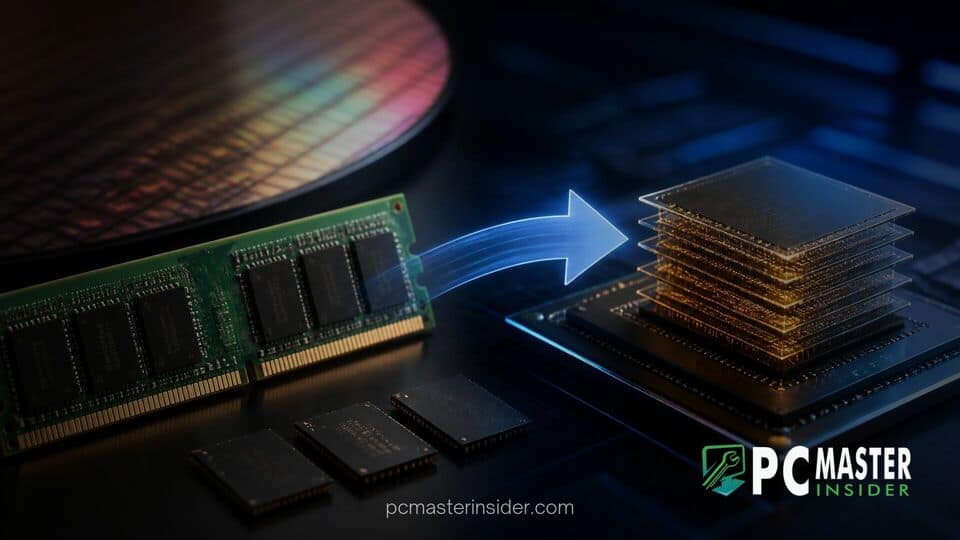
Samsung Electronics is officially adjusting its memory semiconductor strategy, choosing to outsource future expansion of standard PC and server memory module production to global partners. By delegating assembly and testing for standard components, the tech giant aims to free up crucial internal manufacturing space for high-value High Bandwidth Memory (HBM) tied to artificial intelligence computing.
The strategic shift highlights how the relentless demand for AI accelerators is reshaping global supply chains. Rather than building entire new facilities for standard memory products, Samsung is utilizing its existing factory footprint to support complex, next-generation AI silicon.
Samsung Outsources DDR5 Memory Production to Focus on AI Accelerators
Under the new operational strategy, Samsung is directing its Outsourced Semiconductor Assembly and Test (OSAT) partners to handle all additional production volume for standard DDR5 RAM modules and consumer solid-state drives (SSDs). This operational transition allows Samsung to avoid adding basic packaging and testing lines at its main South Korean sites. Instead, those facilities will focus on complex packaging techniques required for high-density HBM chips.
Samsung Shifts Standard DDR5 Production to Asian Partners
To ensure that the global market maintains an adequate supply of standard PC and server memory, Samsung has been working closely with key OSAT vendors across Asia. Rather than managing the labor-intensive assembly of mounting DRAM and NAND chips onto printed circuit boards in-house, Samsung is transferring these back-end processes to specialized external partners.
Offloading PC RAM Production to Focus on HBM
The decision stems directly from physical constraints at Samsung's primary back-end manufacturing campuses in Cheonan and Onyang, South Korea. With cleanroom space at a premium, the company is converting existing packaging lines into advanced packaging hubs specifically tailored for HBM stacks.
Advanced AI silicon requires intricate 3D stacking techniques and silicon interposers that demand far more sophisticated equipment than conventional memory sticks. Industry reports indicate that memory stockpiles at Samsung and SK Hynix have faced ongoing pressure due to tight factory capacities, forcing major chipmakers to prioritize high-margin AI contracts. As a result, Samsung is advising its external packaging vendors to accelerate their own expansion plans to ensure standard consumer hardware volumes remain steady.
Key Overseas Partners in India, Vietnam, and Philippines
Several established manufacturing partners across Asia are absorbing the increased DDR5 and SSD assembly workload. Dreamtech has already initiated mass production of DDR5 memory modules at its facilities in India. Meanwhile, Hanyang Digitech is handling memory module assembly at its operations in Vietnam, and SFA Semicon is leveraging its semiconductor packaging facilities in the Philippines.
By delegating these routine surface-mount technology (SMT) and testing tasks to established overseas hubs, Samsung maintains high output while redirecting its internal engineering focus. Industry sources note that Samsung has requested these partners bring forward planned capital investments to prevent supply bottlenecks in standard desktop and server memory markets.
Impact on the Consumer PC RAM Market
For everyday PC builders and system integrators, Samsung's strategic shift is unlikely to result in a shortage of system memory sticks. Standard DDR5 modules rely on well-established manufacturing standards, meaning third-party assembly centers can build compliant RAM sticks to strict quality specifications. Buyers looking to upgrade desktop rigs with high-performance memory, such as Trident Z5 Royal NeoX DDR5 modules, will continue to see steady retail availability powered by these enlarged supply chains.
DDR5 Supply Chains and Pricing Outlook
While component availability should remain stable, pricing trends across the broader memory ecosystem reflect high demand across data centers. With major semiconductor fabs prioritizing silicon wafers for high-value enterprise HBM and server DRAM over standard consumer chips, overall DRAM wafer capacity remains tight.
Outsourcing backend assembly helps mitigate cost spikes associated with domestic factory conversions, but pricing for standard PC memory will ultimately depend on global silicon wafer supply. As hardware makers navigate shifting production costs, some manufacturers are making adjustments; recently, Framework retroactively cut LPCAMM2 RAM prices after securing more favorable module pricing from suppliers.
What Lies Ahead for AI and Desktop Memory
Samsung's decision to shift standard module assembly outward demonstrates how deeply the artificial intelligence boom is reorganizing semiconductor manufacturing priorities. Building dedicated fab infrastructure for advanced packaging requires massive capital expenditure and years of construction. By converting current internal facilities to HBM production and outsourcing standard DDR5 module builds, Samsung can scale up its AI memory output immediately.
This strategy also aligns with broader industrial movements where chipmakers coordinate closely with third-party foundries and specialized packaging partners. As tech giants race to power next-generation data centers, the division between high-end custom AI silicon and standard mass-market computer hardware continues to widen. For Samsung, offloading commodity packaging allows its core domestic facilities to remain focused on leading the next wave of advanced enterprise memory innovation.