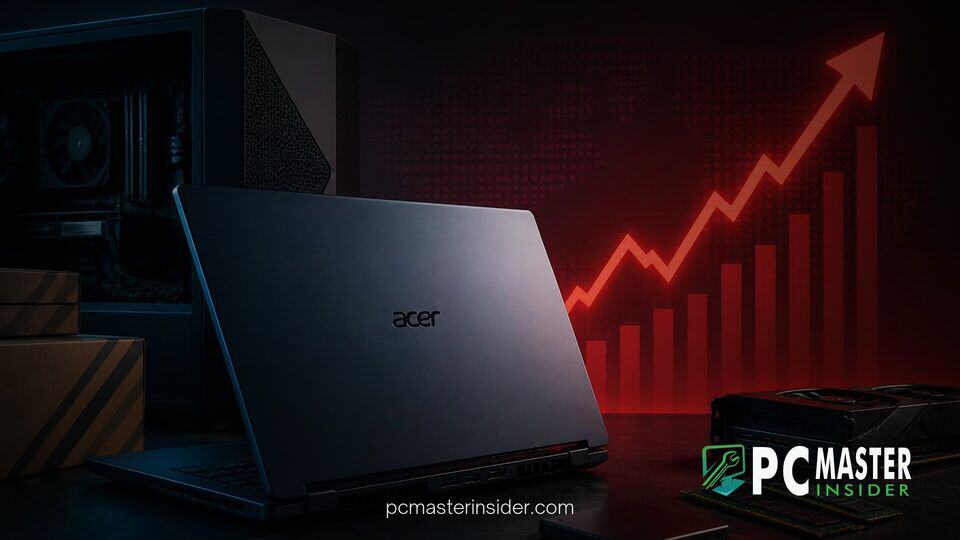
Acer has signaled that retail prices for its laptops and desktop computers could increase by up to 20 percent during the fourth quarter of 2026. The major PC manufacturer points to compounding cost pressures across key hardware components as the primary driver behind the upcoming price adjustments.
The announcement comes as hardware makers across the personal computing industry face tightening profit margins, forcing companies to pass rising component costs on to consumers ahead of the critical holiday shopping window.
Acer PC Price Increase Q4 2026: Key Drivers and Market Impact
According to executive statements and supply chain projections, the anticipated Acer PC price increase in Q4 2026 stems from escalating costs in core hardware subsystems. Price hikes are expected to affect both entry-level laptops and premium gaming rigs, with mainstream consumer configurations taking the most direct hit as manufacturers struggle to absorb raw material inflation.
Industry analysts indicate that price adjustments will likely vary by region and product tier. While high-end machines with higher built-in profit margins may experience single-digit adjustments, high-volume consumer notebooks could see retail price tags jump by 15 to 20 percent compared to current summer levels.
Acer Forecasts Q4 Price Hikes for Consumer PCs
Acer management highlighted that price increases have become unavoidable after months of absorbing elevated manufacturing expenses. The company noted that upstream component suppliers have steadily raised wholesale prices throughout the second half of the year, leaving original equipment manufacturers (OEMs) with limited operational leverage.
Rather than quietly scaling back hardware specifications, Acer is preparing distributors and retail partners for formal price updates. This strategy aims to give system builders and enterprise buyers sufficient lead time to adjust purchasing budgets before the end-of-year sales period begins in earnest.
The price increases mirror broader movements across the PC sector. Silicon vendors and board partners have similarly signaled adjustments, with recent reports indicating that Intel is preparing a 10 percent PC CPU price hike for October to bolster corporate operating margins.
Sustained SSD and Memory Costs Drive System Price Increases
At the center of Acer's price recalculation is the ongoing crisis in the memory and storage markets. System memory prices have reached unprecedented levels following prolonged supply shifts toward enterprise artificial intelligence hardware. Earlier this month, market analysis revealed that DDR5 RAM prices surged to a new record high in September, drastically increasing the bill of materials for consumer desktops and laptops.
Storage modules are experiencing parallel cost growth. High-capacity solid-state drives (SSDs) have become notably more expensive as NAND flash producers allocate fabrication capacity to enterprise customers. When combined with recent reports that AMD raises GPU and chipset prices by 10 percent, system integrators like Acer are hit simultaneously on CPUs, memory, storage, and graphics processing units.
Impact on System Builders and Pre-Built PC Buyers
For everyday shoppers and custom system builders, Acer's warning signals a challenging end to 2026. Buyers who held out for traditional late-year sales events may find that discounts merely bring prices back down to early-2026 MSRPs rather than offering true bargain savings.
The broader market environment reflects these rising baseline costs. Trend reports demonstrate that US PC average selling prices exceeded $1,000 for the first time in Q2 2026, confirming that hardware affordability was already trending downward long before Acer's Q4 warning.
Pre-built desktop buyers are expected to feel the squeeze alongside laptop shoppers. While laptop manufacturers often soldier through supply chain pinches by altering display or battery specifications, desktop pre-builds rely heavily on standardized components whose market pricing is transparent and instantly impactful on total assembly costs.
Expected Timeline for Component Price Stabilization
Industry observers do not anticipate immediate relief for hardware pricing as the calendar moves toward 2027. Supply chain experts suggest that DRAM and NAND wafer capacity will remain heavily constrained through at least the first half of next year due to ongoing data center expansion and high-margin AI accelerator production.
Handheld and niche hardware developers are also recalibrating their long-term hardware roadmaps around these supply realities. For instance, Valve confirmed Steam Deck 2 plans remain unchanged despite the ongoing RAM crisis, though launch timing and final pricing targets remain closely watched variables across the sector.
Unless consumer demand drops sharply enough to free up component inventory, hardware buyers should prepare for a elevated pricing baseline across all personal computing categories throughout the remainder of 2026.