
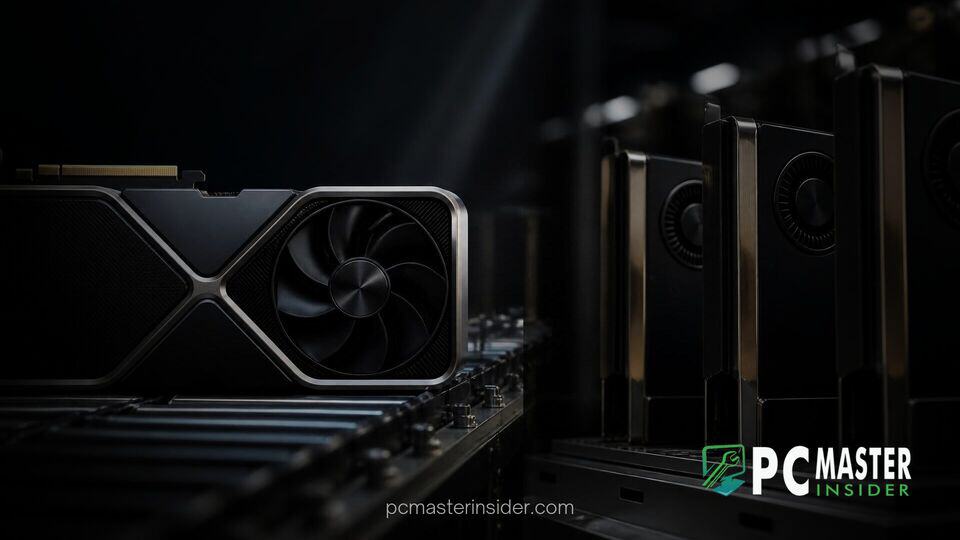
Nvidia has reportedly ceased new allocations of its top-tier GB202 silicon for consumer graphics cards, signaling a major supply shift toward high-margin enterprise hardware. Industry reports indicate that all upcoming batches of the largest Blackwell GPU die will be reserved strictly for the professional RTX Pro line.
This reallocation effectively halts fresh production runs for the GeForce RTX 5090 and its regional variants. With global demand for artificial intelligence infrastructure and enterprise workstations continuing to outpace supply, Nvidia is funneling its premium silicon into segments that deliver significantly higher profit margins per wafer.
Nvidia Shifts GB202 Silicon to Workstation GPUs
The core of this market adjustment centers on how Nvidia utilizes its flagship die. According to supply chain reports and leaks from hardware commentators, Nvidia notified manufacturing partners that future shipments of the GB202 processor will be allocated exclusively to enterprise products. While existing component inventories mean board partners can continue assembling graphics cards for a short window, new allocations for consumer-focused cards have come to a standstill.
This strategic move directly impacts the consumer flagship segment. Retail buyers facing stringent purchasing conditions, such as Micro Center requiring ID and anti-export pledges for RTX 5090 buyers, may soon see stock levels tighten even further as channel inventory dries up.
Diverting Blackwell Silicon to Enterprise Hardware
The enterprise workstation catalog offers vastly higher returns compared to consumer gaming components. The full GB202 processor powers top-spec professional workstations such as the RTX Pro 6000 series, which pairs 24,064 CUDA cores with up to 96GB of high-speed memory for heavy computing workloads. Furthermore, Nvidia recently rolled out intermediate enterprise options like the RTX Pro 5500, which mirrors the 21,760 CUDA core configuration of the RTX 5090 while doubling its memory capacity for AI development.
Enterprise workstations routinely command prices exceeding five figures, giving Nvidia strong economic incentive to prioritize production for corporate clients, data centers, and research labs over individual retail consumers.
Impact on GeForce RTX 5090 Retail Availability
With fresh silicon diverted at the foundry level, the gaming market faces an impending reduction in top-end GPU supply. Board partners rely on continuous chip shipments to maintain manufacturing schedules, and stopping GB202 supply for consumer cards means retail availability will depend entirely on existing distributor stock.
This tightening supply arrives alongside ongoing challenges in the retail space. Beyond availability concerns, hardware enthusiasts have noted operational hurdles, ranging from thermal power spikes documented in DLSS 5 power connector testing on the RTX 5090 to customer service disputes like PNY closing a ticket over a melted GPU cable. A decrease in total card volume could make warranty replacements and RMA processing more complicated for third-party vendors.
Market Pricing and Supply Outlook
When high-end silicon availability contracts, retail prices typically climb on secondary markets and among third-party resellers. Previous hardware cycles demonstrate that whenever top-tier consumer dies are redirected to enterprise products, street prices drift far above manufacturer suggested pricing. With enterprise clients buying consumer cards in bulk for smaller AI clusters, retail units are expected to become increasingly scarce.
What Is Next for PC Gamers
As the GeForce RTX 5090 moves toward limited availability, industry sources suggest Nvidia may shift its top-end gaming focus toward lower-tier chips like the GB203. Reports indicate that a revised GeForce RTX 5080 featuring an expanded 24GB VRAM configuration could become the new flagship option for high-end gaming rigs.
Concurrently, software and platform optimizations are playing a larger role in maintaining performance standard. Initiatives like Microsoft bringing Advanced Shader Delivery to Nvidia RTX cards help extract maximum performance from existing desktop builds without requiring immediate hardware upgrades.
Although Nvidia has not officially declared the GeForce RTX 5090 end-of-life, prioritizing the RTX Pro series highlights where the company sees its primary growth. For high-performance PC enthusiasts, securing top-tier Blackwell desktop silicon is likely to remain challenging for the foreseeable future.