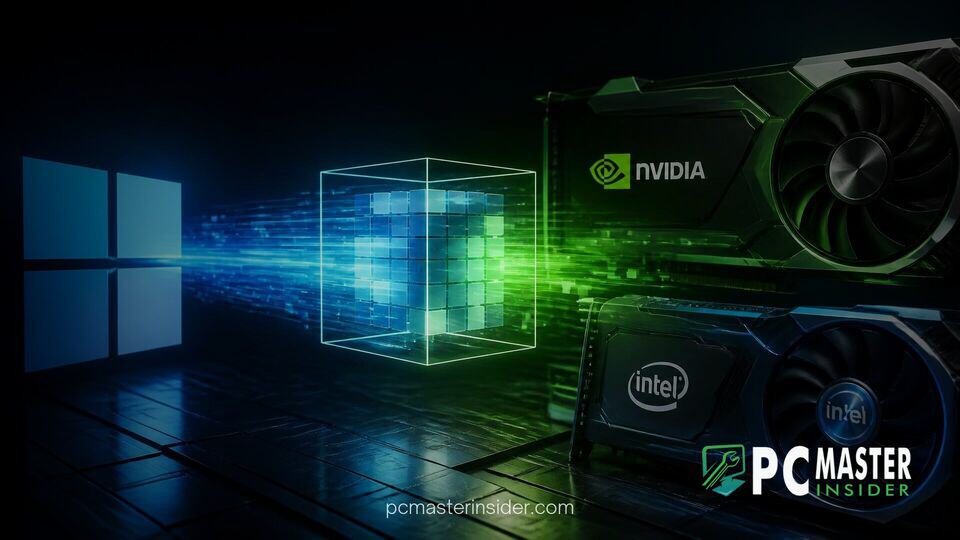
Microsoft has confirmed a significant update to its Windows 11 gaming stack, expanding its Advanced Shader Delivery system beyond AMD hardware to include all Nvidia GeForce RTX graphics cards and Intel Arc GPUs. The feature promises to drastically reduce initial loading times and virtually eliminate shader compilation stuttering for games launched through the Xbox app on PC.
Microsoft Advanced Shader Delivery RTX Support Arrives on PC
With Microsoft Advanced Shader Delivery RTX integration rollouts underway, PC gamers using Nvidia GeForce RTX graphics cards and Intel hardware will no longer need to wait through lengthy shader compilation screens. By delivering precompiled shaders straight from cloud infrastructure to match specific GPU and driver configurations, Microsoft aims to streamline the initial launch experience for modern DirectX 12 titles.
Shader compilation stutter has remained one of the most persistent technical hurdles in modern PC gaming. When games render complex visual effects, physics, or lighting models, the graphics driver must translate high-level DirectX code into machine-readable instructions tailored to specific GPU architectures. Historically, consoles avoided this bottleneck because every system shares identical hardware specs, allowing developers to ship fixed, precompiled binaries.
On PC, the vast combination of processors, graphics architectures, and display drivers meant that shaders had to be compiled locally on the user's PC. This process frequently leads to multi-minute wait times upon launching a game for the first time or sudden frame drops when new asset files load dynamically during gameplay.
Xbox PC App Expands Precompiled Shader Support Beyond AMD
Microsoft originally debuted Advanced Shader Delivery (ASD) in late 2025 as a dedicated feature for handheld PCs, specifically targeting AMD RDNA architecture. Early tests conducted on titles such as Obsidian Entertainment's Avowed demonstrated launch time reductions of up to 85 percent. Subsequent updates expanded support across discrete AMD Radeon desktop GPUs ranging from the RX 5000 series up to modern RDNA architectures.
However, PC gamers on non-AMD hardware were left waiting. The latest announcement confirms that Microsoft is removing this limitation by opening up its automated shader distribution pipeline to the broader PC market through the Xbox PC app.
Support for Nvidia RTX and Intel Arc Hardware
The updated system covers a broad spectrum of graphics hardware. On Nvidia's side, Microsoft verified that all GeForce RTX series graphics cards will support Advanced Shader Delivery alongside Nvidia's enterprise and cloud RTX Spark infrastructure. This includes every hardware generation supporting real-time ray tracing, from RTX 20 series GPUs to the latest desktop and laptop models.
For Intel users, support is targeted at modern graphics architecture. Advanced Shader Delivery will be available for Intel Arc B-Series discrete GPUs, such as the Arc B570 and B580, as well as integrated graphics built into Intel Core Ultra Series 2 and Core Ultra Series 3 processors. It comes alongside major hardware developments across the ecosystem, including recent compliance checks where Intel Nova Lake platforms clear PCIe and USB compliance certifications ahead of future platform launches.
Reducing Load Times and Shader Stutter in PC Games
The technical implementation behind Advanced Shader Delivery operates by combining cloud compilation with DirectX 12 Agility SDK tools. Developers upload a Shader Object State Database (SODB) to the Xbox Partner Center. Microsoft's automated backend then compiles those shaders across popular GPU and driver combinations, generating Pre-compiled Shader Databases (PSDB).
When a player downloads a title via the Xbox app, the matching precompiled shader cache downloads simultaneously. Upon booting the title, users are greeted with a splash screen notification stating "Precompiled shaders installed," skipping local processing almost entirely. Early benchmark demonstrations running Gears of War: E-Day showed that shader compilation wait times dropped by up to 95 percent, with only an insignificant fraction of remaining shaders requiring local compilation on the user's rig.
This development arrives during a period of massive expansion for Microsoft's broader Windows gaming ecosystem. The tech giant continues to optimize platform performance across multiple categories, including recent updates where Microsoft officially begins rollout of Windows 11 2026 Update version 26H2 to deliver core platform improvements.
Supported Titles and Rollout Timeline
Microsoft noted that Advanced Shader Delivery integration requires minimal effort from studios using recent engine pipelines. Major games already benefiting from or scheduled to receive Advanced Shader Delivery support include Gears of War: E-Day, Forza Horizon 6, S.T.A.L.K.E.R. 2: Heart of Chornobyl, Avowed, and recent entries in the Call of Duty franchise.
As the rollout continues, PC gamers running updated graphics drivers from Nvidia and Intel will automatically start benefiting from the reduced load times on supported Xbox app titles. While the system remains exclusive to games delivered through Microsoft's Xbox storefront and Game Pass on PC for now, its widespread hardware support marks a decisive step forward in fixing PC gaming's notorious shader compilation problem.