
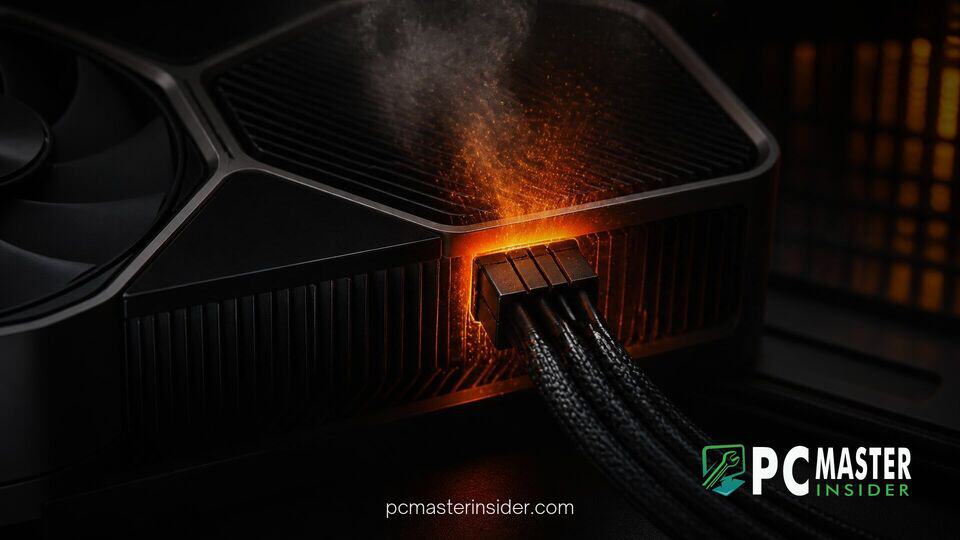
Recent thermal testing has highlighted significant thermal and electrical strain placed on flagship graphics cards when running next-generation upscaling workloads. Tests conducted on the Nvidia GeForce RTX 5090 reveal that enabling DLSS 5 drives total board power and connector temperatures to unprecedented levels during demanding gaming scenarios.
During heavy rendering sessions, hardware monitoring recorded transient power spikes peaking at 647 watts through the primary 16-pin power input. Concurrently, thermal imaging captured localized connector temperatures exceeding 91 degrees Celsius, raising fresh concerns among PC enthusiasts regarding long-term component durability under maximum neural rendering workloads.
DLSS 5 Thermal Testing Highlights Severe Power Connector Spikes
Independent thermal and power benchmarking carried out by hardware tech outlet QuasarZone examined the operational behavior of Nvidia's flagship GPU when running DLSS 5. Testing focused on an RTX 5090 Founders Edition executing a heavily modded build of Cyberpunk 2077 at 4K resolution using the Ultra preset over a continuous 20-minute run. The primary objective was to observe whether the additional computational pass required by DLSS 5 altered the power draw and heat signature of the revised 12V-2x6 high-power connector.
The resulting data confirmed a dramatic elevation in both thermal output and electrical draw. Without DLSS 5 engaged, internal sensors logged the RTX 5090 operating at an average board power of 509.2W. Once DLSS 5 was toggled on, average board power surged to 575.1W, effectively locking the graphics card at its maximum rated thermal design power. External monitoring tools, such as the Nvidia PCAT system, captured brief transient spikes reaching as high as 658W for total board power, with up to 646.7W routed directly through the 16-pin power cable alone.
QuasarZone Tests Show 12V-2x6 Connector Temperatures Surpassing 90°C
The extreme power throughput directly impacted the physical operating temperature of the supply harness. Thermal imaging targeted both sides of the graphics card's 12V-2x6 connector to track localized heat dissipation. On the side containing the four small sense pins, temperatures climbed from a baseline of 80.9°C up to 91.7°C under sustained DLSS 5 load. The latch side of the connector similarly saw a temperature rise from 77.1°C to 83.4°C in an ambient room environment of 27.5°C.
Interestingly, this behavior appears unique to ultra-high-end silicon pushing near-600W sustained loads. Comparative testing on an RTX 5080 Founders Edition demonstrated a far milder reaction. While its average power draw increased from 298.2W to 350.3W with DLSS 5 enabled, its 12V-2x6 connector temperatures peaked at a comfortable 52.2°C. To monitor current distribution across individual lines, testers also analyzed a custom board design. Using an ASUS ROG Astral RTX 5090, individual pin measurements revealed current per line increasing from 6.94A–7.47A without DLSS 5 to 7.83A–8.51A with the feature active, bringing current delivery closer to safety limits.
Why Neural Rendering Drives High Power Draw on Flagship GPUs
The underlying reason for these sudden energy spikes stems from the architectural workload introduced by DLSS 5. Unlike traditional spatial upscalers or basic frame generation algorithms, DLSS 5 integrates advanced 3D-guided neural rendering. This process requires continuous real-time execution across the GPU's dedicated Tensor cores alongside the standard rasterization and ray tracing pipelines.
In standard gaming scenarios, specific functional blocks of a GPU occasionally pause or experience minor pipeline bubbles while waiting for geometry or texture data. Neural rendering minimizes these idle states. By feeding continuous matrix math operations into the Tensor execution units simultaneously with raster rendering, the graphics processor achieves near 100 percent functional block utilization. This constant saturation prevents the GPU from dipping into lower power states, locking power consumption at the absolute hardware limit for extended durations. Hardware enthusiasts using telemetry utilities like GPU-Z hotspot temperature tracking can frequently observe these elevated thermal trends across core silicon and power delivery components.
Potential Hardware Risks and Prevention Measures for Enthusiasts
The discovery of connector temperatures exceeding 90°C has renewed discussions surrounding cable reliability and system safety. While standard 12V-2x6 and 12VHPWR terminal housings are generally rated to withstand operating temperatures up to 105°C, operating near this threshold leaves little margin for error. If a cable experiences uneven pin contact, excessive bending, or improper seating, current imbalance across the six primary 12V pins can lead to localized thermal runaway.
Recent incidents in the enthusiast community highlight the consequences of uneven electrical load. Extreme testing scenarios have demonstrated how minor pin resistance discrepancies can cause single lines to carry disproportionate current, leading to melting failures at the power supply or GPU terminal. In extreme cases where users bypass factory standards, custom hardware modifications—such as when modders replace the RTX 5090 header with triple 8-pin connectors—have been explored to safely handle elevated wattage demands across broader physical interfaces.
For everyday users operating flagship graphics cards, several preventative steps can mitigate hardware risks:
- Ensure Proper Cable Seating: Verify that the 16-pin connector is fully inserted into the GPU socket until the plastic latch visibly engages with zero gap.
- Avoid Aggressive Bends: Maintain at least 30mm of straight wire clearance from the plug head before applying any bend to minimize strain on individual terminal pins.
- Utilize Direct PSU Cables: Favor native ATX 3.0 / ATX 3.1 power supply cables over multi-adapter splitter harnesses to reduce connection resistance points.
- Monitor Thermal Telemetry: Keep track of system thermals during heavy gaming. Similar to techniques used to prevent PCIe 5.0 SSD thermal throttling, maintaining active chassis airflow directly over the GPU power cable header helps sweep away trapped radiant heat.
What NVIDIA and Power Supply Makers Must Address Next
As software technologies rely increasingly on hardware-heavy neural processing, hardware manufacturers face new engineering challenges. The test results confirm that transient power spikes over 600W, while transient, put sustained stress on current 16-pin power standards when paired with top-tier GPUs pushing 575W power targets. While transient spikes of this magnitude fall within brief nominal tolerances for power supplies, prolonged heat build-up at the cable joint remains a point of vulnerability.
Addressing these concerns will likely require coordinated adjustments between graphics board partners, power supply vendors, and standard bodies like PCI-SIG. Potential solutions could involve tighter software power capping during neural rendering passes, improved thermal telemetry sensors built directly into the connector harness, or revised power delivery standards for future ultra-enthusiast graphics cards. Until then, users running high-end hardware with DLSS 5 enabled should ensure optimal case ventilation and rigorous cable management to keep operating thermals well within safe parameters.