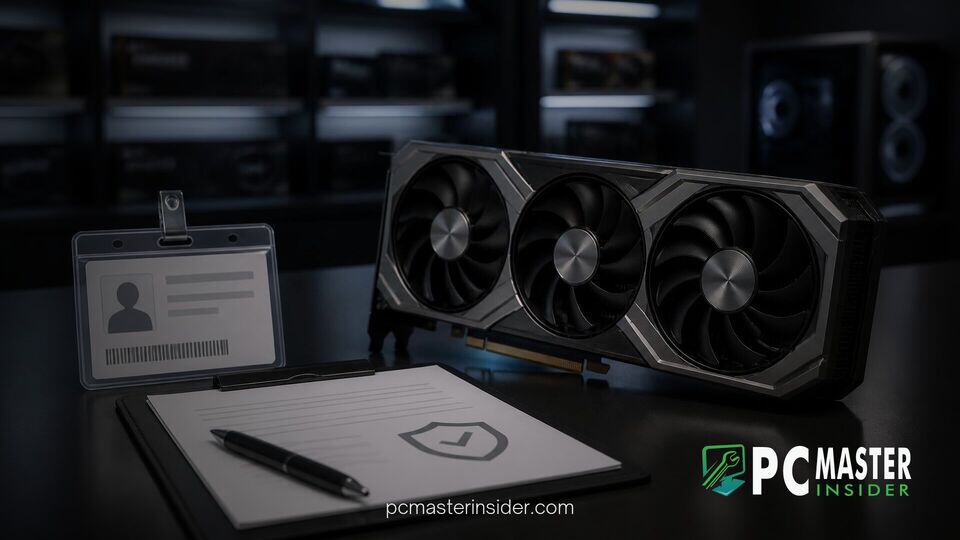
Electronics retailer Micro Center has implemented strict compliance protocols for customers purchasing Nvidia GeForce RTX 5090 graphics cards, including prebuilt systems containing the flagship GPU. Customers are now required to present a government-issued photo ID for scanning and sign an official declaration promising that the hardware will not be exported outside the United States.
The updated checkout procedure represents a direct retail response to ongoing supply constraints and heightened federal scrutiny around high-performance computing hardware. While buying top-tier PC components typically involves standard payment processing, buyers at select locations must now navigate a formal vetting process before leaving the store with their equipment.
Micro Center Implements Anti-Export Declaration for RTX 5090
To curb international unauthorized reselling and ensure compliance with trade rules, Micro Center has introduced a specialized document titled the Advanced Computing Product Purchaser Declaration. Under this policy, any customer attempting to buy an RTX 5090 graphics card or a workstation containing the card must complete paperwork certifying their compliance with federal restrictions. The document explicitly outlines a strict anti-diversion mandate, stating that no exports or transfers outside domestic borders are permitted under any circumstances.
The requirement came to light after customers at locations such as the Tustin, California, and Columbus, Ohio, stores reported being asked to sign the form during checkout. Store staff confirmed that the procedure is a recent implementation designed to track end-user placement of top-tier hardware. While similar steps have occasionally been deployed by smaller regional distributors, Micro Center's adoption marks a significant expansion of compliance measures across national brick-and-mortar retail.
Customer Requirements and Identification Scanning Protocol
The newly mandated questionnaire requires consumers to supply extensive personal and technical information. Standard fields on the paperwork include:
- Full legal name and primary residential or business address.
- A mandatory physical scan of a government-issued photo ID, such as a driver's license.
- Active phone numbers and electronic mail contacts.
- Detailed installation location details, including physical facility addresses.
- Specified primary use cases and intended end-user identification.
Buyers are required to affirm that the product will remain inside the United States and that they will not attempt to resell or ship the item to international destinations. Customers who decline to provide these details or refuse to sign the pledge are denied purchase approval for the graphics card.
Broader Trade Regulations and High-End GPU Supply Pressures
The policy reflects broader regulatory pressures regarding advanced silicon architecture. The U.S. Department of Commerce's Bureau of Industry and Security (BIS) maintains rules restricting the export of high-performance computing components to specific international markets. BIS guidance encourages suppliers and vendors to institute robust verification protocols, ensuring hardware does not route through unauthorized export channels. Similar compliance practices have also affected major software platforms, such as when Microsoft highlighted enterprise system security and global infrastructure risk in its recent defense reports.
Because the RTX 5090 possesses substantial processing power suitable for artificial intelligence research and enterprise compute tasks, parallel import markets have seen high demand. Unauthorized brokers have frequently attempted to purchase consumer-grade cards domestically to export them abroad for premium markups. Similar supply chain bottlenecks have echoed across the industry, mirrored by news that Micron expects hardware component tightness to persist over the coming years.
Implications for Retail Consumers and Prebuilt PC Buyers
For standard gaming enthusiasts and local workstation users, the new policy introduces an extra layer of administrative procedure. While the mandatory form does not restrict local sales to eligible domestic residents, it creates a paper trail connecting individual buyers directly to their purchased hardware serial numbers.
This verification applies to both standalone component sales and prebuilt desktop computers containing the RTX 5090 GPU. As hardware manufacturers continue balancing consumer gaming demand with high-performance computing restrictions, additional PC hardware retailers may adopt comparable customer verification mechanisms.
Micro Center's new policy underscores how international trade regulations directly shape consumer retail operations. By requiring identity scans and anti-export pledges, the retailer aims to ensure high-end hardware remains within domestic supply chains while fulfilling regulatory anti-diversion expectations.