
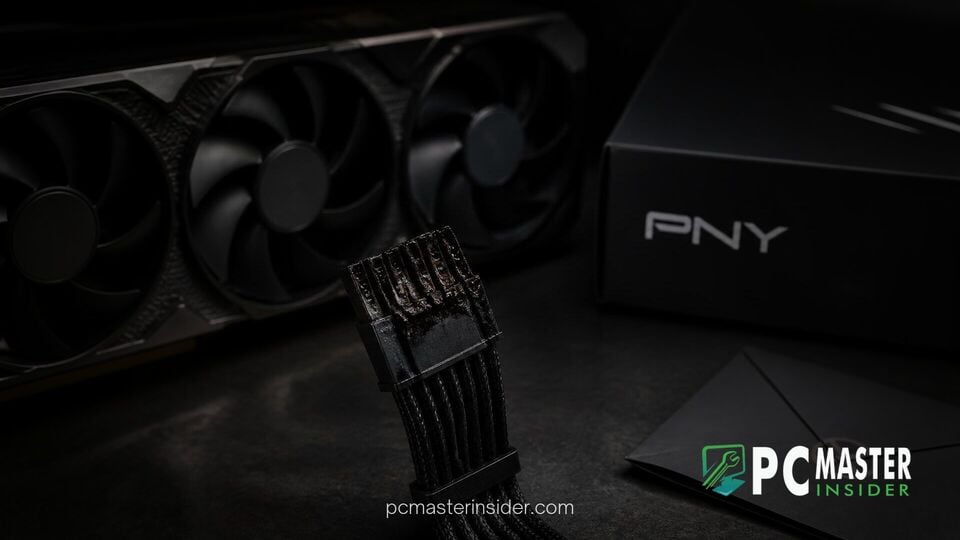
Graphics card vendor PNY is facing significant scrutiny after denying a warranty claim for a GeForce RTX 5090 that suffered a melted power connector. The company closed the customer support ticket after stating that third-party power supply cables are not covered under its warranty terms, despite the user utilizing a native modular cable supplied with an ATX 3.1 power supply.
The incident surfaced online when the affected user shared detailed support communications regarding the hardware failure. The user reported that the flagship graphics card stopped working after both ends of the 12V-2x6 power cable melted, damaging the power connector on the GPU.
PNY Denies Warranty Claim for Melted RTX 5090 Power Cable
In a summary of the dispute, PNY support stated that only the official power adapter included inside the graphics card box is approved for warranty coverage. The customer support team informed the user that any thermal damage resulting from third-party power supply unit (PSU) cables falls strictly under the financial responsibility of the power supply manufacturer. When the customer pointed out that official written policy documentation did not mention this restriction, a senior technician reportedly marked the decision as final and closed the support ticket.
According to the detailed account provided by the card owner, the system was equipped with a high-capacity 1600W ASRock PG-1600G power supply. The setup made direct use of the native 12V-2x6 modular cable provided by the PSU manufacturer rather than an aftermarket adapter or third-party extension cable. The user further stated that the GPU was operating on stock factory settings with a manually reduced power ceiling when the thermal breakdown occurred while the system was sitting idle.
Despite these precautions, the internal power pins experienced severe overheating, leading to melted plastic around the header. When high-end hardware experiences thermal strain, severe hardware issues can emerge; for instance, thermal testing shows DLSS 5 drives RTX 5090 power connectors past 91°C with transient spikes, illustrating the extreme thermal load these modern connectors endure.
PNY Refuses Warranty Coverage for Burned RTX 5090 Graphics Card
The core of PNY's rejection centers on how power is routed to high-draw graphics cards. In its response to the customer ticket, PNY written support stated:
"All PNY GPUs that require a 16-pin (12VHPWR / 12V-2x6) input include a PNY-approved power cable or adapter in the box. This cable is the only configuration covered under warranty. If a third-party power cable, adapter, or PSU cable is used and damage occurs including melting, burning, overheating, or deformation of the connector PNY cannot accept the product under warranty. Damage caused by non-PNY cables falls under the responsibility of the manufacturer of that cable or power supply."
Support Ticket Closed Despite Native Power Supply Usage
The denial left the customer in a difficult situation because power supply vendors generally design native 12V-2x6 cables to bypass bulky box adapters, which are often cited by builders as awkward to route in standard desktop cases. Upon reviewing PNY's public warranty documentation, the user observed that the published terms contained no explicit clause prohibiting native PSU cables or mandating the exclusive use of the included box adapter.
When the card owner requested clarification on which specific section of the published warranty terms governed this enforcement, PNY support declined to provide additional policy citations and closed the communication channel. This abrupt ticket resolution has raised serious practical questions about how hardware manufacturers assign fault when standard power delivery components degrade during normal operation.
Background on RTX 50 Series 12V-2x6 Power Connector Issues
The 16-pin power standard, originally introduced as 12VHPWR and later revised to the 12V-2x6 specification, has been a central point of discussion among hardware enthusiasts since its introduction. High-power flagship GPUs push substantial electrical current through small connector pins, making proper seating and cable integrity critical to avoiding thermal resistance spikes.
To circumvent physical cable stress entirely, some extreme enthusiasts have explored radical hardware modifications. For example, modders replaced the RTX 5090 16-pin header with triple 8-pin connectors to eliminate single-point connector failures. However, standard retail consumers must rely on traditional warranty agreements and stock power delivery setups provided by reputable vendors.
While cable issues are most commonly reported on ultra-high-draw flagship cards, power delivery failures are not exclusive to NVIDIA hardware. Previous reports highlighted how even traditional legacy connectors can fail under unusual circumstances, such as when a Thermal Grizzly WireView adapter melted on a Radeon RX 7900 XTX GPU.
Community Reactions and Consumer Protection Concerns
The news of PNY closing the support ticket without offering a repair or replacement has sparked wide discussion across hardware forums. Many system builders point out that power supply manufacturers explicitly encourage using direct, native cables rather than multi-8-pin adapter splitters. Direct native cables reduce cable clutter and eliminate additional electrical connection points that could introduce resistance.
Consumer advocate discussions have highlighted the potential conflict between vendor policies and consumer protection guidelines. In many jurisdictions, warranty providers must demonstrate that an unapproved third-party component directly caused a failure before denying a claim entirely. Because native modular cables from established power supply brands meet ATX 3.1 industry standards, enthusiasts argue that denying coverage outright sets an alarming precedent for custom PC builders.
What RTX 5090 Owners Should Know About Warranty Policies
For current and prospective owners of flagship graphics cards, this incident highlights the necessity of carefully checking support guidelines. Buyers should verify how individual board partners treat native PSU cables versus bundled box adapters before assembling high-end desktop systems.
As board partners continuously adjust to demanding power specifications, hardware tracking remains essential. System builders closely follow flagship releases from various manufacturers, including news such as when MSI unveiled the RTX 5090 LIGHTNING Z GPU to see how custom board designs address thermal management and power delivery.
PNY has not yet issued an updated public statement clarifying whether its warranty documentation will be officially revised to mention cable restrictions or if the denied claim will undergo secondary executive review. For now, RTX 5090 owners using PNY cards may want to keep provided box adapters handy or document their power configurations thoroughly in case technical support claims arise.