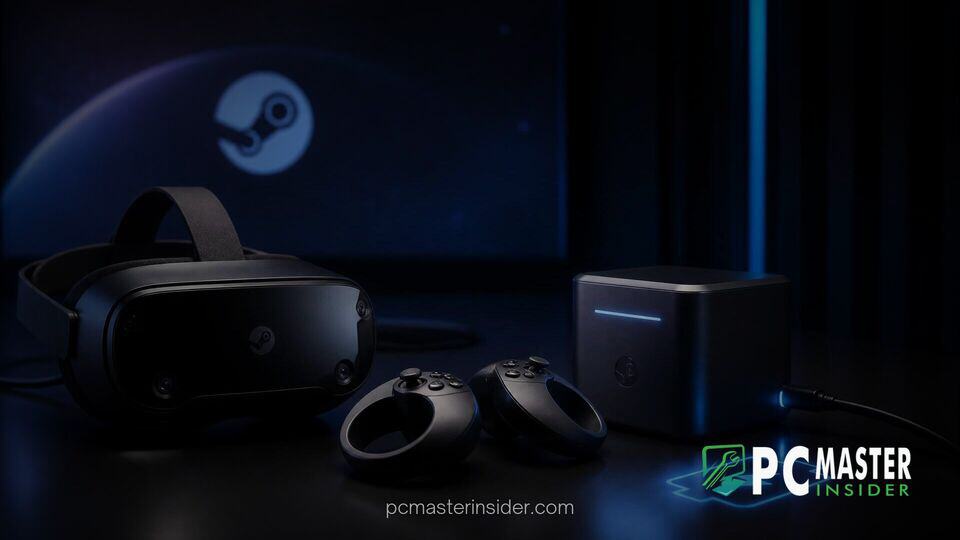
Valve has officially released SteamOS 0.3.0, marking the first major system update for its new standalone Steam Frame VR headset. The software update directly addresses initial user feedback by significantly accelerating power delivery and refining overall virtual reality performance.
Alongside the notable bump in battery charging speeds, the release brings comprehensive fixes for haptic controller tracking, microphone audio clarity, motion smoothing behavior, and graphics driver optimization across the board.
Valve Rolls Out SteamOS Update Addressing Steam Frame Battery Charging Speeds
The primary highlight of the patch is a dramatic improvement in power management. Early review units and initial adopters reported sluggish recharge times that made extended gaming sessions frustrating, as the headset often took upwards of three hours to fully replenish. With SteamOS 0.3.0, Valve has adjusted power profiles so the hardware draws energy far more efficiently while powered off or in sleep mode.
Independent hardware testing revealed that prior to the update, a fully drained Steam Frame initially pulled as little as 8W before peaking near 27W. Following the firmware patch, the device now initiates charging between 19W and 21W and can draw up to 42W while actively running games. This change ensures that users who keep their headset plugged in during play can maintain battery levels or charge up even while running demanding native software. Valve recommends using a 45W or higher USB-C power delivery supply to achieve optimal charging rates.
Key Improvements to Controller Tracking and Motion Smoothing
In addition to battery delivery fixes, SteamOS 0.3.0 introduces crucial refinements to core virtual reality interaction features. Early users noted slight tracking jitter when physical haptics fired vigorously. Valve has patched controller input routines to maintain precise positional fidelity even under heavy force feedback rumble.
User interface and motion smoothing settings have also seen extensive updates. A bug where the per-application Motion Smoothing setting for "Force Always-On" was ignored by the system operating layer has been resolved. Motion interpolation algorithms have been specifically tuned for flagship titles like Half-Life: Alyx to offer cleaner frame generation during rapid head movements. Furthermore, Valve resolved a frustrating hardware bug that produced garbled audio over the built-in microphone array, alongside adding user controls for game dimming when the system dashboard overlay is active.
Vulkan and Graphics Driver Upgrades Enhance Standalone PC VR Compatibility
Under the hood, SteamOS 0.3.0 brings significant updates to the underlying software stack that powers the headset's Snapdragon processor. Valve included updated Vulkan layers aimed at boosting game compatibility when running titles via translation frameworks. These underlying system updates align with Valve's recent engineering pushes, similar to how the company expanded its broader ecosystem when SteamOS added native NVIDIA GPU support in development builds.
Graphics performance has been bolstered through targeted Mesa driver enhancements, yielding better frame time consistency and reduced thermal throttling during sustained workloads. Developer guidelines have also been loosened; Valve updated the criteria for titles marked as Playable on Steam Frame, removing the strict 1440p resolution requirement to allow games to utilize dynamic scaling and alternative target resolutions.
What Steam Frame Users and Developers Need to Know Next
The fast turnaround on this patch demonstrates Valve's commitment to supporting its hardware ecosystem through frequent, post-launch software updates. Just as hardware developers continuously tune their systems, PC gaming software requires regular attention, much like how users maintain regular driver routines with tools like Driver Easy Pro to maintain peak system stability.
The SteamOS 0.3.0 update is available for immediate download directly through the system settings menu on all active Steam Frame devices. As more units ship to reservation holders over the coming weeks, players can expect additional system tweaks, audio optimizations, and further Vulkan rendering fixes to roll out continuously.
In summary, Valve's quick deployment of SteamOS 0.3.0 eliminates the single biggest operational bottleneck facing early Steam Frame adopters. By dramatically boosting charging speeds to 42W and smoothing out controller tracking and motion synthesis, Valve has significantly refined the user experience for its standalone VR device.