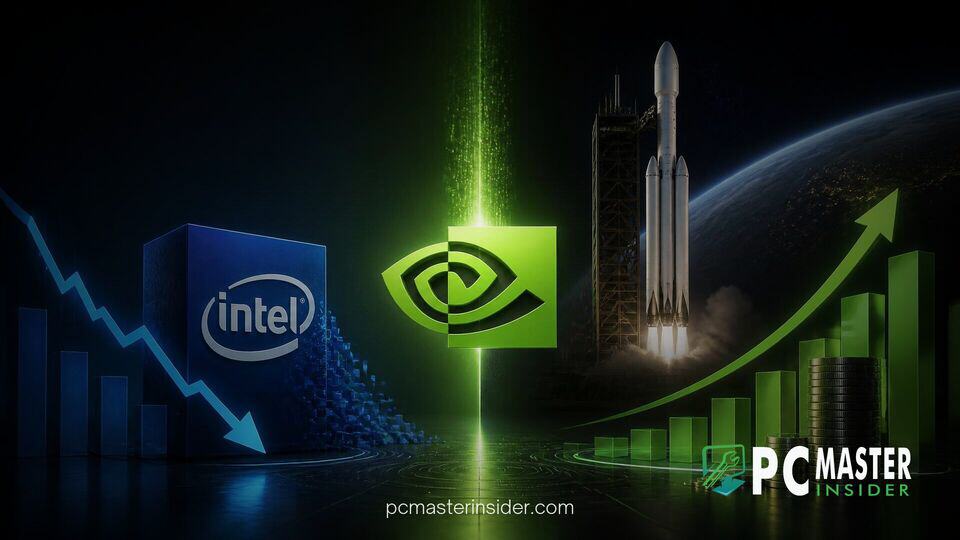
Nvidia has significantly reshuffled its public equity investments, reducing its position in Intel by 25 percent while increasing its stake in SpaceX, according to its quarterly SEC filings. The latest portfolio report shows SpaceX taking over the top spot in Nvidia's equity investments as the graphics processing giant refines its strategic corporate venture holdings.
The regulatory disclosure outlines notable changes across Nvidia's corporate investment strategy during the third quarter, reducing exposure to legacy hardware partners while doubling down on commercial space infrastructure and high density AI compute platforms. Market participants have analyzed the filing to understand how the chip manufacturer is allocating its capital outside core research and production operations.
Overview of Nvidia's Q3 13F Portfolio Filing
In its mandatory Form 13F report submitted to the Securities and Exchange Commission, Nvidia detailed eight distinct equity positions held as of September 30. The total market value of the company's disclosed U.S. listed equity holdings fell to $48.33 billion from $63.44 billion at the end of the previous quarter. This contraction reflects price adjustments across technology equities as well as active position reductions across several core investments.
Despite the overall decrease in asset valuation, Nvidia's holdings remain heavily concentrated. Its top two equity bets, SpaceX and Intel, together make up more than 80 percent of the total disclosed portfolio. The remaining positions include specialized enterprise software firm Synopsys, specialized data center supplier CoreWeave, optical technology provider Coherent, infrastructure developer Nebius Group, and biotechnology firm Generate Biomedicines. While several established holdings were trimmed during the quarter, positions in specialized infrastructure partners like CoreWeave remained entirely unchanged.
Portfolio shifts like these demonstrate how hardware leaders navigate broader industry trends. While Nvidia expands its strategic ecosystem, other hardware manufacturers face operational shifts, such as global PC shipments falling as memory prices soar.
Reduction in Intel and Nokia Holdings
The most prominent divestment detailed in the filing involved Intel. Nvidia reported holding 161,082,488 Intel shares as of September 30, down from 214,776,632 shares recorded on June 30. This 25 percent reduction resulted in the liquidation of roughly 53.69 million shares. The position originally traces back to a $5 billion private placement completed in late 2025 at an average purchase price of $23.28 per share, which was accompanied by technical joint-development partnerships spanning personal computing and enterprise server architectures.
Despite the quarter-over-quarter reduction, the remaining Intel holding had a reported value of $19.37 billion at quarter-end prices, leaving Nvidia with a substantial gain relative to its initial entry basis. The SEC disclosure does not state the exact dates or execution prices for the open-market liquidations. Nevertheless, the news triggered mild downward pressure on Intel equity in premarket trading following the report. The sale coincided with broader challenges for Intel, which has seen volatile market conditions while competing for client hardware ground, even as reports suggest Intel recaptured desktop CPU market share from AMD in select quarters.
Intel was not the only legacy holding subject to trimming during the quarter. Nvidia also significantly cut its investment in telecommunications equipment manufacturer Nokia, reducing its stake by 56 percent from 166.39 million shares down to 72.86 million shares. Additionally, Nvidia trimmed its stake in electronic design automation supplier Synopsys by roughly 10 percent, taking its holding down to 4.35 million shares.
SpaceX Takes Top Position in Portfolio
As Nvidia trimmed legacy positions, Space Exploration Technologies Corp. moved into the top spot within its reported equity portfolio. Nvidia purchased an additional 7.71 million shares of SpaceX during the third quarter, representing a 6.3 percent increase in its holding. This brought its total position to 130,472,925 shares, valued at approximately $19.68 billion at the close of the reporting period.
SpaceX was the only asset in Nvidia's eight-line portfolio where the company added shares during the third quarter. Nvidia's direct equity exposure to SpaceX expanded following earlier corporate transactions involving artificial intelligence research entities and subsequent corporate consolidations. The substantial holding underlines the growing technical convergence between satellite communications infrastructure, orbital data processing, and accelerated machine learning hardware.
The space technology company has become a major buyer of high-end compute hardware for ground stations, processing telemetry, and driving automated satellite control networks. Strategic alignments between AI hardware pioneers and data infrastructure platforms are increasingly common across the technology industry. Similar enterprise alignments include instances where Microsoft releases software to run AI models on Nvidia GPUs.
Market Impact and Future Outlook
The quarterly 13F filing arrived at a dynamic moment for Nvidia and the broader semiconductor sector. The changes reflect asset positions held through September 30, preceding internal executive transitions and quarterly financial performance announcements. Nvidia continues to push new computing architectures into high-performance markets, similar to when Nvidia unveiled the Rubin HPC GPU architecture for scientific workloads.
Wall Street analysts note that 13F filings reflect historical quarterly balances rather than active real-time trading decisions. Portfolio managers view Nvidia's partial divestment from Intel as routine portfolio rebalancing and risk management following strong performance rather than a breakdown in technical collaboration. Both companies maintain shared architectural initiatives and joint hardware development projects targeting next-generation data center solutions.
Meanwhile, the expanded investment in SpaceX positions Nvidia as a key equity stakeholder in commercial space flight and global satellite internet infrastructure. As demand for high-efficiency distributed computing continues to grow beyond traditional terrestrial data centers, Nvidia's portfolio realignment highlights its strategy of deploying capital into next-generation technology platforms. Market observers will review the company's next quarterly disclosures in early 2027 to see if this portfolio reallocation continues.