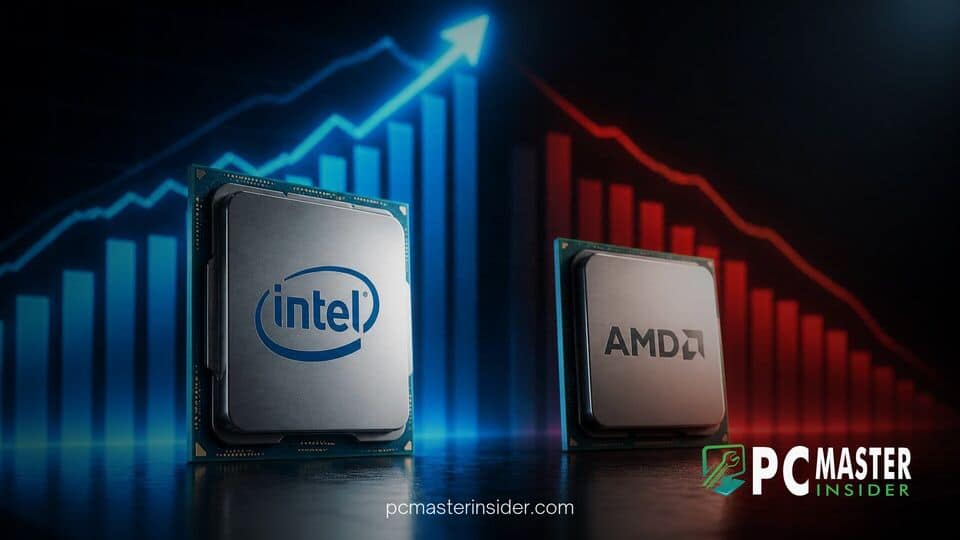
Intel staged a major comeback in the desktop processor space during the third quarter of 2026, driving its market share back above the 70 percent mark. Data from industry analysis firm Mercury Research reveals that Intel picked up roughly 5.1 percentage points of desktop unit volume, pushing AMD below 30 percent for the first time in over a year.
The sudden reversal marks an unexpected shift in consumer hardware supply trends following consecutive quarters of steady expansion by AMD. Industry analysts emphasize that the swing reflects broader supply chain adjustments and strategic reallocation of manufacturing capacity across both semiconductor giants rather than a simple shift in end consumer preference.
Intel Surges to 70.1% Desktop CPU Market Share in Q3 2026
The latest quarterly tracking report from Mercury Research indicates that Intel captured 70.1 percent of worldwide x86 desktop processor shipments in the third quarter of 2026. This represents a sharp rise from the 65.1 percent share Intel held in the second quarter. Conversely, AMD saw its desktop CPU shipment share drop from an all-time peak of 34.9 percent in Q2 2026 down to 29.9 percent in Q3.
A five-percentage-point swing in a single quarter is unusually large for the desktop market, which typically experiences incremental shifts of one or two percentage points. It also brings AMD to its lowest desktop volume level since early 2025. However, these statistics measure desktop processor unit shipments from manufacturers to OEMs, prebuilt system integrators, and retail distribution channels rather than actual point-of-sale customer receipts.
Mercury Research Data Highlights Shift in Desktop Processor Shipments
The underlying metrics point to a market affected by macro trends across mobile and desktop segments. Overall desktop unit shipments hit a low point in Q2 2026 before entering a modest autumn rebound. During that time, Intel took advantage of seasonal system builder demand by ramping up shipments to mainstream desktop retail channels.
Retail bundle offers and desktop hardware pairings have also helped sustain momentum for Intel platforms. For instance, recent retail promotions like the G.Skill and Micro Center Intel Core Ultra bundle have maintained strong interest among budget-conscious DIY builders. At the same time, broader PC component pricing pressures have altered system builder strategies worldwide.
Key Factors Behind the Market Share Reversal
Market analysts credit Intel's shipment rebound to a combination of internal manufacturing recalibrations and changing demand patterns across the PC industry. During the second quarter and early third quarter, laptop processor demand softened noticeably, with both Intel and AMD seeing mobile CPU shipments decline by over 10 percent.
With notebook demand cooling, Intel possessed available internal wafer capacity that it redirected toward desktop silicon production. Having under-supplied certain desktop segments earlier in the year, Intel moved aggressively to replenish channel inventories right as seasonal third-quarter buying picked up.
Supply Chain Adjustments and Mobile Market Softening
While Intel redirected silicon toward desktop platforms, AMD operated under entirely different operational priorities. AMD executives have openly characterized the company as taking a data-center-first approach, prioritizing high-margin server chips over entry-level and mainstream desktop volume.
That strategy paid off handsomely in enterprise infrastructure, where AMD expanded its server market share to 35.5 percent in Q3, up from 34.5 percent in the prior quarter. AMD generated $8.5 billion in data center revenue during the single quarter. Because server processors and desktop CPUs share manufacturing allocations on leading-edge foundry nodes, every wafer assigned to enterprise hardware reduces the volume available for consumer desktop products.
External factors in the PC ecosystem also played a role. Broader industry headwinds, such as elevated memory prices, have impacted overall system assembly volume. As covered in reports on how global PC shipments fell due to rising memory costs, high DRAM pricing has caused manufacturers to adjust prebuilt production schedules. High graphics card pricing also tempered standalone DIY upgrade enthusiasm. Because AMD relies heavily on DIY gaming enthusiasts who buy standalone GPUs, GPU supply constraints hit AMD's desktop momentum harder than Intel's broad OEM channel presence.
What the Q3 Figures Mean for PC Builders and the CPU Market
For everyday consumers and custom PC builders, the Q3 2026 market share numbers do not indicate a sudden collapse in performance leadership for either brand. AMD continues to hold a strong technical position in gaming performance with its 3D V-Cache lineup, but those processors are often constrained by tight allocations and higher price points. Intel, meanwhile, benefits from deep integration with major OEM desktop vendors like Dell, HP, and Lenovo, ensuring high shipment volumes across corporate and off-the-shelf consumer desktops.
Hardware security remains another critical point of focus for system integrators across both ecosystems. Both vendors continue to maintain rigid software patch schedules, as demonstrated when Intel and AMD issued security updates for hardware vulnerabilities across their respective desktop and server platform lines.
The broader semiconductor landscape is also seeing hardware vendors collaborate on AI software foundations to maximize performance on existing architecture. Recent initiatives such as the LMSYS SGLang Consortium involving Nvidia, AMD, and Intel demonstrate how chipmakers are cooperating on open-source execution standards even as they fight fiercely for physical CPU channel share.
Looking ahead to the fourth quarter of 2026 and early 2027, industry analysts expect desktop processor volumes to remain tightly bound to overall system demand and memory cost dynamics. While Intel has successfully reclaimed the majority desktop shipment share for now, AMD's intentional emphasis on enterprise data centers suggests that desktop unit battles may remain secondary to enterprise revenue growth for the foreseeable future.