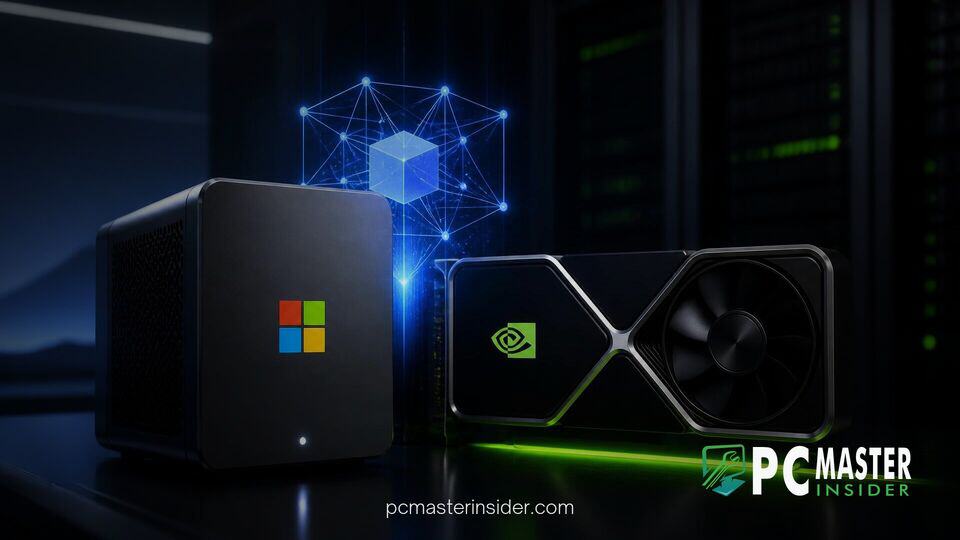
Microsoft has officially released an update to its Foundry Local runtime, enabling developers to execute Alibaba's Qwen3.8-27B artificial intelligence model directly on local hardware. The new release brings full support for running agentic coding tasks on Nvidia GPUs, pairing the open-weights model with GitHub Copilot through a Bring Your Own Key workflow.
By shifting large language model inference from cloud datacenters to local desktop setups, Microsoft aims to eliminate per-token API costs, reduce request latency, and address enterprise privacy concerns regarding source code transmission. The deployment requires an Nvidia graphics processor with at least 24GB of VRAM to maintain real-time generation speeds across long repository contexts.
Microsoft Foundry Local Qwen 3.8 27B Local AI Runtime Details
The core of Microsoft's release centers on bringing high-capability coding agents into offline developer environments. Powered by ONNX Runtime, the Microsoft Foundry Local optimization stack targets the 27-billion-parameter Qwen3.8 dense vision-language architecture. Under 4-bit weight quantization, the model footprint shrinks to approximately 18GB of memory, allowing it to fit inside high-end desktop hardware.
Developers using the updated framework can load the model via the Foundry Local command-line interface version 0.13.0 or later and route requests locally from GitHub Copilot. The on-device server creates an OpenAI-compatible endpoint, allowing existing code editors and integrated development environments to stream completions without establishing internet connections.
Microsoft Launches Foundry Local for On-Device Agentic Coding
With this release, Microsoft targets software development teams seeking zero-data-leakage environments. Proprietary source code and repository structure data remain localized on the workstation, resolving compliance friction for industries operating under strict confidentiality mandates.
The move also complements previous desktop isolation features such as Microsoft Execution Containers, which help contain autonomous agent execution within secure operating system boundaries. By pairing local inference with secure sandboxing, developers can allow coding agents to autonomously modify local repositories and run tests without exposing corporate codebases to external networks.
Integrating ONNX Runtime with GitHub Copilot Workflows
Integrating local models into developer workflows has historically suffered from setup complexity and fragmented backend tools. Foundry Local resolves this by bundling configuration details into a single runtime layer built on ONNX Runtime.
Once initialized, developers configure GitHub Copilot to point to the local server port. The integration handles prompt construction, context window management, and token parsing automatically. For developers running multi-task environments, this ensures that local agentic workflows integrate cleanly alongside existing developer tooling.
Hardware Requirements and VRAM Thresholds for Local Execution
Running a 27-billion-parameter model locally demands substantial graphics memory. Microsoft specifies a hardware floor consisting of an Nvidia GPU with a minimum of 24GB VRAM.
- Minimum VRAM: 24GB graphics memory (e.g., Nvidia GeForce RTX 3090, RTX 4090).
- Supported Context Window on 24GB: Up to 64,000 tokens.
- High-Capacity VRAM: 32GB or more (e.g., Nvidia RTX 50 Series GPUs like the RTX 5090 or workstation accelerators).
- Supported Context Window on 32GB+: Up to 262,000 tokens.
- Dependencies: Foundry Local CLI v0.13.0+, CUDA toolkit, and matching cuDNN libraries.
While consumer hardware like the GeForce RTX 3060 remains popular on Steam hardware surveys, modern 27B local LLM workloads necessitate enterprise-grade or enthusiast-tier graphics cards with heavy VRAM allocations.
Performance Benchmarks Across Coding Evaluation Suites
According to benchmark data published by Microsoft's developer team, Qwen3.8-27B demonstrates competitive performance across standard software engineering evaluation suites:
- Terminal Bench 2.1 (Agentic Terminal Tasks): 73.0
- SWE-bench Pro (Agentic Coding): 61.7
- NL2Repo-Bench (Repository-Level Code Generation): 42.3
- DeepSWE 1.1 (Complex Software Engineering): 42.2
In side-by-side inference testing against llama.cpp on systems like the Nvidia GeForce RTX 5090 (32GB VRAM) and an Nvidia DGX Spark system (128GB unified memory), Microsoft reported that Foundry Local achieved faster token generation speeds across all evaluated prompt lengths, with performance advantages growing significantly past 131,000 tokens of input context.
Technical Architecture and Optimization Stack
Achieving sustained generation speeds on workstation hardware requires deep acceleration techniques across the full inference pipeline. Microsoft's engineering stack incorporates several advanced optimizations:
- DFlash2 Speculative Decoding: Employs a small drafting model to predict multiple tokens simultaneously, reducing main model evaluation passes.
- INT4 Weight Quantization: Compresses 16-bit float weights down to 4-bit integers to preserve memory bandwidth.
- KV-Cache Quantization: Reduces memory overhead for long-context windows by compressing key-value attention caches.
- Prefix Caching: Retains context tokens across concurrent requests to avoid re-evaluating unchanged repository context.
- CUDA Graph Fusions: Optimized kernel execution pipelines tuned specifically for Nvidia Streaming Multiprocessors.
Availability and Platform Roadmap
The Qwen3.8-27B model profile is available immediately through the Microsoft Foundry Local catalog on Nvidia-powered systems. Microsoft confirmed that platform support will expand in upcoming updates to include Apple Silicon (Mac) devices and AMD graphics cards, alongside deeper native integration into future GitHub Copilot clients.
While local execution offers significant cost and privacy advantages, Microsoft notes that cloud-hosted frontier models remain recommended for ultra-complex reasoning tasks that exceed local hardware capacities. Nevertheless, for daily repository maintenance, offline development, and sensitive agentic workflows, Foundry Local establishes a robust on-device alternative.