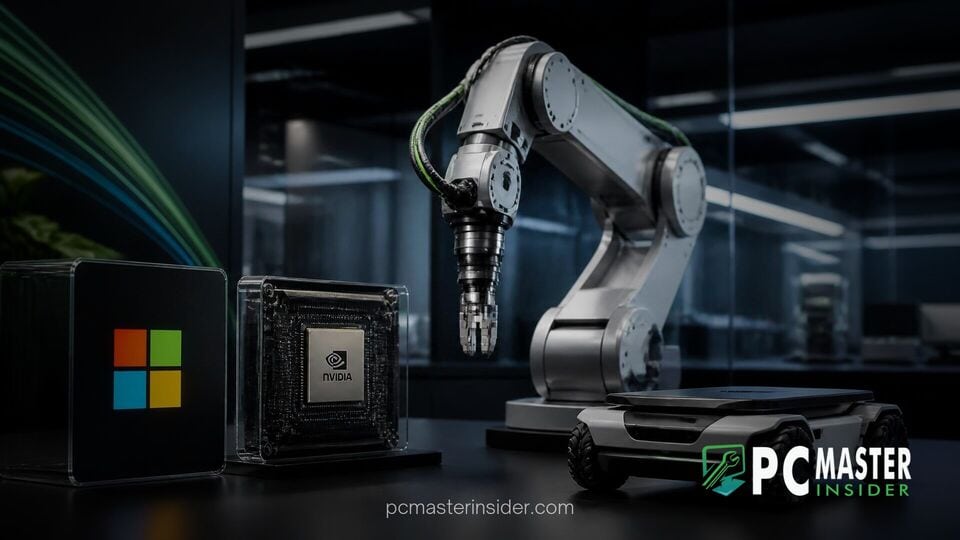
In a major effort to accelerate the transition of artificial intelligence from digital models to real-world machinery, Microsoft, Nvidia, Infineon Technologies, and Munich-based innovation center UnternehmerTUM have jointly launched the Physical AI Growth Lab. The initiative is a four-month equity-free accelerator program designed to empower early-stage robotics, industrial automation, and physical AI startups across Europe, the Middle East, and Africa (EMEA).
Set to run from January through April 2027, the hybrid accelerator program offers selected founders comprehensive support, including enterprise software credits, cutting-edge hardware, expert mentorship, and direct access to corporate partners and venture capital networks. Applications are officially open through November 13, 2026, with ten to fifteen promising deep-tech startups expected to join the inaugural cohort.
Unveiling the Physical AI Growth Lab Accelerator
The launch of the Physical AI Growth Lab accelerator highlights an industry-wide pivot toward autonomous systems that can safely perceive, reason, and act in physical spaces. While generative models have dominated software over the last few years, physical AI focuses on embedding advanced intelligence directly into physical infrastructure, manufacturing environments, autonomous logistics networks, and robotics.
Participating startups in the incubator program retain full equity in their companies while gaining access to top-tier technical assets. Microsoft provides up to $350,000 in Azure Cloud credits alongside developer tooling to assist startups in deploying scalable backend infrastructure. Concurrently, Nvidia offers access to its specialized software development kits (SDKs), open foundation models, and benefits through the Nvidia Inception program, aiding founders in training complex vision models and spatial intelligence engines.
Partnership Between Microsoft, Nvidia, Infineon, and UnternehmerTUM
The consortium brings together key players across the entire technology stack required for physical AI deployment. UnternehmerTUM, recognized as Europe's largest center for innovation and business creation, serves as the primary operator leading program execution in Munich. By combining software ecosystems, compute infrastructure, and hardware components, the collaboration attempts to overcome the capital-intensive barriers that traditional robotics startups typically face.
Infineon Technologies contributes critical hardware foundation components to the physical AI accelerator. Startups will gain direct access to Infineon's semiconductor platforms, including power management chips, microcontrollers, advanced sensors, and secure connectivity modules. This hardware foundation allows raw synthetic models to interface smoothly with physical actuators and edge processing components in real-world machinery.
Focus Areas for Industrial AI and Robotics Startups
The program specifically targets early-stage technology companies operating within the EMEA region or building solutions tailored for the EMEA market. To qualify, startups must have been founded within the past three years, maintain a team of up to 20 people, include at least one technical co-founder, and possess a working prototype or minimum viable product (MVP).
Target operational areas include autonomous mobile robots (AMRs), humanoid manufacturing assistants, automated inspection devices, predictive industrial maintenance platforms, and smart logistics systems. By connecting algorithmic simulation with physical edge hardware, the program aims to shorten the development lifecycle required to convert experimental prototypes into market-ready industrial tools.
Infrastructure, Capital, and Ecosystem Support for Founders
Beyond technical development resources, the Physical AI Growth Lab provides startups with hands-on guidance from over 170 deep-tech mentors, engineering leaders, and industry specialists. Founders will participate in tailored workshops, operational reviews, and technical sparring sessions in Munich and online.
Access to market opportunities forms another major pillar of the program. Selected founders will receive direct introductions to enterprise customers across Western Europe's vast industrial manufacturing network. Additionally, startups will pitch to a curated network of over 200 venture capital firms and angel investors specializing in robotics, hardtech, and applied artificial intelligence.
The collaborative push between Microsoft and Nvidia builds on recent joint software and hardware developments. Earlier this year, the two companies introduced enhanced enterprise tooling and simulation workflows, such as integrating Nvidia Omniverse libraries with cloud services to manage digital twins and complex physical environments. As hardware requirements shift toward localized edge execution, platforms like Nvidia DLSS and specialized workstation hardware continue to shape rendering, spatial modeling, and offline synthetic data processing.
Future Outlook for European Autonomous Technologies
The creation of the physical AI growth lab accelerator arrives at a strategic juncture for the European tech ecosystem. High industrial concentration, rigorous safety standards, and clear regulatory frameworks under the EU AI Act have positioned the region as a fertile testing ground for automated manufacturing and commercial robotics.
By bringing compute power, specialized silicon, and industrial mentorship into a single non-dilutive accelerator, Microsoft, Nvidia, Infineon, and UnternehmerTUM aim to establish Europe as a premier global hub for physical AI innovation. The program promises to accelerate the deployment of intelligent robotics from laboratory testbeds directly onto factory floors and logistics hubs worldwide.