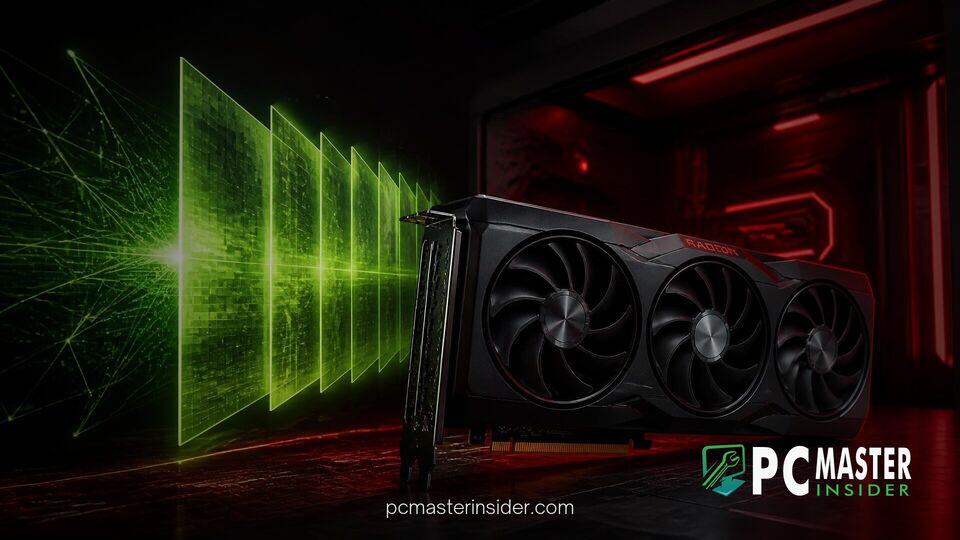
A community modification has made significant strides in breaking hardware exclusivity by bringing Nvidia's advanced DLSS 5 tech stack to AMD Radeon GPUs. Developed by independent programmer Daniel Blanco, the project successfully executes Nvidia's neural rendering and frame generation workloads on competing graphics architectures.
By bypassing traditional vendor boundaries, the project enables owners of modern Radeon cards to utilize advanced AI reconstruction tools previously limited to GeForce hardware. The release demonstrates how custom software layer optimization can bridge feature gaps across competing PC graphics hardware.
Community Mod Porting DLSS 5 Features to AMD Radeon Cards
The project, known officially as DLSS-NR on AMD, has expanded from an experimental neural rendering bridge into a complete suite port. With the recent release of version 0.8.0, the mod unlocks almost every major feature introduced in Nvidia's neural graphics ecosystem. This includes DLSS 4.5 Super Resolution (utilizing Models M and L), Ray Reconstruction (Model F), Multi-Frame Generation (MFG) offering up to 4x frame insertion, and Nvidia DLSS 5 Neural Rendering.
Rather than relying on simple wrapper DLL replacements or standard translation wrappers, the software implements custom Heterogeneous-compute Interface for Portability (HIP) compute kernels. HIP is AMD's open-source C++ runtime and kernel language that allows developers to write portable code for AMD execution units. By recreating the execution layer to run on AMD hardware natively while reading Nvidia's proprietary AI neural network dynamic link libraries (DLLs), the mod executes the AI models directly on Radeon compute units.
Technical Breakdown of the Unofficial Modification
To run the software, users rely on an accompanying manager called NeuralHub. NeuralHub automatically scans a user's system for compatible installed DirectX 12 games, handles file injection, and provides an in-game overlay. Because distributing original proprietary code remains illegal under copyright laws, users must provide their own official Nvidia dynamic link libraries extracted from supported games or software packages.
Once installed, the mod hooks directly into existing render pipelines such as AMD FidelityFX Super Resolution (FSR) or Intel XeSS. The in-game menu lets players adjust upscale parameters, toggle Ray Reconstruction models, and calibrate multi-frame generation multipliers directly during gameplay without quitting to the desktop.
Supported Architectures and Early Performance Results
The mod natively targets current-generation AMD architectures, providing full feature compatibility for RDNA 4 (Radeon RX 9000 series) and RDNA 3 (Radeon RX 7000 series) GPUs. Experimental support is also available for RDNA 2 (Radeon RX 6000 series) hardware, though currently restricted to Neural Rendering features while additional components undergo stability testing.
Initial real-world performance benchmarks reported by early adopters show promising results, though variance remains notable depending on title optimization. According to developer notes, running DLSS 5 Neural Rendering at 1080p resolution on a Radeon RX 9070 XT yields frame rates hovering between 90 FPS and 100 FPS. Community testing in demanding titles like Cyberpunk 2077 at 1440p with full path tracing enabled showed Ray Reconstruction functioning with minimal performance penalties on high-end RDNA 4 hardware. However, other configurations observed frame rate drops ranging between 15% and 25% when enabling complex neural denoising workloads.
Impact on Graphics Card Ecosystem and Vendor Lock-In
The ability to execute Nvidia's deep learning algorithms on competing AMD silicon reopens broader discussions regarding hardware exclusivity in the PC gaming landscape. Historically, major GPU vendors have leveraged proprietary software features to differentiate their desktop hardware lineups and justify higher price tiers.
When Nvidia introduced hardware-accelerated AI upscaling, vendor-locked features became a primary factor in purchasing decisions. AMD has offered open-source alternatives like FSR, but community adoption and performance consistency across all titles have often favored Nvidia's closed ecosystem. By proving that AMD compute architectures can execute Nvidia's machine learning models effectively, independent software developers are challenging vendor-enforced feature barriers.
Bypassing Hardware Gatekeeping in Modern Games
Projects like DLSS-NR on AMD highlight how much vendor-specific feature segregation relies on software compatibility frameworks rather than strict hardware impossibilities. While Nvidia hardware includes specialized Tensor Cores specifically designed for matrix math operations, modern AMD GPUs possess general-purpose AI matrix accelerators that can process similar math payloads when fed appropriate instructions through custom compute pipelines.
Community sentiment surrounding the project has been overwhelmingly positive, with enthusiast forums praising independent modders for expanding platform longevity. By giving older or competing cards access to modern frame generation and AI denoising tools, open-source developers continue to challenge the necessity of frequent hardware upgrades driven primarily by software artificial barriers.
Limitations and Potential Risks of Using Modded Drivers
Despite the technical achievement, utilizing third-party mods carries notable caveats that gamers must consider:
- Anti-Cheat Incompatibility: Because the mod functions by hooking into game executable pipelines and injecting custom DLLs, automated anti-cheat systems in multiplayer titles flag the modification as unauthorized software. Gamers are strongly advised to restrict usage strictly to single-player titles to avoid account bans.
- Visual Artifacting: Because AMD compute units lack identical architectural hardware specifications to Nvidia Tensor Cores, certain lighting, shading, or motion vector passes can produce visual noise, ghosting, or temporary image corruption.
- Stability and Crashes: Unofficial memory management models and custom HIP kernels can cause game crashes or driver resets, particularly when switching between graphics presets or running non-DirectX 12 render APIs.
- Lack of Official Support: Neither Nvidia nor AMD officially supports or endorses the software modifications. Future driver updates or game patches may break compatibility without notice.
As independent developers continue refining execution kernels and expanding hardware compatibility, projects like DLSS-NR on AMD continue to blur the lines between competing graphics ecosystems. While official software stacks remain locked behind corporate boundaries, community-driven development proves that modern PC hardware is capable of far more cross-platform flexibility than manufacturers officially allow.