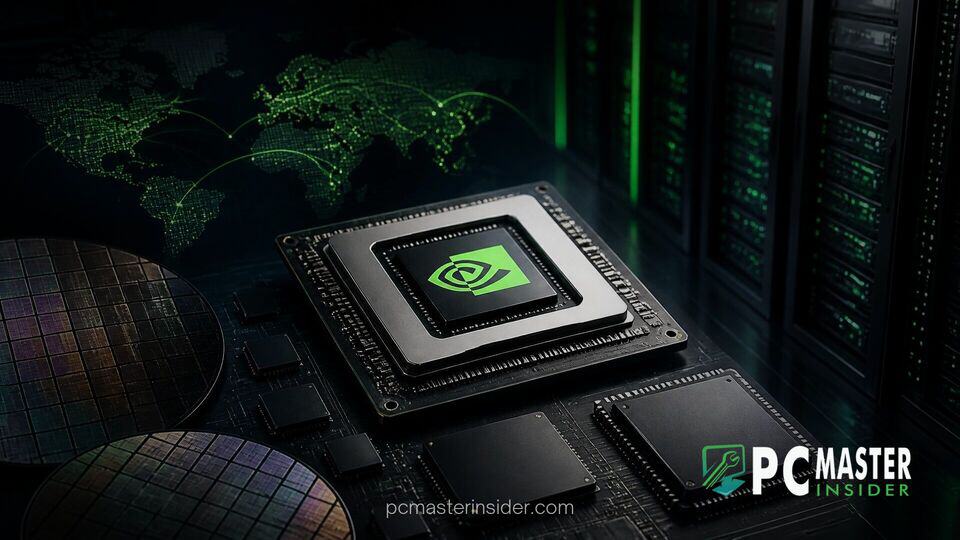
Nvidia has formally announced major multi-year capacity expansion agreements with six leading semiconductor supply chain partners to tackle global artificial intelligence hardware supply constraints. Through direct prepayments and capital support, the graphics chip giant aims to scale substrate manufacturing, advanced packaging, and testing capabilities across the global supply chain.
Speaking at GTC Berlin, Chief Executive Officer Jensen Huang emphasized that supply chain capacity remains the primary limiting factor for meeting international compute demand, framing the expansion as a vital step in scaling data center buildouts worldwide.
Nvidia AI Supply Chain Capacity Expansion 2026: Brief News Summary
Capacity bottlenecks in the back-end manufacturing pipeline have continuously challenged hyperscalers trying to deploy high-density compute systems. To resolve these bottlenecks, Nvidia is leveraging multibillion-dollar capital injections to guarantee dedicated production allocations. The strategic initiative directly targets four critical layers of semiconductor assembly: package substrates, advanced wafer-level packaging, high-throughput chip testing, and optical engines for high-speed networking.Nvidia Secures Major Supply Chain Partnerships for AI Hardware
The strategic framework brings together key OSAT (Outsourced Semiconductor Assembly and Test) providers, substrate specialists, and test engineering leaders. Nvidia's partner lineup includes Amkor Technology, IBIDEN, King Yuan Electronics Corporation (KYEC), Samsung Electro-Mechanics, Siliconware Precision Industries (SPIL), and Unimicron Technology Corporation . Rather than relying solely on spot allocations, Nvidia is taking an active role in funding and co-investing in supplier facilities to build predictable, long-term manufacturing output.
"We are in the midst of the largest infrastructure buildout in human history. Demand is extraordinary. Capacity is the constraint," said Huang during his keynote presentation . "Our supply chain partners are the world's best manufacturers. I am grateful they are expanding capacity around the globe to scale production and help us deliver the AI supercomputing systems powering this new industrial revolution."
Substrate Capacity Expansion and Advance Funding Details
High-density packaging substrates serve as the electrical foundation connecting high-bandwidth memory (HBM) modules and processor dies to host circuit boards. Due to tight manufacturing limits on organic FC-BGA (Flip-Chip Ball Grid Array) components, substrate production has frequently held back full GPU cluster assembly. Under the new agreements, Nvidia expects to drive a 2.5-fold increase in package substrate supply dedicated to its products over the next three years .
Japan-based IBIDEN is receiving a multibillion-dollar capacity reservation advance to support a threefold expansion at its Ono plant , with the added volume projected to ramp through early 2028 . Meanwhile, Samsung Electro-Mechanics joins Nvidia's substrate supply network with immediate capacity from its South Korean operations, supported by facility upgrades and new fab construction in Sejong and Busan . Taiwan's Unimicron Technology Corporation has also signed a long-term capacity reservation deal to expand its KF plant, bringing online progressive capacity beginning in mid-2027 .
Global Semiconductor Manufacturing Alliances
In addition to raw substrate production, post-silicon assembly and validation demand high-tech tooling. Amkor Technology is expanding its advanced packaging footprint, planning a greater than 300 percent increase in interposer wafer capacity in South Korea . This step ensures that complex 2.5D and 3D stacking processes can scale alongside raw silicon wafer output from main foundry partner TSMC.
To overcome testing logjams before chips ship to cloud providers, Nvidia committed a $1.1 billion advance payment to King Yuan Electronics (KYEC) . The deal finances the construction of dedicated testing facilities in the United States and equipment integration across Taiwan and Singapore, paving the way for Nvidia to double its global semiconductor testing throughput by 2027 . Siliconware Precision Industries (SPIL) is focusing on high-speed connectivity, targeting a 15-fold increase in co-packaged optical engine capacity by mid-2027 to power next-generation scale-out networking clusters .
Addressing Industry Bottlenecks in Data Center Compute
Demand for accelerated computing hardware has led to systemic component shortages across the tech supply chain, directly impacting hardware availability and component costs. Widespread allocations have affected memory components, where 32GB DDR5 desktop RAM kits have surged to $450 due to tight DRAM wafer supply diverted toward enterprise high-bandwidth memory. Meanwhile, competing chip manufacturers are exploring custom architectural options; for instance, enterprise cloud operators like Microsoft unveiled the Azure Maia 300 chip to supplement external GPU allocations.
On the desktop and edge computing fronts, specialized hardware demands continue to shape hardware roadmaps. Enterprise creators and localized developer platforms have increasingly relied on workstation-class compute solutions, such as the recently announced ASUS ProArt GR1X Mini PC with Nvidia RTX Spark hardware. By securing packaging and back-end throughput early, Nvidia aims to ensure its enterprise and workstation product stacks remain cushioned against sudden supply shocks.
Impact on Next-Generation AI Infrastructure Timelines
Industry analysts view Nvidia's direct capital deployments as an essential evolution in tech supply chain management. By financing capital expenditures upfront, Nvidia mitigates financial risks for key partners while insulating its production roadmaps against geopolitical and operational disruptions across East Asia and North America.
Looking ahead, these manufacturing agreements will play a critical role in stabilizing hardware availability across compute networks. As advanced packaging capacity expands over the coming years, hyper-scale cloud operators and enterprise clients can expect more predictable server delivery cycles, helping sustain momentum across global enterprise software deployment and sovereign infrastructure projects.
By securing key production lines across multiple manufacturing hubs, Nvidia has taken direct control of its back-end hardware pipeline. These long-term partnerships reflect a proactive strategy to eliminate physical hardware constraints and maintain reliable platform delivery as global compute demands continue to rise.