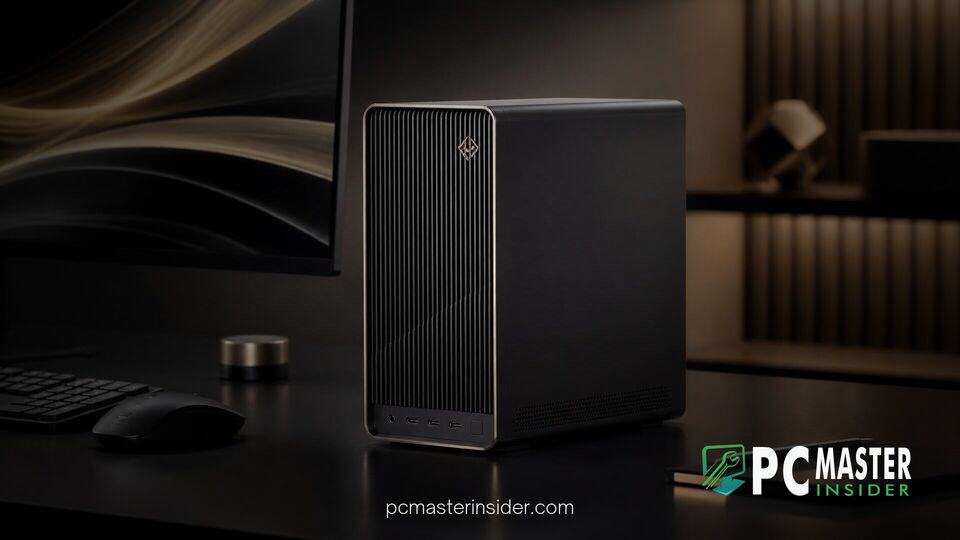
ASUS has officially detailed the ProArt GR1X, an ultra-compact mini PC engineered around Nvidia RTX Spark platform hardware. The 1.1-liter desktop workstation integrates a 20-core Grace CPU with a 6,144-core Blackwell RTX GPU, delivering local AI processing power in a chassis measuring just 150 x 150 x 51 mm.
Designed for creators, software developers, and engineering teams, the ProArt GR1X targets heavy computational workloads without relying on external cloud infrastructure. By adopting Nvidia unified memory architecture, ASUS offers high-throughput processing for demanding generative models, complex 3D rendering, and modern gaming engines within a constrained desktop footprint.
ASUS ProArt GR1X Form Factor and Hardware Specs
The ASUS ProArt GR1X mini PC brings desktop workstation performance into a lightweight 1.48 kg chassis. Despite its compact physical dimensions, the internal hardware layout maximizes memory density and expansion options. The system supports up to 128GB of high-bandwidth LPDDR5X unified memory, enabling seamless data sharing between processing cores and graphics hardware without traditional VRAM bottlenecks. Storage configurations include two M.2 NVMe slots supporting PCIe 5.0 and PCIe 4.0 standards, allowing users to fit up to 4TB of high-speed solid-state storage.
To support high-throughput networking, ASUS equips the desktop with a 10 Gigabit Ethernet port alongside Wi-Fi 7 wireless connectivity and Bluetooth 5.4. Physical I/O ports feature three USB-C 3.2 Gen 2x2 connections running at 20Gbps with DisplayPort Alt Mode support, along with a dedicated HDMI 2.1 video output capable of driving up to 8K resolution displays. In total, the system can output signal to four independent monitors simultaneously.
Grace CPU and Blackwell GPU Integration
At the core of the ProArt GR1X lies the Nvidia RTX Spark N1X superchip. The processor combines 20 high-efficiency Nvidia Grace ARM cores alongside a 6,144-core GPU based on the Blackwell architecture. This hybrid arrangement is tailored specifically for real-time ray tracing, complex mathematical simulations, and matrix acceleration. The integrated tensor architecture delivers up to 1 petaFLOP of FP4 precision compute, providing raw performance designed to speed up localized neural network inference and training pipelines.
The architecture allows developers to bypass hardware allocation limits often seen in traditional desktop setups. The hardware ecosystem aligns with recent enterprise and consumer shifts toward specialized silicon platforms. For instance, tech providers have begun expanding high-density systems, as seen when Dell unveiled the XPS 16 Creator Edition powered by Nvidia RTX Spark to target similar creator workflows.
Thermal Design and 140W Power Consumption
Maintaining sustained performance in a 1.1-liter enclosure requires a specialized cooling setup. ASUS built a dual-fan thermal system featuring twin 109-blade blowers, four dedicated copper heat pipes, and an array of 57 wide exhaust fins. This design keeps the RTX Spark superchip operating within a 140W total thermal design power (TDP) envelope under full operational loads.
External power is delivered via a 240W USB-C Power Delivery (PD EPR 3.1) power adapter, eliminating the need for bulky proprietary power bricks. Efficient power delivery allows the desktop to run continuous AI generation tasks quietly while maintaining system stability.
Target Use Cases and Performance Expectations
ASUS targets two primary market segments with the ProArt GR1X: creative professionals running agentic software stacks and technical users executing demanding visual tasks. The onboard unified memory pool removes the barrier between CPU and GPU memory allocation, facilitating smoother workflows when loading uncompressed 8K video timelines or manipulating 90GB 3D asset scenes.
The emphasis on specialized local processing mirrors broader industry efforts across software and hardware ecosystems. System monitoring tools have adjusted to these platforms, including when CPU-Z and HWMonitor gained ARM64 telemetry support for Nvidia RTX Spark chips to help users track system status accurately.
Local AI Agent Workloads and Content Creation
The ProArt GR1X is configured to run persistent local personal AI agents continuously in the background. ASUS states that the 128GB unified memory variant can locally host large language models (LLMs) with up to 120 billion parameters alongside context windows reaching up to one million tokens. Running these models entirely on local hardware ensures data privacy and eliminates cloud API latency.
Software support includes native integration for local AI frameworks such as ComfyUI and Hermes Agent, as well as proprietary ASUS software like MuseTree for visual ideation. The hardware platform also supports hardware-accelerated 4:2:2 video decoding and encoding, cutting render export times in professional editing suites.
1440p Gaming Benchmarks and Feature Support
While engineered primarily as a professional workstation, ASUS highlights the device's capability as an efficient gaming machine. Official marketing materials indicate the system can maintain framerates above 100 FPS in modern AAA titles at 1440p resolution.
To achieve these frame rates within a 140W power limit, the ProArt GR1X leverages Nvidia graphical technologies, including DLSS Dynamic Multi Frame Generation, Nvidia Reflex, and fourth-generation ray tracing cores. Additionally, support for RTX Remix allows modders to remaster older game titles with path tracing directly on the desktop platform.
Market Availability and Pricing Context
ASUS expects the ProArt GR1X mini PC to reach specialist system retailers and commercial distributors later this year. Customers will be able to select pre-configured models running either Windows 11 Home or Windows 11 Pro operating systems. While exact regional pricing details remain unannounced, configurations will be offered with 64GB or 128GB unified memory choices.
As hardware manufacturers continue expanding localized compute options, devices like the ProArt GR1X demonstrate how unified memory architectures can deliver workstation-class performance in increasingly compact form factors.