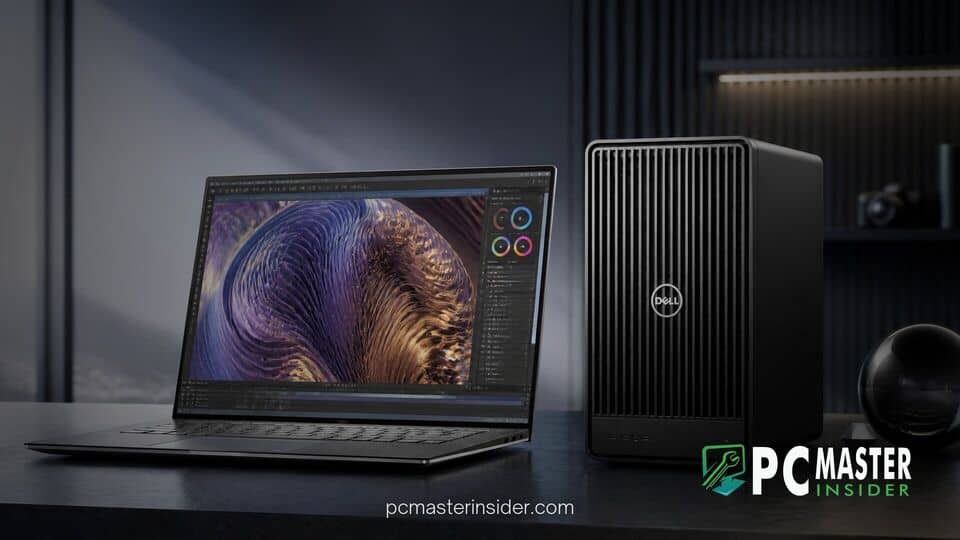
Dell Technologies has expanded its creator and developer lineup with the official announcement of the XPS 16 Creator Edition laptop and the companion Dell Creator Edition Desktop. Both systems feature Nvidia's Arm-based RTX Spark hardware, delivering unified memory architectures and high-density local AI processing for demanding creative workflows.
The new announcements represent Dell's most aggressive push into local agentic AI hardware to date. By integrating Nvidia RTX Spark platform superchips directly into slim mobile and compact desktop form factors, Dell aims to bridge the performance gap between power-hungry workstation towers and portable systems.
Dell Integrates Nvidia RTX Spark Across Laptops and Desktops
The headline announcement centers on the Dell XPS 16 Creator Edition, which marks the first time Nvidia RTX Spark processor technology has appeared in Dell's flagship XPS series. Combining an Arm-based Grace CPU with a Blackwell-architecture RTX GPU onto a single unified package, the RTX Spark platform allows system memory to be shared seamlessly between processing cores. Alongside the 16-inch laptop, Dell revealed the Dell Creator Edition Desktop, a small-form-factor desktop system configured around the same integrated silicon architecture.
Both products are designed specifically to tackle modern generative AI workloads, real-time 3D rendering, and high-bitrate video editing without depending on cloud processing endpoints. The integration comes as multiple tech manufacturers race to adopt specialized silicon for localized AI workloads. Recent industry movements, such as Microsoft opening Surface Laptop Ultra preorders powered by Nvidia RTX Spark, highlight a broader hardware transition toward local AI hardware.
Key Specifications of the XPS 16 Creator Edition
The Dell XPS 16 Creator Edition features a sleek 17.8mm aluminum chassis that houses top-tier hardware configurations. Inside, buyers can configure the system with up to a 20-core Grace CPU and a 6,144-core Blackwell RTX graphics processing unit. To sustain large language models and intricate digital assets, the laptop supports up to 128GB of fast LPDDR5X unified memory running at 9,400 MT/s. Dell claims the highest tier setup delivers up to 1 petaflop of FP4 AI compute performance.
Visual output is handled by a 16-inch 3.2K tandem OLED touchscreen panel supporting variable refresh rates between 20Hz and 120Hz. The display boasts VESA DisplayHDR True Black 600 certification, up to 1,000 nits peak brightness, 100 percent DCI-P3 color gamut coverage, and factory Pantone validation. External connectivity includes three USB4 Type-C ports, an HDMI 2.1b output, Wi-Fi 7, Bluetooth 6.0, and a full-sized SDXC v7.1 media card slot. Preorders for the XPS 16 Creator Edition start at $3,799 in the United States.
Dell Creator Edition Desktop and Workstation Capabilities
For fixed desktop environments, the Dell Creator Edition Desktop provides similar architectural advantages inside a compact, redesigned mini-PC chassis. Upgraded from initial concept designs shown earlier in the year, the desktop unit drops top-mounted logos and front ports in favor of a clean, minimalist profile designed to sit neatly under workspace monitors.
Unlike entry-level laptop variants that may use scaled-down silicon, the desktop configuration relies exclusively on full-spec Nvidia RTX Spark N1X superchips. It ships with 20 CPU cores, 6,144 GPU execution cores, up to 128GB of unified RAM, and up to 4TB of high-speed solid-state storage. The desktop addresses creators who require sustained thermal headroom for continuous rendering or localized AI development loops without taking up bulky mid-tower footprints. Furthermore, utility software tools are quickly adapting to this hardware shift; software updates such as CPU-Z and HWMonitor gaining ARM64 telemetry for Nvidia RTX Spark ensure power users can accurately monitor frequencies and thermal loads on these specialized platforms.
Addressing Local AI Workloads for Creators and Developers
The push toward unified memory architectures like Nvidia RTX Spark stems directly from the rising memory capacity requirements of localized artificial intelligence. Traditional mobile setups often face strict memory bottlenecks when running multi-billion-parameter neural networks locally, as conventional consumer GPUs are typically limited to 8GB or 16GB of dedicated VRAM. By enabling the GPU to address up to 128GB of system memory directly, Dell's new creator lineup allows developers to execute context-heavy LLMs, local AI agents, and complex diffusion models entirely on-device.
This localized execution strategy offers substantial benefits in latency, cloud subscription cost savings, and data privacy. Creative software suites like Unreal Engine, DaVinci Resolve, and Blender are increasingly integrating local neural processing features for real-time background removal, upscaling, and motion tracking. Having high-bandwidth unified memory ensures those background processes do not starve active viewport rendering tasks of vital frame-buffer space.
The enterprise tech market has seen equivalent shifts across standalone units. Market deployments like Nvidia launching a 64GB DGX Spark workstation demonstrate how unified computing blocks are rapidly reshaping hardware choices for both small studios and enterprise developers.
Market Availability and Ecosystem Positioning
Dell's introduction of the XPS 16 Creator Edition and Creator Edition Desktop places the manufacturer directly in competition with high-end ARM workstations and premium creative laptops. Running Windows on Arm, both systems rely on native Arm software compilation alongside Microsoft's Prism emulation layer to execute existing x86 applications seamless out of the box.
The market timing aligns with a general surge in specialized AI hardware across desktop ecosystems. Similar compute trends are visible across alternative platforms, such as Gigabyte unveiling the AI TOP 100 B850 desktop for local AI workloads or Framework opening preorders for modular desktops with 192GB RAM. Dell's unified design strategy seeks to capture users who want high memory capacity paired with consumer-ready aesthetics and vendor support.
Preorders for the Dell XPS 16 Creator Edition are live through official retail channels, with initial customer shipments slated to begin on October 16. Pricing and exact launch dates for the Dell Creator Edition Desktop are expected to be confirmed by Dell in the coming weeks.