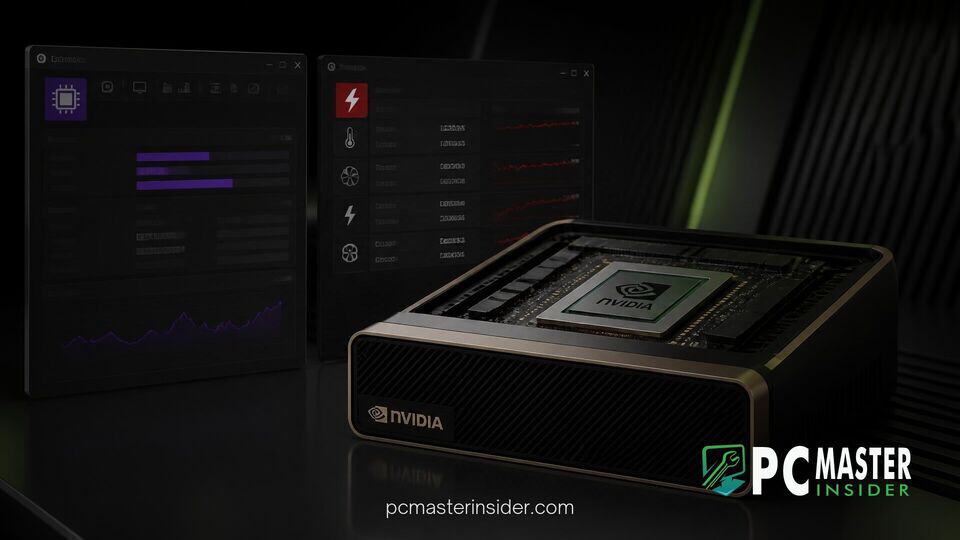
CPUID has released native ARM64 updates for its popular hardware diagnostic tools, CPU-Z and HWMonitor, adding preliminary telemetry support for Nvidia's upcoming RTX Spark platform. The new version 1.06 releases expand detection capabilities and sensor monitoring for Windows 11 on ARM systems ahead of the highly anticipated chip deployment.
The update ensures that enthusiast users, developers, and hardware reviewers will have access to real-time clock frequencies, temperature metrics, and power draw figures on ARM64 systems powered by Nvidia's new superchip architecture.
CPU-Z HWMonitor Nvidia RTX Spark ARM64 Telemetry and Feature Support
>With the release of version 1.06 for both CPU-Z and HWMonitor ARM64, CPUID has implemented specialized detection routines for the Nvidia RTX Spark superchip. CPU-Z focuses primarily on hardware identification, reading system specs, cache topologies, and core layouts. Meanwhile, HWMonitor expands this data into active diagnostic telemetry, tracking live core frequencies, thermal output, power consumption, and voltage levels across system components.
According to CPUID's patch notes, the ARM64 software update handles complete hardware monitoring for the upcoming platform, including real-time clock speeds for both CPU clusters and detailed sensor metrics for the integrated graphics processor. The update allows early testing units running Windows 11 on ARM64 to report accurate operational metrics without relying on emulation layers.
Architectural Context and the Nvidia RTX Spark Ecosystem
Nvidia's RTX Spark superchip represents a significant push into high-performance desktop and mobile computing for ARM-based Windows PCs. Combining a multi-core MediaTek ARM SoC codenamed Grace alongside a high-performance Blackwell GPU architecture featuring up to 6,144 CUDA cores, RTX Spark is designed to handle demanding local AI workloads, content creation, and modern ray-traced gaming.
The system design relies on unified memory access and FP4 Tensor Core acceleration to deliver low-latency AI performance directly on consumer devices. As hardware manufacturers prepare next-generation laptops and small-form-factor desktops around this platform, accurate monitoring tools are critical for early system validation and performance profiling.
The arrival of native monitoring tools complements wider developer momentum around Windows on ARM. Nvidia recently extended its development stack to the platform when NVIDIA extended CUDA Toolkit 13.4 to Windows on Arm, enabling native deployment of accelerated code on non-x86 architectures. Diagnostic support from tools like CPU-Z and HWMonitor provides essential visibility into hardware behavior as these unified platforms reach consumers.
Expanded Hardware Support and Native Utilities
In addition to Nvidia RTX Spark enhancements, the 1.06 update for CPU-Z and HWMonitor ARM64 refines support for several recent system chips. CPUID included fixes for core set maximum frequencies, improved high-DPI logo rendering, and updated detection for Qualcomm Snapdragon platforms, including early references to new Snapdragon X chips.
Maintaining separate native ARM64 executables allows CPUID to bypass the performance overhead and potential driver translation issues associated with x86 hardware emulation. Direct API access ensures that HWMonitor can query system controllers and embedded sensors directly, delivering millisecond-accurate thermal and power telemetry.
This approach to telemetry tracking reflects recent developments across other GPU monitoring utilities. For instance, diagnostic software developers have made concerted efforts to expand sensor access on new graphics architectures, as seen when GPU-Z added hotspot temperature tracking for Nvidia RTX 50 GPUs earlier this year.
Implications for Windows 11 on ARM Hardware Tracking
The fast adoption of native diagnostic tools highlights how rapidly the Windows 11 on ARM ecosystem is maturing. Historically, Windows utilities were built exclusively around x86 register layouts and Intel or AMD platform drivers. As Nvidia, Qualcomm, and MediaTek expand their silicon offerings, utility developers are prioritizing day-one native compatibility.
Industry excitement surrounding upcoming joint hardware initiatives continues to grow. Silicon vendors and software partners are aligning schedules ahead of major industry showcases, including upcoming industry events where Microsoft announced a major Windows and Surface event to highlight desktop AI and ARM hardware developments.
By establishing native sensor and hardware telemetry ahead of retail silicon availability, CPUID provides both system builders and early adopters with trusted diagnostic tools to evaluate thermal headroom, power efficiency, and clock stability on Nvidia RTX Spark systems from day one.