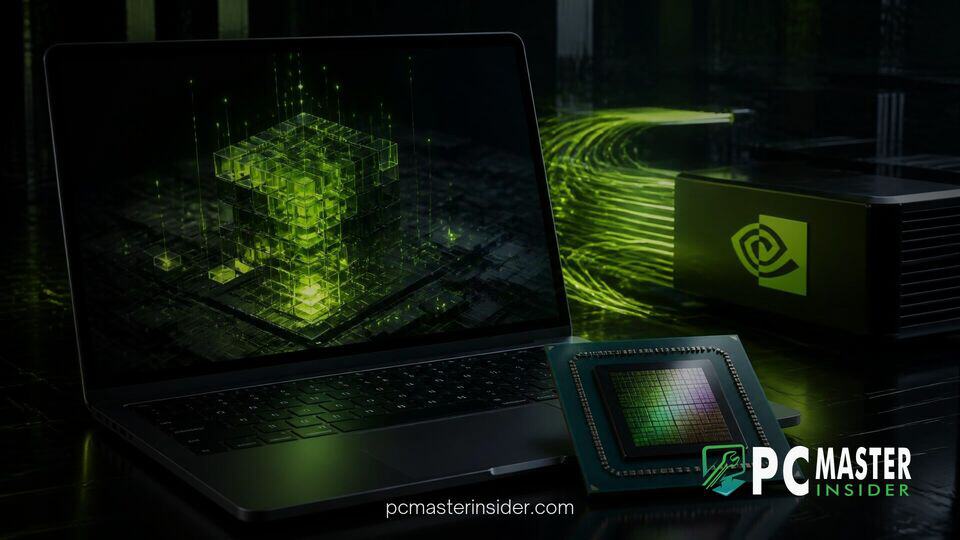
NVIDIA has officially released CUDA Toolkit 13.4, marking a historic expansion by introducing native support for Windows on Arm. The release extends high-performance CUDA compilation and acceleration tools directly to Arm64 Windows environments, bridging a software gap that previously required developers to rely on Linux or cross-compilation workflows.
Along with native Arm64 development capabilities, CUDA 13.4 introduces Multi-Process Service (MPS) V3 for enhanced GPU partitioning, programmatically queryable unified memory residency, and an early developer preview of the next-generation NVIDIA Rubin architecture.
NVIDIA Brings CUDA Toolkit 13.4 to Windows on Arm
The arrival of CUDA Toolkit 13.4 delivers native software support for compiling, building, and optimizing GPU-accelerated applications on Windows 11 Arm64 hardware. Historically, developers targeting Arm CPUs with NVIDIA parallel computing capabilities had to operate within Linux environments. With this update, essential CUDA components, including the NVCC compiler, runtime libraries, cuBLAS, cuFFT, and Nsight diagnostic tools, run natively on Arm-powered Windows devices.
This software milestone arrives as desktop GPU shipments hit four-year highs and demand for local artificial intelligence development environment tools escalates. By offering production-ready software tools for Windows on Arm systems, NVIDIA ensures that AI engineering, computer vision, and high-performance computing (HPC) workflows can be developed locally on thin-and-light laptops and desktop workstations without requiring remote x86 server pipelines.
Core Capabilities and GPU Acceleration Support
The CUDA 13.4 release includes several key platform enhancements beyond Arm architecture translation:
- Multi-Process Service V3 (MPS V3): Modernizes shared GPU resource management by offering a scriptable command-line interface, TOML configuration files, named server instances, and execution namespaces. It provides fine-grained controls over Streaming Multiprocessor (SM) partitions and cgroup-integrated memory limits.
- Unified Memory Residency Queries: Developers gain programmatic API access to query exact data locations across managed or system-allocated memory, enabling smarter runtime scheduling decisions.
- NVIDIA Rubin Architecture Preview: Adds initial functional support for compute capability 10.7 (SM_107), allowing developers to compile and prepare software for future Rubin-based hardware platforms ahead of general availability.
- CUDA Compute Fabric Transport: Low-level NVLink data movement capabilities designed for communication library developers, enabling tighter multi-GPU data transfer coordination.
- Math Library Optimizations: Core libraries like cuBLAS receive updates, including Ozaki-II schemes for emulated FP64 matrix multiplications and specific adjustments for mobile N1X laptop processors.
Strategic Impact on Arm-Based Workstation Computing
Bringing CUDA natively to Windows on Arm significantly reshapes the landscape for portable workstation computing. While Microsoft has actively resolved platform software challenges, such as when Microsoft fixed app launch failures on ARM Windows 11 PCs, native GPU development environments were long considered a missing piece for enterprise AI developers.
This release clears the software runway for upcoming hardware initiatives, including systems designed around NVIDIA RTX Spark platforms. By combining high-efficiency Arm CPUs with powerful dedicated or integrated RTX graphics cores, device manufacturers can offer mobile workstations capable of running complex local inferencing models and CUDA acceleration natively.
According to documentation published on the official NVIDIA Technical Blog, extending CUDA to Arm on Windows aligns with broader initiatives to homogenize software tools across different hardware targets. Developers can now write, debug, and profile CUDA code on Windows Arm64 devices using familiar Nsight Systems and Nsight Compute utilities, maintaining feature parity with standard x86 workstation setups.
System Requirements and Developer Availability
CUDA Toolkit 13.4 is available immediately for download via the NVIDIA Developer portal. The toolkit requires a compatible Windows 11 Arm64 operating system installation along with updated R615 display drivers or later. Notably, NVIDIA has updated its installer package structure so that CUDA SDK installers no longer bundle host display drivers, requiring developers to install matching standalone drivers separately.
While the operating system environment continues to receive regular updates, as seen when Microsoft released the September Patch Tuesday KB5124008 update, GPU driver distribution models are also undergoing adjustments. NVIDIA recently announced that it will transition older platforms to quarterly security updates, prioritizing primary driver branch development for modern 64-bit Windows 11 and Arm platforms.
Additionally, developers utilizing web services, remote desktop administration, or browser-based developer portals alongside CUDA tools can leverage stability improvements provided in recent GPU updates, such as those delivered in the GeForce Hotfix Driver 616.86 release.
With general availability now live, CUDA Toolkit 13.4 sets the stage for a new generation of Arm-powered computing devices. By opening native parallel computing tooling to Windows on Arm, NVIDIA reinforces its platform ubiquity across mobile workstations, data centers, and emerging AI hardware architectures.