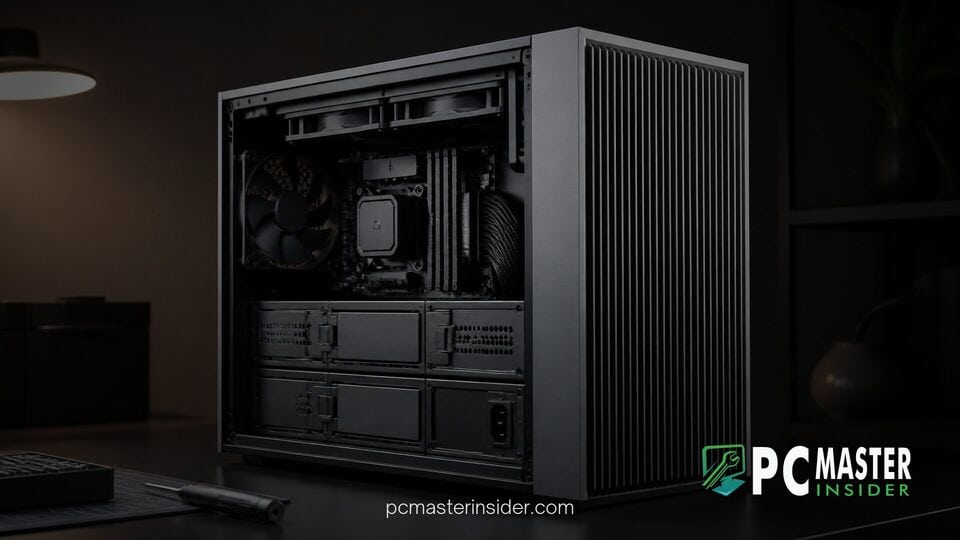
Framework has officially confirmed the opening of preorders for its most powerful workstation to date, featuring 192GB of unified LPDDR5X memory. Built inside the company's compact 4.5-liter chassis, the refreshed small-form-factor computer is powered by AMD's flagship Ryzen AI Max+ PRO 495 processor.
Designed primarily for local machine learning execution and demanding workstation applications, the new system expands on Framework's modular Mini-ITX platform. Despite the massive performance leap, the system maintains complete structural and backward compatibility with earlier chassis and power supply configurations.
Framework Desktop 192GB RAM System Targets High-End Local AI Computing
The updated workstation represents a major leap forward for compact PC design, combining high-speed memory with powerful integrated processing units. By leveraging 192GB of unified system memory operating at 8533 MT/s, the system achieves up to 273 GB/s of total memory bandwidth. Up to 160GB of that memory pool can be allocated directly to the integrated GPU as video memory, making it an attractive platform for developers running massive open-source artificial intelligence models directly on local hardware without depending on cloud infrastructure.
AMD Ryzen AI Max+ Pro 495 Specs and VRAM Allocation
At the center of the hardware upgrade is the AMD Ryzen AI Max+ PRO 495 accelerated processing unit (APU). The chip houses 16 Zen 5 CPU cores and 32 threads with boost clock speeds reaching up to 5.2 GHz. For graphics and parallel computing, the processor includes an integrated Radeon 8065S GPU running 40 RDNA 3.5 compute units at 3.0 GHz.
The integrated Neural Processing Unit (NPU) delivers up to 55 TOPS of dedicated AI performance, bringing the total combined system AI compute to roughly 131 TOPS. Because the APU utilizes a unified memory architecture, assigning up to 160GB as VRAM allows developers to load large language models (LLMs) like DeepSeek V4-Flash or Llama-based architectures entirely into graphics memory. This unified approach removes the traditional PCIe bottleneck associated with transferring model weights between standalone system RAM and discrete GPU memory.
This design philosophy aligns with a broader industry trend of bringing workstation-class artificial intelligence performance into smaller desktop builds. Competing form factors are also embracing specialized hardware architectures, similar to how the GMKtec EVO-X5 Pro AI Mini PC with Ryzen AI Max+ PRO 495 utilizes unified memory pools to tackle heavy AI processing tasks.
Hardware Upgrades and Modular Mini-ITX Design
Framework has made several minor physical refinements alongside the internal memory boost. To accommodate broader expansion options, the built-in PCIe x4 slot features an open-ended edge design, allowing users to physically insert larger expansion cards such as full-length capture cards or multi-gigabit networking add-ons.
Cooling has also been optimized to manage thermals effectively within the compact chassis. The 192GB configuration comes standard with a pre-installed Noctua NF-A12x25 fan to ensure quiet, consistent airflow across the processor and high-density LPDDR5X modules. Power delivery remains handled by a standard, replaceable FlexATX power supply unit.
In keeping with the modular spirit seen in recent industry developments—such as Logitech G PLAY 2026 modular sim racing hardware—Framework continues to focus on standardized components where possible. While the LPDDR5X memory is soldered directly to the processor board due to the ultra-wide 256-bit memory bus constraints, the motherboard, power supply, cooling setup, and outer housing can be serviced, replaced, or upgraded individually.
Customers can order the new desktop either as a customizable DIY kit or as a pre-built machine. Pre-built variants offer a choice between Windows 11 and Fedora Linux, catering directly to open-source software developers and Linux enthusiasts. The effort to offer Linux-first desktop configurations mirrors broader hardware strategies aimed at accommodating diverse developer workflows across different platforms.
Target Workloads and Local AI Development Value
The inclusion of 192GB of RAM in a Mini-ITX form factor targets software engineers, data scientists, and creative professionals who require massive memory overhead without maintaining full-sized tower cases or server racks. Running heavy workloads locally provides lower latency, enhanced data privacy, and relief from continuous cloud computing subscription costs.
The market demand for local compute hardware continues to rise across various sectors. As high-performance hardware becomes more accessible, software tools are rapidly expanding to leverage desktop AI resources. This shift is reflected across the industry, with companies like Google launching dedicated tools like the Gemini Desktop App for Windows 11 and Microsoft integrating tools into a unified Copilot app to streamline local and cloud workflows.
Furthermore, desktop silicon performance gains are forcing hardware makers across the ecosystem to rethink thermal and structural layouts. Similar design innovations are visible in high-end prebuilt towers, such as the ASUS ROG G1000 desktop with isolated Thermal Atrium chamber, showing that efficient cooling is vital whether building massive gaming rigs or ultra-compact AI workstations.
By offering an impressive memory capacity inside a modular 4.5L enclosure, Framework's high-capacity desktop system sets a new standard for localized machine learning capability in a small form factor. Orders for the 192GB system are scheduled to open through Framework's official website, giving developers direct access to one of the most dense unified memory platforms available on the consumer market.