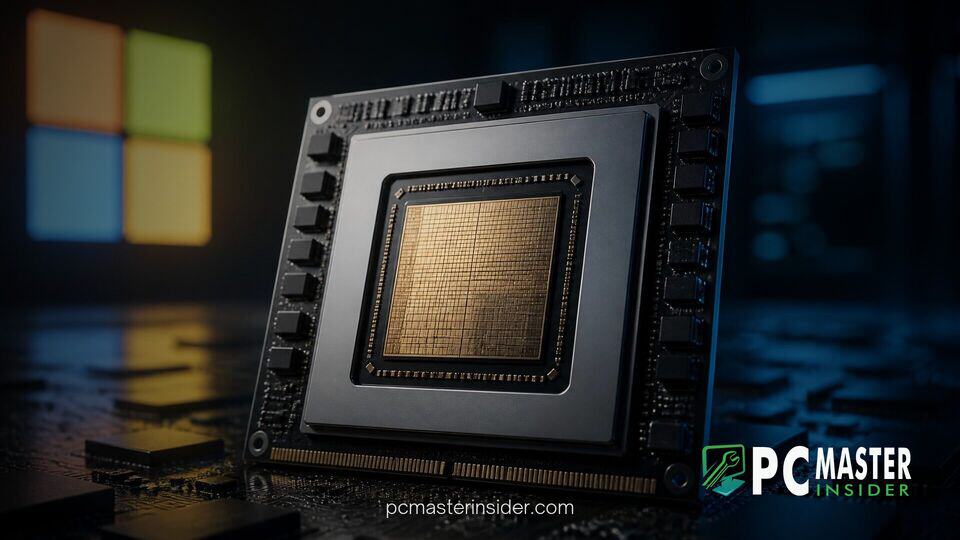
Microsoft has officially unveiled the Azure Maia 300, its third-generation custom artificial intelligence accelerator engineered to power large language model inference across cloud data centers. The tech giant revealed plans to scale the new silicon across multi-gigawatt facility buildouts, positioning the in-house processor family as the primary engine for its core consumer and enterprise AI workloads.
The announcement underscores Microsoft's long-term commitment to vertical hardware integration as high-performance computing demands continue to climb. By expanding its homegrown silicon portfolio, Microsoft aims to significantly optimize operational power budgets while softening its reliance on external accelerator vendors across global data center networks.
Microsoft Unveils Maia 300 Custom AI Chip to Power Next-Gen Cloud Workloads
The microsoft maia 300 custom ai chip represents a major architectural leap designed specifically for complex inference tasks, such as long-context reasoning, real-time conversational agents, and multi-step computational workflows. Built on Taiwan Semiconductor Manufacturing Company's (TSMC) advanced N2P process node, the chiplet-based architecture incorporates high-bandwidth memory (HBM4) to deliver dramatic throughput improvements over its predecessors.
According to Microsoft, a fully populated rack featuring 96 Maia 300 accelerators can generate up to seven times the token throughput of the current second-generation Maia 200 platform. Crucially, the system offers up to 40 percent higher output per megawatt compared to conventional GPU-based cluster configurations, directly targeting the energy constraints currently capping global data center expansions.
Microsoft Unveils Maia 300 Custom Silicon Architecture
Unlike general-purpose graphics processors that cater to both model training and diverse visualization workloads, the Maia 300 features an inference-first software-defined dataflow design. The platform consolidates memory controllers and I/O components onto isolated dies, feeding raw compute cores via eight stacks of HBM4 memory that deliver a peak memory bandwidth of 18 terabytes per second.
Networking is integrated directly into the silicon architecture rather than relying on standard off-the-shelf expansion cards. Each accelerator utilizes electrical links for direct board-to-board communication within the rack chassis, paired with an optical transport tier that links up to 128 racks into massive 12,288-accelerator superpods. This co-engineered approach allows software layers to treat thousands of distinct chips as a single unified processing node, minimizing latency and drastically reducing data movement overhead.
Efficiency Gains and Deployment Timeline for 2027
While the second-generation Maia 200 is currently deployed across production environments in North America, Europe, and Australia to drive Microsoft Copilot, Copilot enterprise integrations, and internal model development, the Maia 300 is scheduled for full-scale production deployment in 2027.
Microsoft plans to roll out the new hardware in multi-gigawatt stages, ensuring that services like GitHub Copilot, Microsoft Foundry, and OpenAI model inference transition seamlessly to custom hardware. The substantial shift toward internal silicon is expected to streamline operational expenditure, especially as power availability emerges as a critical bottleneck for data center expansion projects globally, as seen in recent enterprise challenges like canceled AI data center grid deals.
Reducing Dependence on Third-Party Data Center Hardware
The strategic drive behind the Maia program centers on reining in long-term capital expenditure and diversifying component procurement. While merchant silicon providers like Nvidia continue to dominate the AI infrastructure landscape, securing high-volume allocations remains costly and subject to broader supply chain bottlenecks, such as global packaging shortages that have impacted graphics hardware pricing like the RTX 50 series component price spikes.
By controlling the underlying hardware layout, Microsoft can tailor silicon design to match its precise software algorithms. Executives emphasize that while third-party accelerators remain integral to Azure's overall cloud offering, transitioning internal workloads to custom silicon frees up third-party hardware for external commercial enterprise customers who bring varied software stacks.
Strategic Implications for Microsoft's Cloud and AI Ecosystem
For cloud customers and enterprise IT managers, Microsoft's push into bespoke hardware signals a future where cloud performance is heavily influenced by software-silicon co-design. Operating proprietary models on custom hardware allows Microsoft to adjust margins and deliver predictable performance for bandwidth-heavy agentic applications.
In a public statement regarding the infrastructure expansion, Satya Nadella, Chief Executive Officer at Microsoft, characterized the custom hardware transition as the company's biggest bet yet on internal silicon development. Meanwhile, Scott Guthrie, Executive Vice President of Cloud and AI at Microsoft, highlighted that system-level optimization spanning power, software, and silicon remains the most effective method to stretch limited energy resources while delivering cloud-scale AI.
The move mirrors broader industry trends, with major cloud providers pursuing similar vertical integration paths to optimize hardware efficiency and software integration, similar to how personal computer ecosystems emphasize tailored silicon integration for localized tasks like local AI computing on Windows PCs.
As cloud platforms face relentless demand for generative AI features, Microsoft's aggressive push into multi-gigawatt custom hardware buildouts marks a decisive step toward self-sufficiency. By aligning custom silicon architecture directly with its AI software stack, the company positions its Azure infrastructure to scale more sustainably through 2027 and beyond.