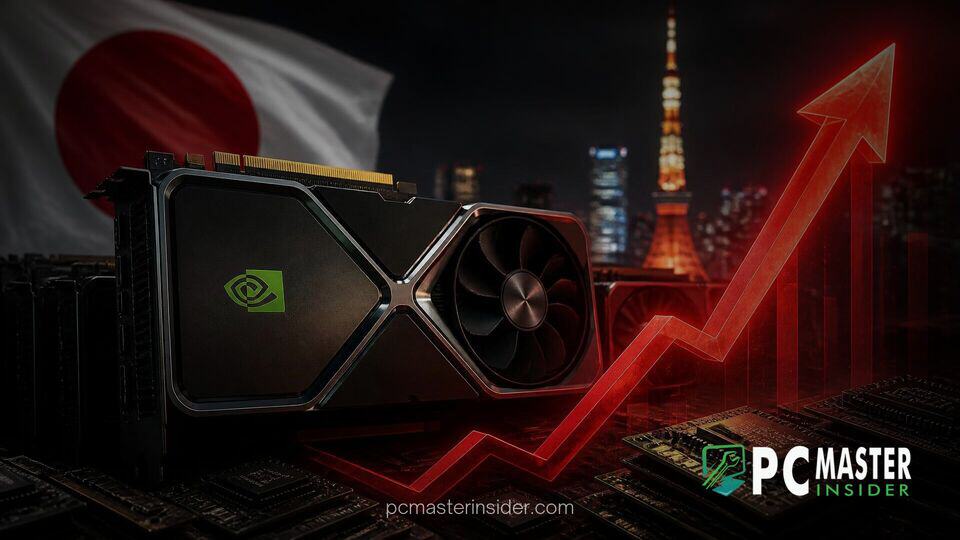
Graphics card pricing in retail markets across Japan has taken a sharp upward turn, with retail listings showing premiums of up to 41 percent on current-generation hardware. The sudden escalation stems from ongoing disruptions in the global memory supply chain and sustained demand across both consumer and enterprise computing sectors.
Retail listings in Tokyo electronics hubs reveal that mid-range and entry-level graphics cards are bearing the heaviest proportional markups. Industry analysts warn that these local price adjustments often serve as an early indicator for international hardware markets faced with similar component cost pressures.
Retail Listings Reveal Massive RTX 50 Price Spikes in Japan
According to recent market tracking and retail shelf sightings in Akihabara, prices for Nvidia GeForce RTX 50 series desktop GPUs have expanded significantly above standard MSRP conversions and comparative North American retail prices. Recent store inventory updates show entry-level models like the GeForce RTX 5060 Ti 8GB carrying a 41 percent price markup compared to standard baseline pricing on major U.S. online retailers, reaching roughly ¥118,800 ($775 USD).
Higher-tier variants have experienced comparable inflationary pressure. Mid-range options such as the RTX 5070 and RTX 5070 Ti now routinely land between 20 percent and 35 percent above earlier listing prices. High-end enthusiast models like the RTX 5080 have breached ¥295,000 ($1,860+ USD) in several brick-and-mortar storefronts. Flagship models remain almost entirely absent from store inventory, with remaining stock listed online at extreme scalper-level markups exceeding several thousand dollars.
The retail price increases hit budget and mid-tier buyers particularly hard. On lower-priced SKUs, small baseline cost increases in individual components convert to large percentage jumps for end consumers, leaving mainstream PC builders with few affordable upgrade paths.
Role of Severe GDDR6 Memory Component Shortages
The principal driver behind the sudden surge in graphics card pricing is an industry-wide shortage of high-speed VRAM modules, including GDDR6 and next-generation GDDR7 chips. Major semiconductor fabricators have shifted significant manufacturing allocations away from standard consumer memory production to satisfy the booming demand for enterprise high-bandwidth memory (HBM) used in artificial intelligence data centers.
This reallocation of silicon fabrication lines has created severe inventory constraints for graphics card add-in-board (AIB) partners. Memory manufacturers have systematically raised wholesale contract prices for video memory bundles supplied to GPU makers. Similar pressures are already affecting AMD Radeon board partners, forcing board vendors to pass increased production expenses down to distributors and retailers.
The hardware crisis is not restricted to video memory. System builders are experiencing concurrent cost increases across system RAM and storage solutions. Standard desktop memory prices have seen sharp increases, with 32GB DDR5 desktop RAM kits and legacy DDR4 memory kits surging in price as supply continues to tighten worldwide.
Potential Repercussions for US and Global Graphics Card Markets
Market analysts note that regional hardware pricing shifts in Asian markets like Japan often foreshadow wider global trends. Japanese electronics distributors, such as CFD Sales, previously issued early notices regarding vendor price revisions on graphics cards, highlighting that board partners can no longer absorb rising component bills.
If memory allocation bottlenecks persist through the remainder of the year, graphics card manufacturers may have to formally adjust suggested retail pricing across Western markets as well. Higher component costs have already begun impacting broader consumer electronics manufacturing, contributing to a broader slowdown where global PC shipments dropped as rising memory prices pushed completed desktop and laptop costs higher.
A Japanese retailer representative, speaking anonymously on inventory conditions, noted: "Our allocation from distributors has dropped substantially while wholesale prices per unit keep going up each week. We have no choice but to adjust store listings to reflect our actual procurement costs."
For PC builders hoping for immediate relief, industry forecasts suggest that component pricing will remain elevated until semiconductor foundries expand overall memory production capacity, leaving consumers to navigate one of the most challenging GPU buying environments in recent years.