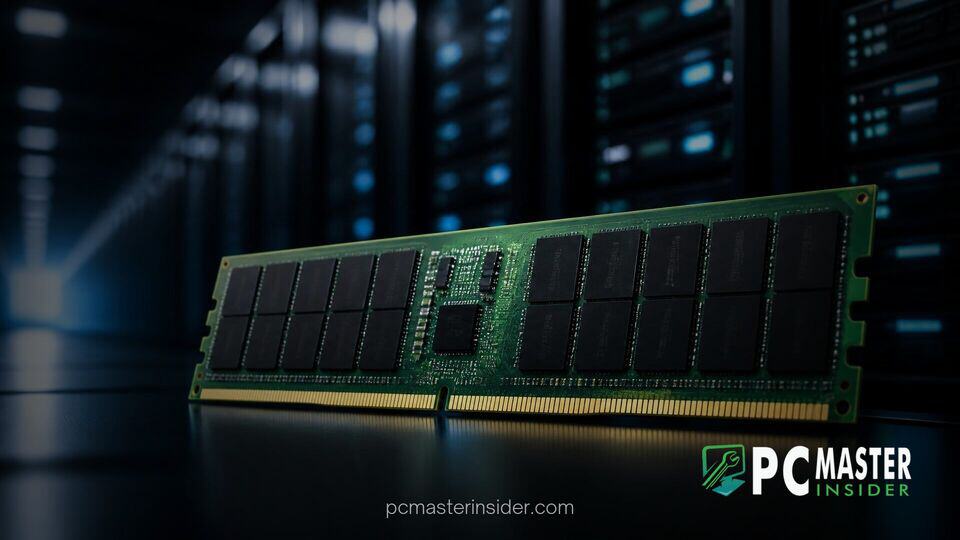
Micron Technology has announced the successful demonstration of the world's first 512GB DDR5 registered DIMM (RDIMM) operating across multiple next-generation server platforms. Engineered to address the escalating memory demands of artificial intelligence, real-time analytics, and in-memory databases, the new memory module achieves speeds of up to 9200 MT/s while dramatically reducing enterprise energy consumption.
By offering unprecedented density in a single stick, the breakthrough allows enterprise data centers and cloud service providers to scale memory capacities significantly without expanding physical rack footprints. The advancement comes at a critical time when hardware manufacturers across the industry are reallocating production pipelines to meet AI-driven demand, similar to how Samsung outsources DDR5 memory production to free up domestic facilities for enterprise AI silicon.
Micron Introduces Ultra-High-Capacity 512GB DDR5 DRAM
The core innovation behind Micron's 512GB DDR5 RDIMM lies in its ability to condense multi-terabyte memory configurations into standard server DIMM slots. Utilizing the micron 512gb ddr5 dram module, data center operators can now outfit a dual-socket server featuring 24 memory slots with up to 12TB of system RAM. This represents a massive leap forward in system memory density, allowing large language models, agentic AI agents, and massive enterprise data pools to reside entirely in primary system memory rather than relying on slower storage tiers.
Key Technical Specifications and 9200 MT/s Speeds
Beyond raw capacity, Micron's flagship RDIMM targets extreme performance demands. Designed to operate at bandwidth rates reaching up to 9200 MT/s, the module far surpasses standard DDR5 baseline specifications. High data throughput ensures that high-core-count processors remain constantly saturated with data, preventing performance bottlenecks in compute-heavy environments. In benchmark testing using Apache Spark Support Vector Machine (SVM) memory-bound analytics workloads, Micron reported up to a 1.4x performance increase compared to standard 256GB DDR5 configurations.
3D Vertical Stacking and 60 Percent Power Cut
To achieve this ultra-dense configuration without expanding the physical dimensions of the memory stick, Micron relied on advanced 3D vertical interconnect packaging. Multiple dynamic random-access memory dies are vertically stacked within individual packages and interconnected using through-silicon vias (TSVs). This packaging technique mirrors the die-stacking approaches found in High Bandwidth Memory (HBM) architectures.
This structural consolidation brings profound operational power savings. According to Micron's technical specifications, a single 512GB RDIMM consumes approximately 16 watts of operating power. In contrast, four separate 128GB modules providing an equivalent 512GB of total capacity consume roughly 44.2 watts under similar test conditions. This reduction of more than 60 percent in operating power lowers active power draw from roughly 86 milliwatts per gigabyte down to 31 milliwatts per gigabyte, drastically reducing overall chassis thermals and operating costs for data center facilities.
Targeting AI Inference and Data Center Workloads
Modern enterprise compute demands have shifted dramatically toward generative AI inference, vector search, and complex multi-tenant virtualization. When memory capacity fails to keep up with model parameters or active cache sizes, systems are forced to page data to non-volatile peripheral storage devices. Even high-speed NVMe drives introduce serialization delays and bus overhead that degrade real-time performance.
By expanding main memory capacity to 12TB per dual-socket node, server systems can retain entire neural network models and active knowledge graphs directly in RAM. This capability is especially vital as cloud giants ramp up compute scale to tackle industry bottlenecks; for example, Microsoft targets 38 gigawatts of data center capacity to ease global computing crunches.
The push for massive memory capacity extends across both specialized AI clusters and versatile workstation environments. High-end desktop and mobile workstations are already pushing internal memory boundaries to process local AI tasks, as seen when China's Sugon unveils 64-thread N50 Pro laptop with 128GB RAM, or when AMD unveils Threadripper Halo Station AI workstation architectures for massive unified bandwidth. Micron's new server module brings that same high-density philosophy to scalable data center infrastructure.
Platform Validation with AMD and Intel
Broad ecosystem support is essential for enterprise hardware adoption, and Micron confirmed that key semiconductor partners are already actively validating the 512GB RDIMM on upcoming server platforms. Both AMD and Intel are integrating the ultra-dense memory modules into engineering validation suites for their next-generation data center architectures.
Speaking on the engineering breakthrough, Raj Narasimhan, senior vice president and general manager of the Cloud Memory Business Unit at Micron, highlighted the operational benefits for enterprise clients: "A 512GB RDIMM enables multi-terabyte servers, supporting larger AI and database workloads, greater virtualization density and improved power efficiency, all within existing server footprints".
Industry partners have mirrored this sentiment. Enterprise infrastructure executives noted that higher capacity memory allows organizations to maximize compute density, optimize operational expenditure, and maintain the scaling flexibility required for modern real-time AI pipelines.
Market Impact and Mass Production Timeline
The announcement of the micron 512gb ddr5 dram module represents a major step in high-density enterprise memory technology. While low-latency memory products like G.Skill Trident Z5 Royal NeoX DDR5 memory target consumer desktop platforms, Micron's TSV-stacked RDIMMs are tailored specifically for hyperscale cloud environments, supercomputing installations, and high-density virtualization racks.
Although functional engineering samples are currently demonstrating speed and efficiency gains across test systems, full-scale commercial availability will follow a structured rollout. Micron plans to initiate volume production for the 512GB DDR5 RDIMM in the second half of 2027, aligning with the arrival of next-generation server platforms from leading CPU manufacturers.
As enterprise workloads continue to demand higher bandwidth, massive capacity, and lower energy footprints, ultra-dense memory solutions like Micron's 512GB module will serve as foundational building blocks for the next era of data center compute.