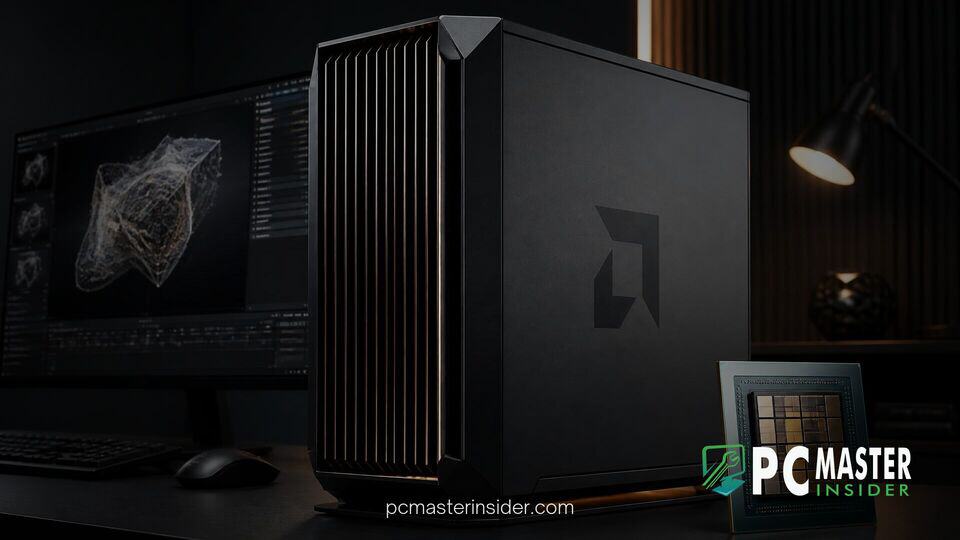
AMD has unveiled the Threadripper Halo Station AI workstation, a compute system engineered to bring enterprise-grade artificial intelligence development directly to the desktop. Featuring a 96-core processor built on the Zen 5 architecture, the high-performance system targets research teams, data scientists, and enterprise engineers who require localized compute power without relying exclusively on cloud infrastructure.
By integrating extreme multi-threaded CPU capabilities alongside specialized hardware accelerators, AMD aims to bridge the gap between cloud data centers and local developer environments. The new system provides the memory capacity and raw computational throughput necessary to execute local fine-tuning, data processing, and large-scale AI model inference without latency constraints.
AMD Threadripper Halo Station AI Workstation Architecture and Specs
The core of the AMD Threadripper Halo Station AI workstation is powered by a flagship 96-core, 192-thread Zen 5 processor designed to handle heavy parallel computing tasks. Combined with massive memory bandwidth and cutting-edge PCIe expansion capabilities, the system provides a robust platform capable of running complex simulations alongside demanding generative AI workloads.
To support high-bandwidth computing, the architecture includes multi-channel DDR5 memory support with ECC error correction, ensuring reliability during multi-day model training sessions. This extreme compute density positions the workstation as a primary solution for laboratories that prefer on-premise execution over cloud-based services. Hardware enthusiasts tracking high-core CPU developments will recall recent enterprise announcements such as Intel's Diamond Rapids Xeon CPUs featuring up to 256 cores, highlighting how competition in the heavy-duty compute landscape continues to accelerate across both server racks and workstation chassis.
96-Core CPU and Dual Liquid-Cooled MI350P Accelerators
To complement the massive 96-core central processor, AMD offers configurations equipped with up to dual liquid-cooled Instinct MI350P accelerators. These specialized AI engines feature high-capacity High Bandwidth Memory (HBM3e), allowing developer teams to keep massive model parameters active directly inside physical memory. Liquid cooling ensures continuous peak operation under heavy workloads while keeping fan noise low enough for office settings.
The system utilizes direct-to-die liquid loops connected to internal radiators, preventing thermal throttling during sustained tensor operations. By pairing 96 x86 CPU cores with dedicated graphics accelerators, the platform delivers balanced host-to-device data transfers, eliminating bottlenecks when shifting dataset batches from system RAM into accelerator VRAM.
Target Workloads for Trillion-Parameter AI Models
AMD designed the workstation specifically to handle complex foundation models, long-context text processing, and real-time inference tasks that demand vast system memory. With scalable unified memory pools, developers can run long-context reasoning frameworks locally before deploying them into full production server clusters.
This localized setup offers significant cost and security advantages for organizations handling proprietary code bases, sensitive financial records, or medical data. Industry developments in specialized rack and desktop computing have seen aggressive movement lately, with competitors offering localized enterprise hardware like Nvidia's GB300 DGX Station desktop system, underscoring the growing market demand for self-contained AI compute nodes.
Enterprise Market Positioning and Release Expectations
The release of the Threadripper Halo Station marks a strategic move by AMD to capture a larger share of the enterprise workstation market. By offering an all-in-one system capable of local AI model training, the company targets defense contractors, financial institutions, and software labs that operate under strict data privacy mandates.
Hardware partners, system integrators, and software vendors have already voiced enthusiasm for the new platform. During the announcement event, AMD highlighted optimized software stacks, including expanded ROCm support for popular machine learning frameworks like PyTorch and TensorFlow, ensuring that AI engineers can deploy pre-existing models without major code rewrites.
At the same time, companies across the semiconductor sector are pushing hardware innovation forward on multiple fronts. From Arm's dual chiplet server CPU architecture to Samsung's smart memory with on-chip processing, the entire technology sector is pivoting toward hardware optimized specifically for AI workloads. AMD's desktop platform aligns with this industry trend by packing data-center class performance into a standard desktop form factor.
System integrators are expected to begin shipping fully configured AMD Threadripper Halo Station workstations later this quarter. While official pricing varies depending on the specific CPU tier, RAM quantity, and liquid-cooled accelerator configurations selected, the platform stands out as a powerful tool for organizations looking to bring high-end AI research back into local office environments.