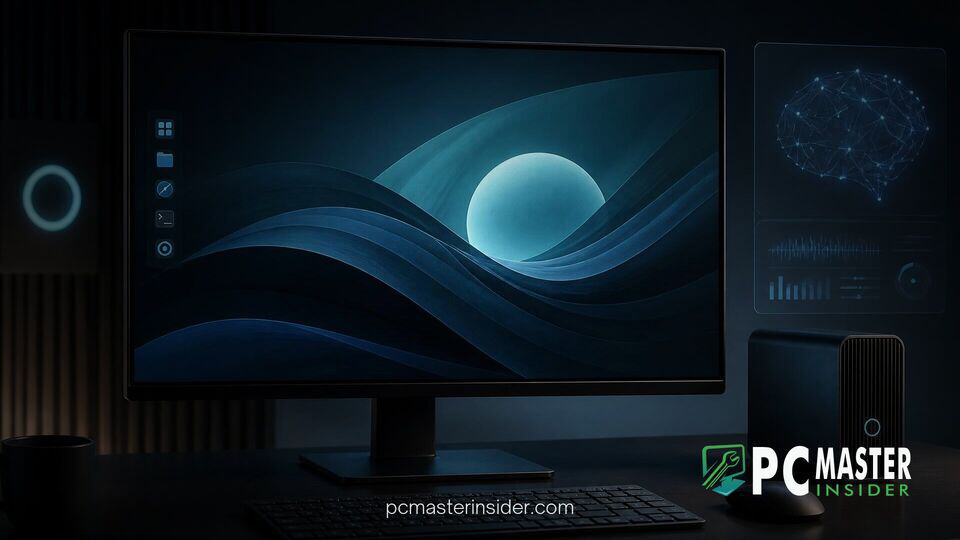
Kirt McMaster, the former chief executive officer and co-founder of Cyanogen, has officially revealed Kora OS, a new Linux desktop operating system engineered from the ground up for native, local artificial intelligence workloads. Developed by Palo Alto-based Kora Systems Inc., the platform aims to integrate generative models and autonomous agents directly into the system architecture rather than treating them as isolated desktop applications.
Cyanogen Co-Founder Announces AI-First Kora OS
The announcement of kora os linux desktop ai operating system architecture marks a pivot for McMaster's team, which previously operated under the name Playtron and developed handheld gaming software. Instead of attempting to capture the entire mainstream PC market, Kora Systems is targeting developers, power users, and data scientists who rely heavily on local AI tools and scriptable workflows.
Unlike traditional operating systems where AI functions operate through web browsers or sandboxed third-party applications, Kora OS embeds model execution directly into the operating system kernel and system shell. The company argues that modern desktop platforms like Windows and macOS were designed decades before generative models arrived, leaving AI assistants constrained by app boundaries and lacking direct visibility into underlying system hardware.
To address security and context isolation, Kora OS introduces sandboxed environments known as "neural workspaces". These workspaces use Linux security mechanisms such as AppArmor to strictly control which files, network resources, and hardware devices an autonomous agent can access. Additionally, the platform features a semantic file system that indexes user documents based on meaning rather than conventional file names, allowing local models to retrieve contextual data without uploading sensitive files to external servers.
System-Level AI Integration vs Traditional Desktop Software
By embedding intelligence into the core operating system layer, Kora OS allows multiple background agents to coordinate tasks across different applications while maintaining shared context. In conventional desktop environments, users must manually copy context between separate browser windows or specialized software tools. Under Kora's framework, system services can trigger AI operations natively, allowing agents to manipulate workspace files, monitor project state changes, and automate multi-step workflows across native software components.
This approach reflects a growing industry trend toward isolating and managing machine learning tasks at the system level. Similar initiatives can be seen across the industry, such as when Microsoft launched Execution Containers to isolate AI agents on Windows systems to manage background agent permissions and enhance overall system security.
Core Architecture and Silicon Compatibility
At the center of Kora OS is Cortex, a proprietary hybrid inference engine designed to manage model execution across diverse hardware environments. While the foundational operating system is built on open-source Linux, the Cortex scheduling engine remains closed-source proprietary technology. Cortex defaults to running lightweight AI models locally on the host machine, falling back on cloud-based APIs like OpenAI or Anthropic only when complex tasks demand greater compute capacity. Kora Systems projects that up to 70 percent of routine user AI requests will be processed locally on device hardware.
Hardware compatibility is a major focus for the new platform. Kora Systems has spent nearly a year collaborating with Qualcomm engineers to optimize the operating system for ARM-based Snapdragon processor architecture. The software is specifically tailored to leverage the Hexagon NPU found inside Snapdragon X2 Elite chips, which Qualcomm rates at 80 TOPS of dedicated AI compute performance. During hardware testing, McMaster confirmed that Cortex ran Google's 26-billion-parameter Gemma 4 model locally on Snapdragon X2 Elite silicon at a decode speed of 25 tokens per second.
In addition to ARM chips, Kora OS is engineered to support traditional x86-64 processors from Intel and AMD. However, the scheduling strategy differs across architectures. While ARM deployments leverage integrated NPUs for primary LLM inference, the Cortex engine on x86 platforms routes heavy large language model processing directly to dedicated GPUs, citing superior throughput on x86 graphics hardware.
Workload Offloading Across CPU, GPU, and NPU
One of the most notable features of the Cortex engine is its ability to dynamically split inference workloads across available system silicon. The software continuously monitors hardware utilization, allocating lightweight task routing to the CPU, vector processing to the NPU, and heavy matrix math to discrete or integrated GPUs.
Furthermore, Cortex can offload compute operations to other secondary machines located on the same local area network. This distributed approach enables lightweight laptops to harness idle GPU capacity from nearby desktop rigs without sending local data across public cloud networks. This hardware flexibility aligns with recent hardware deployments in the local AI space, including setups seen when Gigabyte unveiled the AI TOP AERO desktop powered by Nvidia RTX Spark hardware to handle heavy desktop inference workloads.
The OS also retains legacy gaming software support carried over from its Playtron roots. A dedicated system layer called GameFrame allows users to launch standard Linux desktop games alongside local development workflows, ensuring broad software utility beyond strict productivity tasks.
Launch Timeline and Target User Base
Kora Systems plans to distribute Kora OS as a free download for individual users, with an official public release slated for 2027. Prior to the general desktop launch, the company is partnering with Saudi AI enterprise firm Humain to launch an enterprise-oriented variant dubbed Humain OS, which is scheduled to ship preloaded on OEM hardware systems.
McMaster emphasized that Kora is not attempting to directly replace Windows for everyday consumer desktop users. Instead, the company is focusing on the rapidly expanding market of software developers, prompt engineers, and technical power users who heavily utilize agentic coding tools. Kora Systems estimates this addressable segment currently stands at roughly 45 to 50 million global users, with projections expected to surpass 200 million power users by the next decade.
In summary, Kora OS represents a focused attempt to rethink desktop computing around native local AI capabilities. By combining local silicon scheduling, sandboxed workspace security, and cross-device compute offloading, Kora Systems hopes to establish a viable alternative for power users seeking private, agentic desktop workflows.