
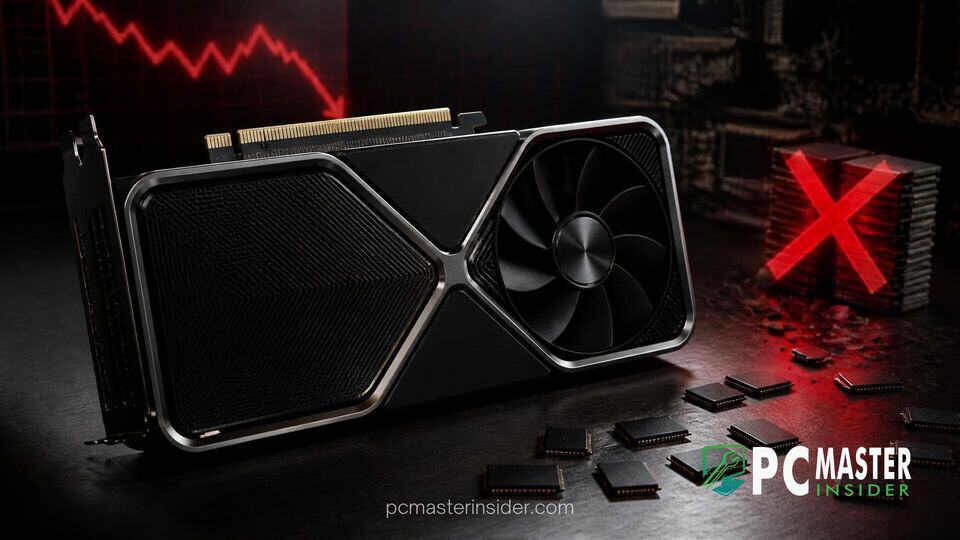
Nvidia has reportedly shelved its planned 24GB GeForce RTX 5080 graphics card following sharp cost increases for high-density video memory. Industry leaks indicate that board partners have been instructed to cancel launch preparations and focus on standard 16GB models instead.
The decision stems from spiraling manufacturing expenses associated with next-generation memory modules, which threatened to push retail pricing far beyond targeted consumer brackets. Consequently, the existing 16GB configuration will remain the primary option for enthusiasts seeking a high-end desktop GPU based on Nvidia's Blackwell architecture.
Nvidia Scraps 24GB RTX 5080 Due to Rising GDDR7 Component Costs
Supply chain reports emerging from Asia indicate that Nvidia recently notified add-in card manufacturers to halt development on the revised 24GB RTX 5080. The variant was previously expected to hit retail shelves in early 2027 to cater to gamers and creators demanding higher VRAM capacity for intensive titles and local artificial intelligence workloads.
Initial plans called for replacing the standard 2GB GDDR7 modules with denser 3GB DRAM chips across the graphics card's 256-bit memory bus . However, early production estimates revealed that constructing the 24GB model under current market conditions would result in prohibitive retail prices, potentially approaching $2,000 per unit . By cancelling the revised project, Nvidia avoids split supply chains while concentrating its chip allocations on standard production runs.
GDDR7 Memory Module Pricing Challenges
The main bottleneck behind the cancellation involves the current market pricing of non-binary 3GB GDDR7 memory modules . Supply chain sources report that these high-density chips currently cost nearly three times as much to produce and source compared to standard 2GB modules .
This dynamic reflects broader market pressures, as severe global DRAM supply constraints continue to elevate memory prices across multiple tech sectors . As DRAM manufacturers prioritize enterprise-grade memory for data centers, consumer graphics memory pricing has faced unprecedented upward pressure . Industry analysts note that soaring memory component costs have forced multiple PC hardware vendors to adjust their product roadmaps and delay planned refreshes.
16GB RTX 5080 Remains the Primary Flagship Option
With the 24GB variant placed on indefinite hold, Nvidia will continue supplying board partners with Blackwell GPU packages configured for eight 2GB GDDR7 modules . This ensures that the 16GB RTX 5080 remains the core offering within Nvidia's upper-tier lineup below the flagship RTX 5090.
Aside from the memory capacity adjustment, the cancelled 24GB variant was not slated to feature core hardware redesigns . Both versions utilize the same underlying CUDA core counts, with performance differences limited to memory-bound scenarios such as 4K gaming with ultra-textured assets, high-resolution ray tracing, and specialized generative AI models .
Market Implications for High-End PC Gaming GPUs
The cancellation highlights ongoing friction between consumer hardware expectations and component pricing realities. Modern games and software applications increasingly require more than 16GB of video memory, leading many PC enthusiasts to request higher VRAM allocations on sub-flagship GPUs.
However, market conditions make expanding memory configurations challenging for graphics card manufacturers. Component distributors have already begun implementing price adjustments on high-end hardware, with several retail listings reflecting steep increases above original base MSRPs . Recent tracking shows that consumer upgrade cycles are adjusting as buyers encounter sustained hardware premiums across retail channels .
For PC builders, the cancellation means that 16GB will remain the standard ceiling for the RTX 5080 series for the foreseeable future. Nvidia has not officially commented on the leak, but industry observers expect the company to maintain its current hardware lineup while monitoring global memory production yields throughout the coming year .