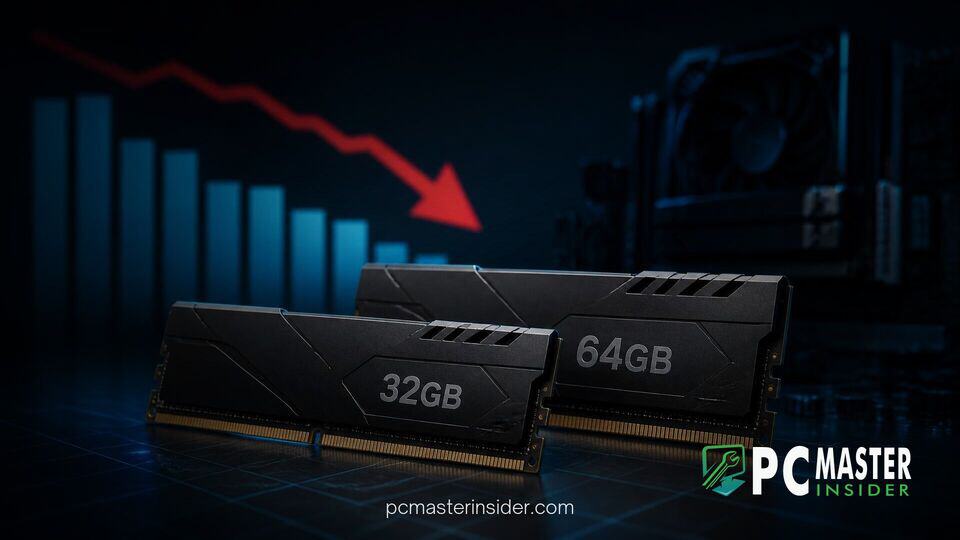
In an unexpected shift for desktop computing hardware, recent diagnostic submission metrics reveal that higher-capacity system memory setups are losing ground to lower-tier configurations. Data captured by the CPU-Z Validator database shows an unusual year over year market share drop for both 32GB and 64GB PC RAM configurations.
While enthusiast platforms historically move toward higher memory densities over time, the newest benchmark metrics indicate a distinct reversal. Builders and original equipment manufacturers appear to be recalibrating system specifications downward in response to persistent memory chip pricing pressure and changing hardware demand.
CPU-Z Validation Report Details Global RAM Capacity Shift
The CPU-Z software tool remains one of the PC hardware industry's primary platforms for verifying clock speeds, core counts, and system specs. System profiler submission statistics compiled by the CPU-Z Validator highlight a noticeable change in how desktop systems are configured worldwide.
According to data highlighted by CPU-Z core developer Doc TB, systems equipped with 32GB of memory remain the single most common configuration, holding 37.2% of total validations. However, that figure represents a 2.5% decline compared to the same period in the previous year. High-end 64GB memory configurations experienced an even steeper drop, falling by 18% year over year to claim just 7.3% of total validations.
Conversely, 16GB RAM setups rebounded sharply, rising by 12.9% year over year to secure 33.0% of all submitted profiles. Entry-level 8GB setups recorded a 5.5% increase to reach 11.0% share, while non-binary 24GB memory kits grew by 19.7% to capture a 2.3% footprint. The data also shows that older DDR4 memory usage grew by 6.0% to represent 54.5% of total validations, whereas DDR5 share slipped by 2.9% to 32.9%.
Market Factors Driving PC Memory Capacity Trends
The cpu z ram capacity market share drop comes during a broader period of financial realignment across the semiconductor sector. Escalating contract and spot prices for dynamic random-access memory (DRAM) chips have significantly increased overall system assembly costs. As major DRAM manufacturers prioritize high-bandwidth memory (HBM) and enterprise server modules for artificial intelligence datacenters, consumer DRAM supply has tightened, pushing module retail prices upward.
Industry analysts point out that elevated prices across high-speed DDR5 kits have forced mainstream consumer system builders to compromise on overall density to keep system costs manageable. This consumer squeeze aligns with findings from Counterpoint Research projecting memory price stabilization only after major fab expansions fully operationalize down the road.
Rather than stocking systems with 32GB or 64GB of memory out of the box, system builders are increasingly defaulting to 16GB kits as a cost-containment strategy. Furthermore, retail market behavior shows buyers leaning into affordable legacy hardware platforms rather than paying premiums for top-tier memory densities on cutting-edge platforms.
Impact on PC Builders and Future Hardware Upgrades
The decline in 32GB and 64GB validation share highlights how hardware pricing alters upgrade patterns for everyday users and gaming enthusiasts alike. For years, 32GB was viewed as the target sweet spot for new gaming builds, but current market dynamics are preserving 16GB as a viable, budget-conscious baseline.
Component availability challenges have echoed across related PC hardware sectors. Recent reporting from the broader industry, such as desktop processor volume trends tracked by Steam hardware survey statistics and third-party analysts, underscores how rising build costs temper consumer appetite for top-spec components.
At the same time, major semiconductor suppliers continue directing silicon wafers toward enterprise environments. As detailed in recent developments regarding SK Hynix DRAM production constraints and allocation shifts seen when Intel shifts CPU production capacity to server chips, consumer supply chains are likely to remain constrained in the near term.
While power users and heavy workstation operators still rely on 64GB and higher capacities for content creation, mainstream gamers and casual users are opting to hold off on high-density RAM upgrades. Until memory market spot pricing softens, 16GB configurations will likely remain the primary choice for budget-conscious builders looking to maintain hardware value.