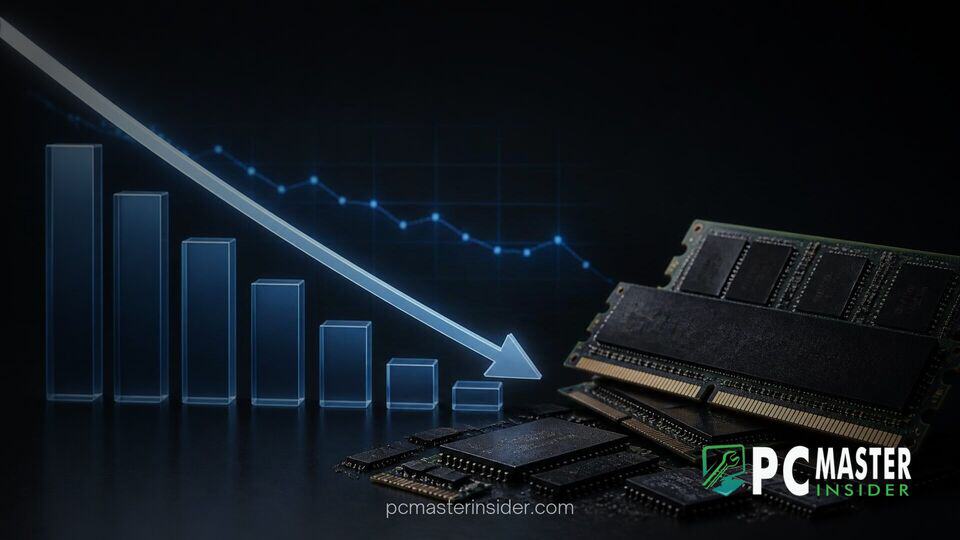
Global DRAM and NAND flash memory prices are projected to reverse their sharp upward trajectory and fall by 20% to 30% by 2028. According to market intelligence firm Counterpoint Research, incoming manufacturing capacity combined with stabilizing enterprise AI capital expenditure will finally relieve the hardware ecosystem.
Speaking at iForum 2026 in Seoul, Counterpoint Research Fellow Kang Kyung-soo detailed how the current memory market supply crunch is expected to ease over the next several years. The forecast offers long-awaited relief for consumer hardware vendors, server builders, and system integrators who have weathered intense cost increases across component supply chains.
Counterpoint Research Memory Price Forecast 2028: Market Downturn Ahead
The latest counterpoint research memory price forecast 2028 outlines a structural pivot in semiconductor supply dynamics. Driven by immense enterprise appetite for High Bandwidth Memory (HBM) and data center server modules, memory chip costs climbed aggressively throughout 2025 and 2026. Major manufacturers reallocated production lines away from standard DDR4 and DDR5 wafers to prioritize lucrative AI server products, causing consumer memory prices to spike dramatically.
In recent months, retail system upgrades hit historic highs as 32GB DDR5 desktop RAM kits hit 450 dollars as DRAM supply tightened across key sales channels. That severe supply bottleneck spread into adjacent categories, forcing graphics card vendors to adjust pricing tiers while global PC shipments dropped 20 percent in Q3 2026 as memory costs rose. Counterpoint expects this tight imbalance to persist through mid-2027 before turning sharply downward in 2028 as new volume enters circulation.
Forecast Predicts End to Current AI Memory Price Surge
The prolonged rally in memory contract pricing has been driven primarily by high-margin enterprise demand. Memory foundries dedicated an unprecedented proportion of silicon output to stacked HBM architectures and enterprise server RDIMMs, leaving standard client PC and mobile memory undersupplied. Consequently, system manufacturers faced severe bill-of-materials inflation.
"As manufacturers concentrated capacity on high-margin HBM and server products, supply of general-purpose DRAM and NAND became relatively scarce," explained Kang Kyung-soo during his presentation. However, Counterpoint's model demonstrates that the pace of contract price hikes will begin moderating over the next 18 months, paving the way for a 20% to 30% drop in overall DRAM and NAND pricing by 2028.
Supply Expansions from Major DRAM Manufacturers
The anticipated price decline relies heavily on massive cleanroom expansions coming online globally. Leading memory producers including Samsung Electronics, SK Hynix, and Micron Technology have invested aggressively in advanced fabrication facilities designed to scale up total wafer starts.
Beginning in 2027, initial volume from SK Hynix and Micron's newest manufacturing nodes will hit the market, followed by massive fab expansions from Samsung in 2028. Simultaneously, domestic production efforts in Asia are adding significant capacity. Chinese semiconductor maker ChangXin Memory Technologies (CXMT) is set to expand its DRAM wafer capacity significantly through 2028, bolstering general-purpose memory supply for volume consumer devices.
Factors Moderating Big Tech AI Infrastructure Spending
On the demand side, analyst projections indicate that hyperscale cloud providers will adjust their capital expenditure growth rates. Tech giants including Microsoft, Alphabet, Amazon, and Meta elevated their infrastructure budgets to unprecedented levels during the initial AI deployment wave.
Counterpoint Research highlighted that capital spending among top cloud service providers currently exceeds 80% of operating cash flow. As these organizations focus on monetizing existing hardware investments and managing free cash flow, the exponential growth in memory procurement is expected to stabilize into a predictable replacement cycle, lessening demand pressures on memory fabs.
Consumer PC Memory Market Outlook Through 2027
While the long-term outlook points to lower component costs by 2028, PC hardware enthusiasts and system builders must navigate elevated pricing in the immediate future. Industry reports from TrendForce and Counterpoint suggest that consumer DRAM contract pricing will remain tight through late 2026 and early 2027 while new fabrication plants are constructed.
The cost pressure has pushed desktop builders to seek creative platform choices. Over the past year, DDR4 memory prices surged 280 percent as PC builders pivoted away from costly DDR5 hardware during the peak of the shortage. Similarly, system manufacturers adjusted base configurations and pricing tiers, as seen when Intel implemented a 10% price increase across PC processors as memory costs rose across board partner supply chains.
Long-Term Impact on PC Hardware Pricing
Once the projected 20% to 30% price reduction takes effect in 2028, the broader personal computing ecosystem stands to benefit substantially. Lower procurement costs for memory chips will allow system integrators, OEM laptop builders, and desktop component makers to improve base device specifications without raising retail prices.
Higher baseline RAM configurations will become significantly more affordable for mid-tier laptops and gaming desktops, accelerating mainstream software adoption. Hardware advances, such as Micron outlining its DDR6 and LPDDR6 memory roadmap on the 1-Delta DRAM node, will benefit from lowered per-gigabyte costs as next-generation memory standards enter mass production.
In summary, while high memory prices will continue to challenge tech manufacturers and consumers through 2027, the long-term forecast points to substantial market relief. As new wafer supply matures and enterprise AI purchasing normalizes, a 20% to 30% drop in memory prices by 2028 should restore balance to global PC and consumer electronics supply chains.