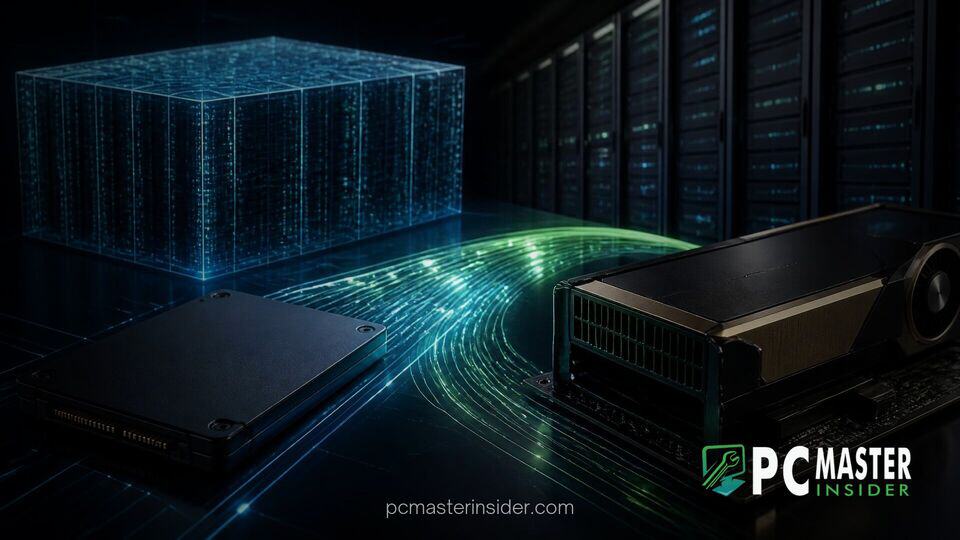
Kioxia and Nvidia have announced a technological collaboration demonstrating how enterprise solid-state drives can extend effective GPU memory capacity to petabyte scale. The joint proof of concept proves that massive AI datasets can be accessed directly from high-speed NVMe SSDs, bypassing the strict physical and economic constraints of relying solely on standard high-bandwidth memory.
As modern artificial intelligence models expand to billions or trillions of parameters, memory capacity has emerged as a major architectural bottleneck in high-performance computing centers. High-bandwidth memory offers immense throughput, but installing hundreds of terabytes of DRAM or HBM per cluster is often cost-prohibitive. By offloading large, fine-grained vector lookups to tailored flash storage tiers, enterprise deployments can significantly scale up accessible memory capacity without ballooning infrastructure expenditures.
Kioxia and Nvidia Demonstrate Petabyte-Scale GPU Memory Expansion
The joint breakthrough addresses the growing challenge of scaling memory capacity alongside compute capacity in modern data centers. By utilizing specialized software hooks alongside high-performance enterprise storage, Kioxia and Nvidia succeeded in expanding the functional address space for GPUs past the single-petabyte boundary. The benchmark setup achieved this milestone on an Nvidia GB200 NVL72 rack-scale architecture equipped with 144 Kioxia XD8 Series 7.68TB E1.S NVMe drives.
Together, these 144 drives generated roughly 1.1 petabytes of raw flash storage capable of supporting GPU access calls at fine granularity. During testing, the joint platform successfully processed a massive vector database containing 2 trillion vectors. This capability allows large graph neural networks, recommendation engines, and context-heavy retrieval augmented generation platforms to stream complex embeddings without running out of hardware memory space.
Integration of Enterprise SSDs with Nvidia SCADA Software
At the center of this technical achievement is Nvidia Scaled Accelerated Data Access software, known as SCADA. SCADA functions as a high-performance software library created to let GPUs address NVMe drives with minimal latency and high efficiency. Instead of forcing data through standard CPU-managed system memory paths, SCADA enables fine-grained 512-byte block transfers straight from storage into GPU compute units.
The proof of concept divided the 144 Kioxia enterprise SSDs across 18 compute nodes within the GB200 rack. This setup provided nearly 60 terabytes of extended, flash-based memory capacity per individual node. By optimizing data access patterns down to tiny 512-byte blocks, the system minimizes read amplification and optimizes IOPS performance during unpredictable graph traversals.
Storage-Next Initiative for High-Bandwidth Memory
The technical demonstration supports Nvidia's broader Storage-Next initiative, which aims to redefine how enterprise storage layers interface directly with accelerator hardware. In conventional system design, flash storage is treated as a secondary tier reserved for cold data retrieval or periodic model checkpointing. Storage-Next bridges this divide by turning fast flash storage into an active memory expansion layer.
While standard system memory relies on system-level allocations, advancements in accelerator design continue to push memory interfaces closer to processing dies. For instance, Nvidia unveiled the Rubin HPC GPU architecture to advance compute capability, but scaling available memory capacity to match next-generation processing demands requires software-driven tiering. Rather than replacing HBM, flash memory acts as a massive buffer tier that dramatically expands effective address space.
To further accelerate direct GPU storage access, Kioxia also showcased its GP2 Series Super High IOPS SSD architecture. Utilizing third-generation XL-FLASH low-latency SLC flash memory, these upcoming PCIe 6.0 drives target over 18 million random read IOPS at 512-byte block sizes. Future generations of the GP Series are planned to target up to 100 million IOPS, helping shrink the latency barrier between flash storage and high-bandwidth GPU memory.
Performance Trade-Offs and Enterprise Data Center Use Cases
While extending GPU memory via solid-state drives offers massive capacity scaling, technical trade-offs remain. On-chip HBM chips offer terabytes per second of bandwidth, whereas PCIe 6.0 NVMe drives peak at tens of gigabytes per second. Consequently, flash-based memory expansion is not meant to replace high-bandwidth memory for active matrix math matrix multiplication. Instead, it serves applications characterized by sparse data access, massive database lookups, and long-context retention.
Data center hardware pricing dynamics also make flash storage expansion compelling. The enterprise computing landscape has been impacted by tight supply and fluctuating component costs. For example, NAND spot prices dropped 20 percent while DRAM prices remained high due to market supply constraints. At the same time, legal developments like the ongoing DRAM price-fixing lawsuit in federal court highlight volatile memory pricing trends. These market realities force data center operators to seek memory expansion alternatives rather than relying solely on DRAM.
Beyond massive server racks, optimizing memory access is a top priority across all computing form factors. Software optimization efforts demonstrate similar principles, such as when Microsoft optimized core apps to save RAM in Windows 11 or updated tools like when Task Manager was updated to track total installed memory. On the enterprise side, software-managed hardware tiers allow computing clusters to handle larger workloads efficiently.
Executive leadership at both organizations emphasized that knowledge access will dictate future AI capabilities. Jason Hardy, Vice President of Storage Technology at Nvidia, noted that AI agent performance relies on the scale of knowledge bases accessible to compute engines. Kioxia Senior Vice President Neville Ichhaporia similarly highlighted that high-performance flash technology offers a viable path forward for scaling massive AI workloads economically.
By bringing together high-density NVMe enterprise SSDs, SCADA software libraries, and direct GPU access routines, Kioxia and Nvidia have proven that petabyte-scale GPU memory access is achievable in modern data centers. This hybrid memory architecture provides enterprise data center operators with a scalable roadmap for training and deploying massive AI datasets without suffering severe memory bottlenecks.