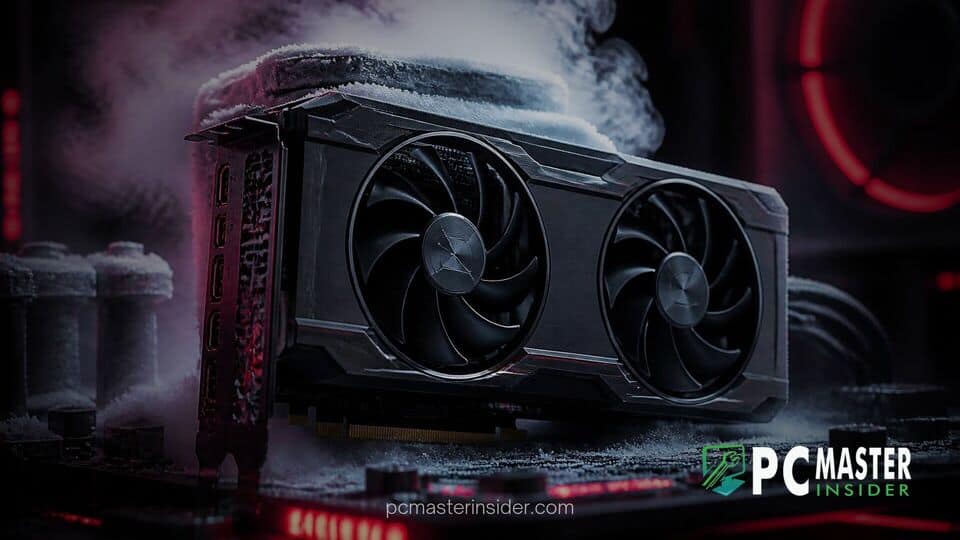
A team of professional overclockers has pushed the AMD Radeon RX 9060 XT to a groundbreaking GPU world record, achieving a peak clock speed of 4.837 GHz under extreme cooling conditions. The historic frequency achievement breaks previous silicon performance barriers, highlighting the structural scaling capabilities inherent to AMD's latest mid-range graphics architecture.
By utilizing specialized sub-zero cooling techniques and customized power delivery modifications, the benching session yielded high-frequency stability that far exceeds standard factory operational limits. The milestone provides enthusiasts with an intriguing look at the frequency limits of current semiconductor manufacturing when pushed well beyond standard thermal specifications.
Radeon RX 9060 XT GPU World Record Shatters Frequency Expectations
Setting a new benchmark for graphics card clock rates, the recent achievement centered around an extensively modified custom board powered by sub-zero liquid nitrogen. By lowering operating temperatures down toward negative 190 degrees Celsius, the engineering team successfully neutralized thermal throttling while driving voltage levels far beyond standard consumer guidelines to claim the radeon rx 9060 xt gpu world record.
During testing, monitoring utilities recorded sustained core frequencies reaching 4,837 MHz, accompanied by substantial improvements in peak compute throughput. Reaching frequencies near the 5 GHz milestone represents a massive leap for desktop graphics cards, which typically operate between 2.5 GHz and 3.2 GHz under default air or standard liquid cooling solutions. Enthusiasts who wish to evaluate their own hardware stability following aggressive tuning can refer to guides on how to test GPU VRAM stability after overclocking or undervolting.
AMD Overclocking Team Pushes RDNA 4 GPU to 4.837 GHz
The record setting attempt focused heavily on testing the upper limits of AMD's RDNA architecture. Silicon binning played a critical role in selecting a chip capable of surviving the elevated voltage necessary to maintain structural signal integrity at nearly 4.9 GHz. Overclockers adjusted digital PWM controllers directly to maintain clean current delivery, preventing micro-stalls during high load stress cycles.
Standard retail graphics cards utilize tightly controlled power limits to protect hardware longevity and maintain reasonable acoustic levels. However, extreme benchmarking removes these artificial boundaries. By bypassing hardware power limiters and injecting direct voltage control through secondary monitoring boards, the tuning team allowed the silicon to scale linearly with frequency as thermal resistance dropped under extreme cooling.
Extreme Liquid Nitrogen Cooling Setup
To withstand the massive thermal density generated by over-volting the GPU core, the team mounted a heavy custom copper cooling evaporator block directly onto the bare silicon die. High-purity liquid nitrogen was continuously fed into the container pot, keeping the package cool enough to prevent thermal runaway even as power draw escalated past typical operating parameters.
In addition to cooling the primary processor die, extensive thermal insulation was applied across the surrounding circuit board. Specialized art eraser putty and thick closed-cell foam were used to enclose the socket area, preventing ambient condensation from forming ice crystals or causing short circuits across the surface-mount capacitors and memory modules.
Performance and Frequency Achievements
Reaching 4.837 GHz required fine-grained control over both core frequency offsets and high-bandwidth memory timings. While memory speeds were kept relatively conservative to preserve total electrical stability for the primary core clock record, synthetic compute passes demonstrated scale performance scaling that aligned closely with the rising frequency curves.
The successful run demonstrates the raw frequency capabilities of modern FinFET and chiplet manufacturing nodes when thermal bottlenecks are completely removed. While daily operational environments cannot replicate liquid nitrogen setups, achievements like this validate the robustness of power delivery design across modern graphics boards. The hardware community continues to monitor how manufacturers tweak underlying firmware, especially after issues like when ASRock released a new VBIOS update following Radeon RX 7900 GPU boot issues.
Market Context and GPU Availability Impact
World record overclocking attempts serve primarily as engineering demonstrations, showcasing silicon potential rather than practical out-of-the-box user experiences. However, strong frequency headroom often correlates with overall silicon efficiency and manufacturing maturity, factors that ultimately benefit regular consumers purchasing retail graphics cards.
The desktop graphics market continues to evolve amid shifting component supply chains and memory pricing trends. Reports indicating that AMD reportedly raised GDDR6 prices for Radeon GPU board partners highlight the economic pressures facing manufacturers as they balance production costs against extreme performance hardware demands. Meanwhile, board partners continue to expand form factors across the product line, such as seen when ASUS unveiled the XG Core portable eGPU featuring the Radeon RX 9060 XT LP.
Software optimization also remains essential for maintaining stability across diverse hardware configurations. AMD routinely updates its software suite to address system stability, similar to how AMD released Adrenalin driver updates for Radeon crashes and timeouts in previous driver branches.
Ultimately, the 4.837 GHz world record stands as a landmark achievement in GPU overclocking history. It illustrates the incredible thermal tolerance and frequency scaling built into contemporary graphics processors, setting a high bar for future enthusiast hardware challenges.