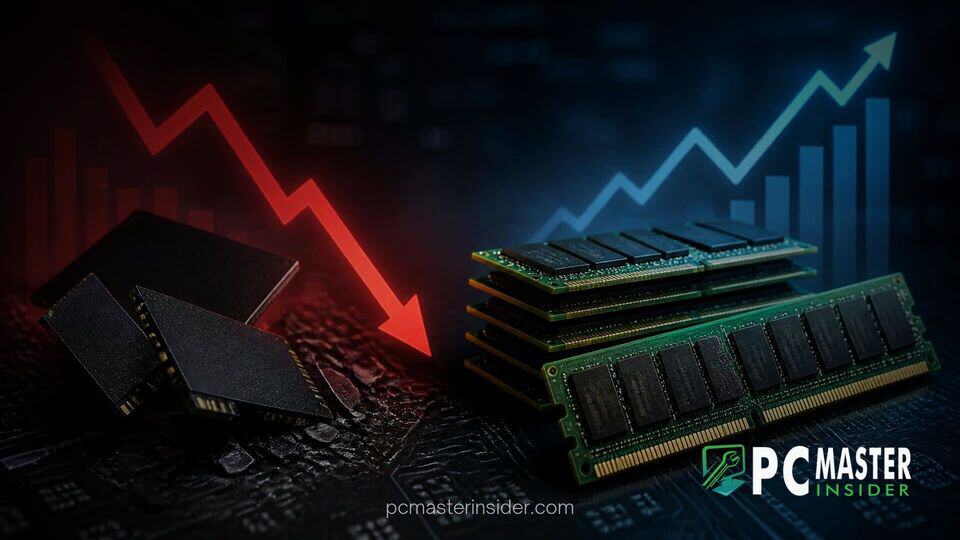
NAND flash spot prices have experienced a swift reversal, dropping roughly 20 percent over a two-week period as inventory clearance pressure mounts across distribution channels. In contrast, the systemic DRAM market continues to face tight supply constraints, keeping system memory and graphics memory pricing elevated.
Data from market research firm TrendForce highlights a widening gap between short-term spot market valuations and long-term memory contract prices. While component buyers are pushing back against high retail tags on consumer storage, persistent enterprise demand for artificial intelligence hardware is preventing a uniform drop across all memory categories.
TrendForce Spot Price Data Shows 20 Percent Drop in NAND Wafers
The recent market update from TrendForce reveals that the gap between NAND flash spot quotes and fixed contract prices now exceeds 20 percent. Unbranded and bare-wafer storage products have taken the brunt of this downward correction. For instance, spot pricing for 512Gb TLC NAND wafers fell around 32 percent month-over-month to approximately $14.30, while 1Tb wafer quotes slid 19 percent to $24.90. Traders and channel distributors are actively slashing quotes in an attempt to offload accumulated inventory before further softening occurs.
This rapid shift in the spot market signals that component distributors held excess inventory following months of aggressive procurement during the early-year memory rally. However, industry analysts note that spot price movements serve as a leading indicator rather than an immediate retail discount. Because solid-state drive manufacturers rely on long-term supply agreements and finished-goods inventories, lower wafer spot costs take several months to filter down to consumer retail shelves.
Falling Consumer Demand Triggers Flash Storage Price Shifts
The primary catalyst behind the NAND spot price decline is a pronounced contraction in global consumer electronics shipments. High component costs throughout the year forced smartphone and personal computer manufacturers to pass price increases onto end users. In response, retail consumers have delayed device upgrades, leading to noticeable shipment drops in both mobile handsets and prebuilt systems.
With hardware OEMs scaling back their component purchasing orders to match lower consumer demand, storage module makers have been left holding surplus capacity. Furthermore, competitive expansion from memory vendors such as Yangtze Memory Technologies Co. (YMTC) in the consumer flash segment has increased overall bit availability. While global memory giants have diverted significant manufacturing resources toward enterprise data center storage, YMTC and second-tier module makers have maintained strong production volumes targeting client devices, exacerbating oversupply in retail channels.
Enterprise SSD Pricing Remains Resilient Amid Cloud Demand
While consumer-grade flash memory experiences price cuts, enterprise storage tells a different story. Demand for high-capacity enterprise SSDs remains robust in North America, where cloud service providers continue expanding data center infrastructure for AI workloads. Enterprise SSD contract pricing is expected to hold steady or see modest gains through the end of the fourth quarter, buffering major chipmakers from the full impact of consumer market weakness.
However, regional variations are emerging within the enterprise space. Reports indicate that some Chinese technology firms have trimmed their 2027 enterprise SSD order projections due to ongoing accelerator GPU supply limitations and slower monetization of commercial AI tools. This divergence between North American and Asian enterprise demand could cause broader NAND contract prices to turn downward by early 2027.
DRAM Market Squeeze Keeps PC System Memory Prices Elevated
In contrast to the oversupply brewing in flash storage, the broader DRAM market remains tight. A report on how global PC shipments fell 21 percent as memory prices soared demonstrated how rising system memory costs are impacting the wider hardware market. Major DRAM manufacturers including Samsung, SK Hynix, and Micron continue prioritizing advanced process nodes for High Bandwidth Memory (HBM) and high-density server RDIMMs to supply AI compute clusters.
Because cleanroom space and wafer capacity are heavily allocated to enterprise server memory, traditional client DRAM output remains limited. Consequently, DDR5 and LPDDR5 spot quotes have stayed relatively firm compared to flash storage. While secondary markets have seen DDR4 spot memory prices dip slightly as buyers resist high premiums, mainstream DDR5 memory kits continue to command elevated prices. High memory pricing has also impacted graphics cards, with hardware makers noting that Nvidia increased RTX 50 series GPU prices by up to $500 partly due to elevated VRAM procurement costs.
System builders are already adjusting to these memory dynamics. Recent hardware telemetries reveal an unexpected trend where 32GB and 64GB PC RAM share declined year over year as buyers opt for lower-capacity configurations to stay within budget. Additionally, software-side mitigations are gaining attention; earlier this year, AMD unveiled AI-predictive memory management to reduce system DRAM usage in enterprise environments to counteract rising hardware expenses.
Market Outlook and What Components May See Savings Next
Looking ahead to early 2027, the memory industry is set for a bifurcated pricing environment. Industry analysts project that consumer NAND contract prices could drop by 5 to 10 percent in the first quarter of 2027, eventually leading to discounts on retail PCIe 4.0 and PCIe 5.0 NVMe SSDs by mid-year. PC builders planning storage upgrades may soon see relief as channel inventory clears.
Conversely, system memory pricing is expected to remain sticky. Unless cloud providers significantly curtail their AI infrastructure investments, DRAM capacity will remain tightly managed by top silicon foundries. As a result, consumer desktop and laptop buyers should prepare for storage prices to decline well ahead of system RAM costs.
In summary, TrendForce spot data confirms a 20 percent drop in NAND flash spot prices driven by cooling consumer demand and distributor inventory liquidation. While SSD builders may soon pass these raw component savings on to shoppers, tight DRAM supply constraints mean that system memory costs will remain elevated for the foreseeable future.