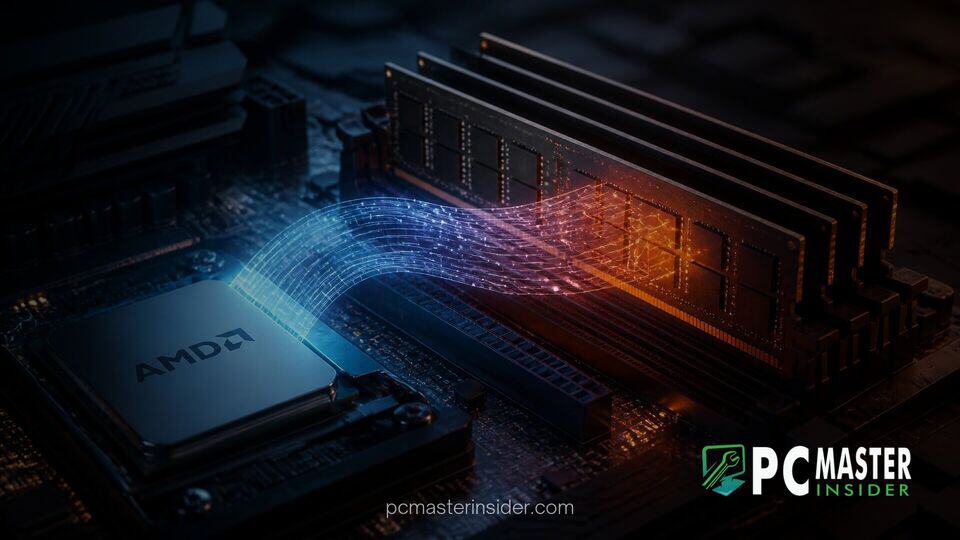
Advanced Micro Devices has officially unveiled its new MEXT predictive memory software, an AI-driven system tiering platform designed to drastically reduce system DRAM requirements across enterprise servers. By pairing low-cost, high-capacity NVMe solid-state storage directly with physical memory, AMD claims system operators can slash physical DRAM capacity by 20% to 75% while keeping performance virtually indistinguishable from all-DRAM setups.
The announcement arrives at a critical juncture for enterprise computing, as [global PC shipments drop due to memory component costs](https://pcmasterinsider.com/global-pc-shipments-drop-memory-component-costs/) and enterprise hardware budgets face severe strain from rising memory prices. Driven by surging AI workloads and severe supply constraints, memory module contract costs have climbed rapidly throughout late 2026, making memory provisioning one of the single most expensive line items when outfitting data centers.
AMD Introduces AI-Driven Predictive Memory Management
The newly unveiled technology is built around software acquired by AMD in June 2026 when it absorbed MEXT. AMD has integrated the software as a low-overhead driver and lightweight background engine for servers powered by AMD EPYC processors. Rather than relying on traditional, reactive operating system swap files or paging, AMD AI predictive memory management continuously analyzes data access patterns using machine learning models.
Traditional operating systems often retain large amounts of inactive or "cold" memory pages directly in expensive DRAM modules, consuming capacity that active tasks could otherwise utilize. According to research cited by AMD, somewhere between 50% and 80% of server memory allocated in data centers sits completely unaccessed for five minutes or longer. MEXT identifies these idle memory blocks and transparently moves them to an attached NVMe SSD. When the application is about to request that data again, the embedded AI engine predicts the upcoming request and streams the pages back into physical DRAM before execution stalls occur.
How AI-Predictive Optimization Reduces System DRAM Footprint
Because NAND flash memory remains hundreds of times slower than standard volatile DRAM, passive disk swapping historically throttles processor throughput. AMD overcomes this hardware latency wall by leveraging machine learning algorithms ranging from lightweight heuristics to transformer-based sequence predictors. The software creates a predictive buffer, continuously promoting high-priority data to physical memory and demoting low-priority memory pages to high-speed NVMe storage.
From the perspective of the operating system and running software, the virtualized memory map remains completely unchanged. System administrators can install the MEXT driver software within minutes without making alterations to underlying application code or operating system settings. In internal workload demonstrations involving chip timing analysis and autonomous AI agents, AMD demonstrated that server nodes operating with 50% physical DRAM retained between 95% and 99% of the performance delivered by configurations equipped with full DRAM capacity.
Balancing AI Server Workloads Amid Rising Component Costs
The release comes as high memory consumption causes headaches across the entire technology ecosystem. In recent months, tech leaders have debated system resource allocations, highlighted by [Sam Altman responding to controversy over AI memory demands on Windows PCs](https://pcmasterinsider.com/sam-altman-ram-usage-windows-pc-controversy/), while workstation users frequently encounter issues when trying to [reduce high RAM usage from Windows 11 background AI services](https://pcmasterinsider.com/windows-11-high-ram-usage-ai-services-fix/). Meanwhile, hardware vendors are pivoting their strategies as [Nvidia reportedly cancels the 24GB RTX 5080 over soaring memory costs](https://pcmasterinsider.com/nvidia-rtx-5080-24gb-cancellation/) and tracking trends where [CPU-Z data shows 32GB and 64GB PC RAM share declining year over year](https://pcmasterinsider.com/cpu-z-ram-capacity-market-share-drop/).
AMD reported that it has already deployed MEXT internally across 145 IT infrastructure servers. By expanding effective memory capacity using flash storage instead of purchasing additional physical DRAM modules, the company avoided approximately $4.9 million in memory procurement expenditures, marking an 82% reduction in memory expansion costs.
Speaking on the internal deployment, AMD Chief Information Officer Hasmukh Ranjan noted, "Rising memory prices are a real challenge for every IT organization. For AMD IT, the challenge was to increase the memory available to engineers without committing the budget that an equivalent expansion using physical DRAM would require."
Implementation Timeline and Future Hardware Compatibility
AMD is rolling out the technology in partnership with enterprise server manufacturers, starting with Hewlett Packard Enterprise. Initial rollout stages focus on certifying "MEXT Ready" EPYC server platforms featuring dedicated high-speed NVMe storage drive bays assigned specifically to memory expansion duties.
The company also provides system administrators with an observability suite called RAM View, allowing IT teams to track real-time memory usage, temperature metrics, and page tiering efficiency across server clusters. Following its initial internal deployment, AMD plans to expand its internal MEXT implementation to over 2,000 production servers by 2027 while making commercial licenses widely available to enterprise cloud providers and data center operators.
By transforming NAND flash into a dynamic, pre-fetched tier of system memory, AMD offers an innovative software alternative to brute-force hardware scaling. As memory costs remain elevated, predictive memory management could fundamentally change how enterprise networks balance speed, capacity, and infrastructure expenditures.