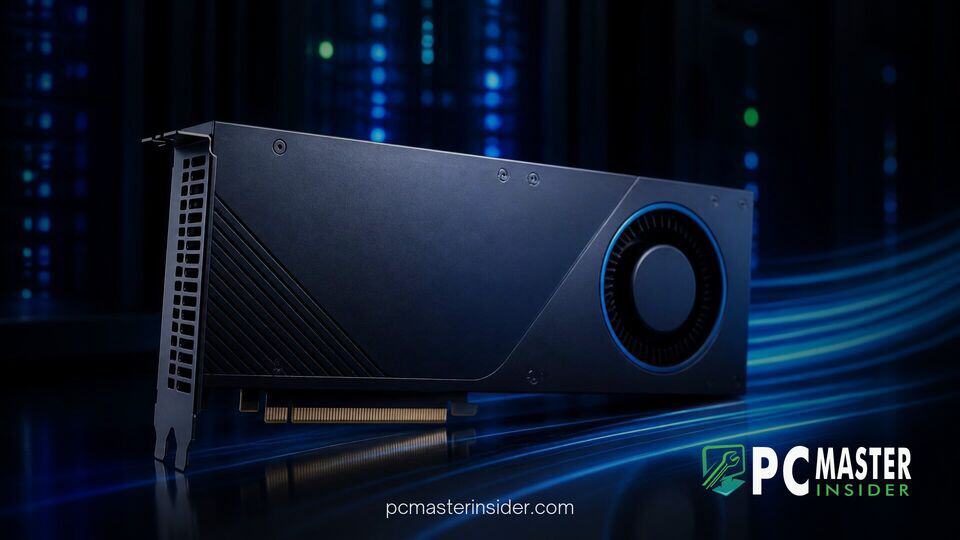
At the Open Compute Project (OCP) Global Summit 2026, Intel formally announced the Intel GPU D-series, previously codenamed Crescent Island. Powered by Intel's updated Xe3P architecture, the new accelerators target memory-intensive enterprise artificial intelligence inference and long-context agentic AI workloads.
Designed as a standard dual-slot PCI Express 5.0 expansion card, the primary flagship model, designated as the Intel GPU D270, delivers up to 1.3 petaflops of FP8 matrix compute and 1.5 TB/s of memory bandwidth inside a air-cooled 350-watt envelope. By removing graphics output and ray-tracing hardware, Intel has reallocated silicon real estate directly to dedicated compute cores and matrix processing.
Intel GPU D-Series Xe3P Announcement Highlights Next-Gen Inference Strategy
The intel gpu d-series xe3p announcement marks a pivot in Intel's enterprise datacenter hardware strategy. Rather than competing purely on peak training performance against power-hungry liquid-cooled server racks, Intel is focusing on the economics of sustained, real-world AI inference deployments. The new GPU D-series leverages high-capacity Low Power Double Data Rate 5X (LPDDR5X) memory instead of conventional High Bandwidth Memory (HBM). This structural choice drastically lowers system thermal overhead and bill-of-materials costs while providing expansive VRAM footprints for handling massive key-value (KV) caches in large language models.
Intel Details GPU D-Series Acceleration Platform at OCP 2026
Intel introduced the GPU D-series as part of a broader push toward open, heterogeneous data center infrastructure. Built on standard PCIe slots, these cards are designed to drop into existing air-cooled enterprise server environments without requiring specialized liquid cooling plumbing or proprietary rack modifications. This launch coincides with broader platform updates across the data center industry, where hardware vendors and software ecosystems are adapting to changing operating system standards and security protocols, such as Windows 11 Secure Boot certificate changes and updated platform management guidelines.
Xe3P Architecture and High-Capacity LPDDR5X Memory
At the core of the GPU D-series is the Xe3P architecture, an updated iteration derived from Intel's client and datacenter graphics roadmaps. The flagship GPU D270 silicon features 32 Xe3P cores, 256 matrix engines (XMX), and a 32MB unified L2 cache. To maximize efficiency for deep learning inference, Intel redesigned the XMX pipeline from a 4-deep systolic array to a 16-deep processing structure, adding native support for data formats ranging from FP4 up to FP64.
Memory capacity represents the biggest highlight of the announcement. Intel's first-party branded reference card ships with 160GB of LPDDR5X memory. However, the underlying PCB design enables original design manufacturer (ODM) partners to manufacture custom configurations that scale all the way up to 480GB of memory per card. This massive memory density allows high-parameter neural networks to remain resident in VRAM without suffering severe performance penalties from host-system offloading.
Power Efficiency and 350-Watt Operational Envelope
Operating within a strict 350-watt thermal design power (TDP), the GPU D-series is optimized for power-constrained server rooms. By omitting 3D graphics rendering engines, display controllers, and dedicated ray-tracing pipelines, Intel maximized the density of tensor execution units while keeping total power draw manageable. The air-cooled dual-slot PCIe design ensures that data center operators can deploy these accelerators within standard 2U or 4U rack units without upgrading power delivery infrastructure.
Targeting AI Inference Economics and Enterprise Infrastructure
As enterprise AI applications shift from initial training toward continuous inferencing, system operational expenses are increasingly dominated by power consumption and token generation costs. The GPU D-series is designed to address this challenge by delivering high model capacity per watt. According to Intel, a single GPU D-series card can host models with up to 300 billion parameters. When arranged in an eight-GPU host system, the cluster can process foundation models exceeding one trillion parameters.
System Configurations and Hardware Partner Ecosystem
Intel demonstrated flexible system topologies at OCP 2026, showing how four 160GB GPU D-series cards can be paired to provide 640GB of unified memory footprint. This setup was highlighted running multi-billion-parameter open-source models with day-zero framework optimization. Hardware partners, including major server OEMs and ODMs, are expected to introduce custom board layouts utilizing up to 480GB of LPDDR5X VRAM per accelerator.
To support deployment, Intel is maintaining software alignment across its entire data center portfolio. Operating system compatibility and driver optimizations are being pushed through upstream Linux kernel trees as well as enterprise operating systems. This focus on broad software support parallels recent driver initiatives in client computing, such as the Windows 11 Driver Quality Initiative and recent Intel GPU driver update releases aimed at improving system stability.
Strategic Positioning Against Competitors
The GPU D-series establishes a distinct competitive niche alongside existing market alternatives. While high-end training clusters rely on ultra-high-bandwidth memory solutions like HBM3e found on top-tier accelerators from rivals, those platforms frequently require complex liquid cooling loops and draw upwards of 600 to 1,000 watts per board. In contrast, Intel's LPDDR5X approach prioritizes raw VRAM capacity, air cooling compatibility, and lower total cost of ownership (TCO) for inference serving.
This deployment model aligns with a broader industry movement where major cloud providers and system builders are diversifying their hardware architecture. Similar cost and power optimization strategies are visible across the tech sector, ranging from cloud-specific custom silicon like Microsoft's Azure Maia chips to localized edge computing solutions such as mini PCs with integrated local AI hardware.
Industry Deployment Roadmap and Availability Timeline
Intel confirmed that validation customer sampling for the GPU D-series is currently underway with tier-one server manufacturers, cloud service providers, and independent software vendors. While official retail pricing and exact general availability dates have not yet been publicly disclosed, early engineering units are actively undergoing qualification across various data center form factors.
By offering an air-cooled accelerator with up to 480GB of memory per card, Intel aims to provide a practical path for enterprises looking to scale agentic AI and long-context language models within standard data center infrastructure.