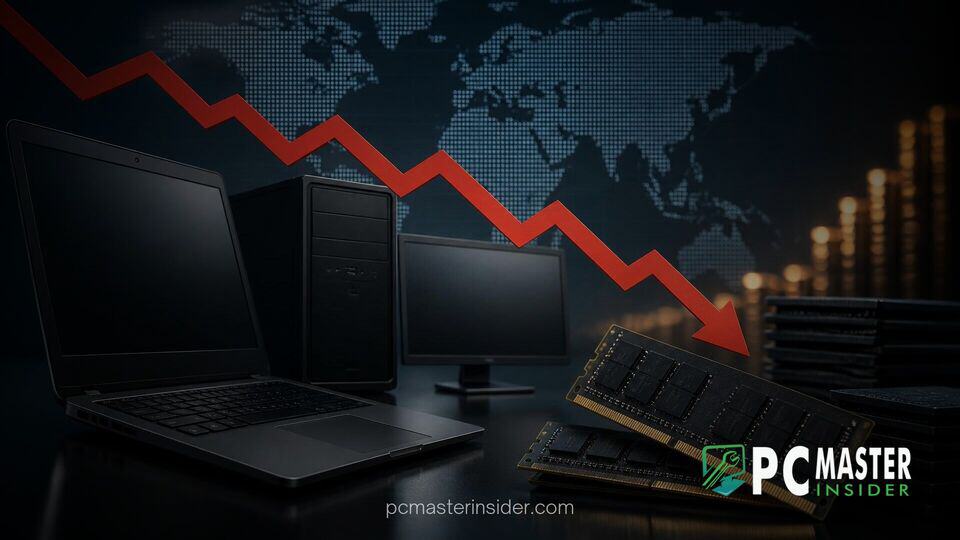
Global personal computer shipments fell 21 percent year over year in the third quarter of 2026 as soaring memory component costs pushed retail prices significantly higher, according to market intelligence reports from leading research firms. The sharp contraction marks the steepest third quarter decline recorded in recent history, driven by relentless price increases across system memory and storage modules.
Unlike previous hardware downturns that stemmed from overstocked distribution channels or weakening consumer confidence, the current slump is directly linked to an unprecedented surge in component expenses. Rapidly expanding artificial intelligence data center builds have absorbed the bulk of world DRAM and NAND flash supply, leaving traditional PC original equipment manufacturers battling severe shortages and inflated bill of materials costs.
Global PC Shipments Drop Memory Component Costs and Market Volume in Q3 2026
>Preliminary figures from top industry tracking agencies indicate that global PC shipments dropped to approximately 57 million to 62.7 million units in the third quarter of 2026. This reflects a year-over-year contraction ranging between 20.1 percent and 22.4 percent depending on the tracking methodology. Analysts emphasize that the traditional third quarter back-to-school purchasing surge failed to materialize, with total shipments actually falling 9.1 percent compared to the second quarter.
Industry research shows that the financial burden of components has transformed radically over the past year. Memory and solid-state storage, which historically accounted for roughly 15 percent of a standard computer's total manufacturing cost, now represent up to 40 percent of the total bill of materials. With DRAM contract prices surging fivefold year over year, system builders have been forced to pass these component premiums directly onto retail customers, reducing affordability for consumer and commercial buyers alike.
DRAM and SSD Inflation Drives Up Computer Manufacturing Costs
The core catalyst behind the hardware pricing squeeze is the massive industrial shift toward enterprise artificial intelligence infrastructure. Global semiconductor foundries and memory fabricators have prioritized High Bandwidth Memory and high-density server modules over standard consumer components. This structural reallocation of wafer capacity has created a widespread shortage of conventional DDR4 and DDR5 memory modules.
As memory producers dedicate their lines to hyper-profitable data center contracts, consumer supply channels have dried up. Industry reports confirm that major suppliers like SK Hynix have sold out DRAM production capacity far into the future, leaving system assembly lines short of essential parts. Enterprise demand for enterprise-grade flash storage has similarly strained the NAND market, causing solid-state drive prices to skyrocket alongside system RAM.
Even secondary component markets are feeling the strain of AI expansion. Explosive server rack deployments have created secondary bottlenecks, with reports indicating that an AI infrastructure demand PCB shortage is simultaneously threatening motherboard production and graphics card supply lines.
Impact on OEM Product Portfolios and Retail Laptop Prices
Faced with escalating assembly costs, major PC vendors have altered their product distribution strategies. Rather than continuing to build low-margin budget systems, computer manufacturers have concentrated their limited memory allocations on high-end laptops, workstations, and premium enterprise notebooks. This shift has severely curtailed the availability of entry-level computers priced below $500.
Market share data reveals that top tier computer manufacturers experienced varying levels of shipment contractions based on their market exposure. Volume leaders like Lenovo, HP, and Dell registered steep double-digit shipment declines. HP was hit particularly hard due to its heavy presence in cost-sensitive consumer and educational markets, recording a shipment decline exceeding 30 percent.
Conversely, vendors with premium focused lineups managed to shield themselves from the worst of the decline. Apple restricted its shipment loss to a relatively modest single to low-double digit drop, expanding its overall market share as affluent buyers proved less sensitive to price increases. However, hardware component inflation has not been contained strictly to desktop and notebook motherboards. The discrete graphics market has suffered identical pressures, evidenced by reports that Nvidia RTX 50 series GPU prices jumped significantly due to soaring VRAM procurement costs.
The consumer reaction to these hardware cost spikes has been swift. Telemetry data from popular hardware diagnostics platforms reflects clear shifts in consumer behavior; for example, CPU-Z RAM capacity share statistics show a notable drop in 32GB and 64GB system builds as builders opt for smaller memory capacities to trim expenses.
Industry Forecast and Supply Chain Outlook for 2027
Market analysts project that the computer industry will face continued margin pressure through the remainder of 2026 and well into 2027. Industry executives warn that relief in component supply is unlikely to arrive quickly, as semiconductor fabricators require several quarters to bring new cleanroom facilities online and rebalance wafer allocation between enterprise servers and client devices.
Leading memory distributors share a cautious outlook. Corporate statements, such as those from Team Group executives regarding the PC memory shortage, indicate that supply constraints will likely persist through mid-2027. Consequently, enterprise IT buyers and end users are expected to extend current device lifespans by 15 to 20 percent, delaying typical upgrade schedules.
In summary, the global PC market has entered a structural realignment where component cost inflation dictates unit volume. Until semiconductor manufacturing capacity expands sufficiently to satisfy both enterprise AI cluster builds and endpoint device production, PC shipments are expected to remain constrained while retail prices stay well above historical baselines.