
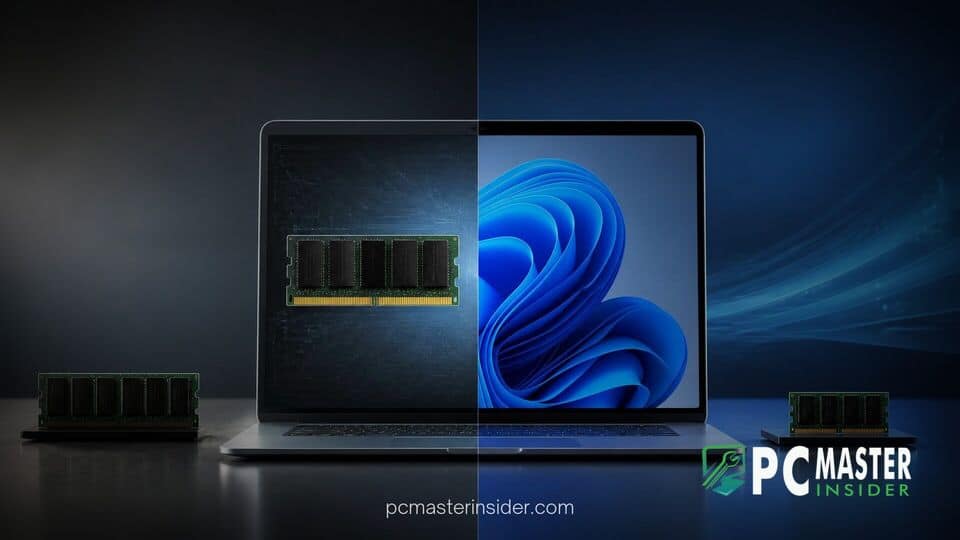
Microsoft has announced that modern Windows 11 laptops equipped with 8GB of memory can achieve real-world performance comparable to 2021 systems configured with 16GB of RAM. The comparison highlights a combination of operating system refactoring, memory compression enhancements, and silicon IPC gains designed to keep entry-level hardware responsive under everyday computing workloads.
Microsoft 8GB RAM Windows 11 Performance Claim
In a technical update detailing system efficiency improvements, Microsoft revealed that recent updates to Windows 11 significantly optimize how memory is managed on low-capacity machines. According to internal lab data, a contemporary PC running 8GB of RAM can match 2021-era 16GB configurations across general productivity tasks, web browsing, light AI processing, and video export routines. The announcement comes alongside metrics showing system responsiveness gains of up to 20 percent and multitasking speed improvements reaching 40 percent on memory-constrained systems.
Memory Compression and OS Optimizations Drive Performance Claims
To achieve these efficiency metrics without increasing physical hardware costs, engineering teams focused on refining the underlying memory pipeline within Windows 11. Rather than continuously swapping inactive application pages to physical storage drives, the updated operating system leverages enhanced memory compression techniques. This refinement allows Windows 11 to hold up to 2GB of additional active data within system RAM before initiating pagefile writes to the disk.
Microsoft has also targeted first-party software footprints to free up resources. System applications like Microsoft Edge, Teams, and standard Microsoft 365 suites have undergone memory reduction passes. For instance, background process growth during extended multitasking sessions has been trimmed by up to 900MB. Additionally, how to reduce high RAM usage from Windows 11 background AI services has become a focal point, as Microsoft defers non-essential background tasks like search indexing while users actively interact with foreground applications.
These operating system optimizations arrive alongside wider platform updates. While updates like Microsoft releases Windows 11 Build 26320.9876 to Beta Channel introduce feature additions, the platform core continues to receive targeted performance tuning for budget and entry-level hardware profiles.
Comparing Benchmark Results and Real-World Hardware Gains
While software efficiency accounts for part of the performance parity, architectural advancements in hardware play a major role. Comparing a modern 8GB system against a five-year-old 16GB PC involves significantly different processor architectures, faster system bus speeds, and faster solid-state storage controllers. Microsoft cited tests featuring modern processors where single-core and multi-core CPU output far surpassed 2021 silicon, helping offset hardware capacity limits.
Independent testing shows a more nuanced picture. While everyday operations such as launching File Explorer, opening system settings, and navigating web browser tabs feel noticeably smoother on optimized 8GB machines, heavy workloads still favor raw memory capacity. Content creation applications, complex spreadsheet operations, multi-stream 4K editing, and heavy virtual machine usage quickly exceed 8GB boundaries, requiring system paging regardless of compression efficiency.
Microsoft openly acknowledged these boundaries in its technical release, noting that 16GB or 32GB configurations remain the recommended standard for heavy workloads and professional multitasking environments.
Market Context and the Push for Budget Windows 11 Laptops
The push to elevate 8GB performance arrives amid fluctuating memory pricing and economic pressures on PC manufacturers. As component costs rise, PC vendors continue shipping budget laptops with 8GB of non-upgradable memory to maintain entry-level price points. Demonstrating that Windows 11 can operate fluently on lower memory configurations ensures these affordable systems remain viable for students, office workers, and casual users.
Software efficiency initiatives are expanding across the Windows ecosystem. Similar to how Microsoft rewrites 17 PowerToys utilities in native WinUI 3 for Windows 11 to reduce resource usage, the operating system core is increasingly tuned to extract maximum responsiveness from available hardware.
Overall, Microsoft's memory optimizations provide a welcome performance buffer for budget-conscious consumers relying on 8GB machines. While raw memory capacity remains essential for demanding power users, software refinements and modern processor architectures ensure that entry-level Windows 11 PCs deliver a responsive everyday experience.