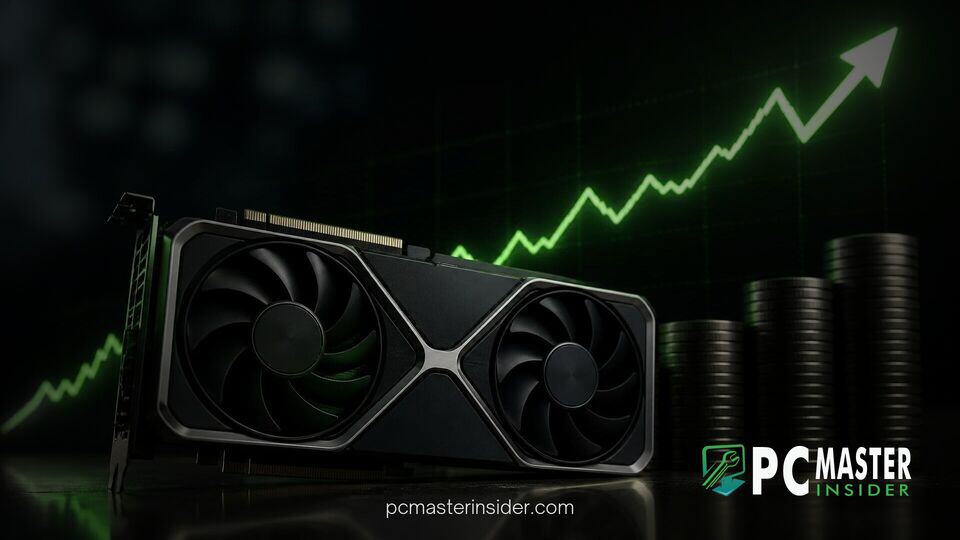
Retail prices for Nvidia GeForce RTX 5070 Ti graphics cards have experienced a sharp uptick across major US retailers, reaching prices up to 79 percent above the manufacturer suggested retail price (MSRP). Entry-level listings for the 16 GB graphics card jumped from $1,179.99 to $1,339.99 over an eight-day span, adding further friction for PC builders seeking mid-to-high-end hardware.
The price surge reflects mounting supply constraints across the broader GPU retail market. With basic partner models now commanding over $1,300 and premium custom cards approaching double their original baseline price, consumer options in the desktop graphics segment continue to shrink dramatically.
Nvidia RTX 5070 Ti US Price Spike Details
Retail tracking data reveals that the baseline price for an Nvidia GeForce RTX 5070 Ti in the US surged by $160 within eight days, representing a 13.6 percent increase over late October levels. Originally launched at an MSRP of $749, the lowest available street price for a new unit now sits at $1,339.99. This steep mark-up places even the entry-tier variants well above the launch price of higher-tier hardware like the RTX 5080.
Retail Price Movement and Availability
The sharp increase in storefront pricing has affected several major American retailers, including Newegg, Best Buy, and B&H Photo. A breakdown of active listings across storefronts highlights the extent of the premium being charged over the original $749 reference price:
- Gigabyte RTX 5070 Ti Aero OC: Listed at $1,339.99 on Newegg (approx. +79% above MSRP).
- Asus RTX 5070 Ti Prime OC: Listed at $1,399.99 on B&H Photo (approx. +87% above MSRP).
- Gigabyte RTX 5070 Ti Gaming OC: Listed at approximately $1,400.00 on Best Buy (approx. +87% above MSRP).
- Asus RTX 5070 Ti TUF Gaming OC: Listed at $1,499.99 on B&H Photo (approx. +100% above MSRP).
Market analysts note that tracking the lowest available price often reflects inventory turnover rather than direct MSRP adjustments by manufacturers. As cheaper stock sells out rapidly, only higher-cost custom models remain available for immediate purchase, driving up the effective minimum buy-in for consumers.
Impact on Mid-Range GPU Buyers
The escalation of retail pricing leaves mid-range PC builders facing tough choices. The RTX 5070 Ti was designed to occupy a sweet spot for high-framerate 1440p and 4K gaming with its 16 GB frame buffer. However, at a minimum cost of $1,340, the graphics card now costs significantly more than the launch MSRP of the next performance tier.
This upward price pressure is not isolated to single components. Across the broader PC building landscape, elevated hardware costs have slowed down upgrade cycles. Users evaluating complete system updates are also facing cost pressures in adjacent segments, as seen when Blackmagic Design raises product prices citing skyrocketing memory costs across the hardware industry.
Similarly, component availability challenges extend to memory and platform upgrades. With hardware builders already managing high pricing elsewhere, many are choosing to delay system overhauls or look toward existing hardware options. Steam user trends indicate that older mainstays remain popular among budget-conscious gamers, reminiscent of how the GeForce RTX 3060 retakes top spot on Steam during tight component cycles.
Market Context and Supply Factors
The pricing trajectory of the RTX 5070 Ti aligns with wider trends across the Blackwell hardware lineup. Flagship cards such as the RTX 5080 and RTX 5090 have also seen heavy retail inflation, with top-tier models selling for well over double their recommended prices. Earlier reports of overall supply shifts were highlighted when Nvidia increases RTX 50 series GPU prices by up to $500 across select regions and product tiers.
Industry sources point toward tight memory supply chains as a core driver of retail scarcity. Board partners like Asus previously clarified that while cards remain in active production, high-speed VRAM component shortages have restricted overall manufacturing output. Furthermore, hardware production streams are competing against industrial demand, as an AI infrastructure demand triggers global PCB shortage for PC hardware, further constraining consumer board manufacturing.
Upstream memory market dynamics continue to complicate matters for add-in-board (AIB) partners. Broader industry reports, including how TrendForce warns AI inference surge is causing DDR5 component shortages, emphasize that high-bandwidth memory allocations are heavily prioritized for enterprise AI chips, leaving consumer desktop card stock constrained.
With no official change to recommended MSRPs announced by Nvidia, current US market prices remain driven by stock availability, distributor markup, and strong retail demand. For now, consumers shopping for an RTX 5070 Ti must either pay a steep premium or wait for supply stabilization to bring retail prices closer to baseline expectations.