
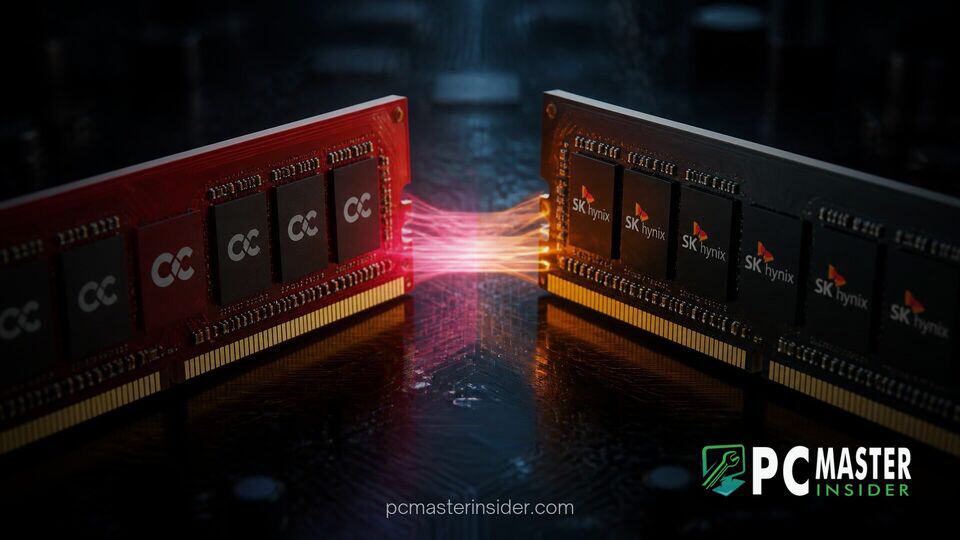
China-based memory manufacturer ChangXin Memory Technologies (CXMT) has achieved a significant milestone in high-speed memory production. Recent independent performance evaluations reveal that CXMT silicon operating at high-frequency profiles is delivering throughput and latency figures virtually identical to industry standard modules from established leaders like SK Hynix.
The benchmarking results mark a major technical leap forward for China's domestic DRAM industry, demonstrating that national memory vendors can produce cutting-edge consumer memory capable of competing on raw execution speed rather than relying solely on low pricing. This development follows impressive manufacturing advancements across the regional supply chain, including reports that CXMT achieved a reported 90 percent yield rate on 17nm DDR5 DRAM earlier in its production ramp.
CXMT DDR5 Benchmarks Show 8000 MT/s Performance Parity
Comparative hardware evaluations centered on high-speed desktop profiles demonstrate that modules utilizing CXMT high-density DDR5 dies match established market leaders across primary gaming and synthetic metrics. When tested under standardized memory workloads, the CXMT 8000 MT/s DDR5 RAM benchmark results recorded read, write, and copy bandwidth figures within a fraction of a percent of equivalent SK Hynix A-die modules configured with identical primary and secondary timings.
System stability tests further indicated that the CXMT memory ICs maintain reliable signal integrity at 8000 MT/s operating frequencies without requiring disproportionate voltage increases. Memory controllers on modern desktop platforms scaled identically across both configurations, confirming that signal quality and electrical characteristics on the newer Chinese silicon meet high-bandwidth enthusiast standards.
Testing Reveals Under One Percent Gap with SK Hynix Chips
Detailed performance breakdowns across synthetic suites like AIDA64 and PyPrime highlight how narrow the gap between top-tier memory suppliers has become. In sequential read throughput testing, modules using CXMT chips achieved over 121 GB/s, placing them within less than 0.8 percent of matching SK Hynix kits under identical test bench conditions. Latency measurements were similarly aligned, with both memory configurations hovering around the 56 to 58 nanosecond range when tuned for low-latency desktop operation.
Practical application workloads, including compressed file archive generation, 3D rendering tasks, and high-frame-rate 1080p gaming benchmarks, showed virtually indistinguishable frametime variances between the two die suppliers. The consistency shown across prolonged stress testing confirms that CXMT has largely overcome previous thermal and stability bottlenecks that historically affected early-stage high-speed DRAM nodes.
Market Impact of Competitive Chinese High-Speed Memory Production
The arrival of competitive domestic DDR5 silicon at 8000 MT/s comes at a critical juncture for the global technology market. Over the past several quarters, global memory supply channels have experienced volatility as established memory makers like Samsung and SK Hynix shift DRAM production capacity toward server DDR5 and High Bandwidth Memory (HBM) to support massive enterprise artificial intelligence deployments. This realignment has periodically created supply bottlenecks for high-performance consumer desktop memory.
By demonstrating parity at 8000 MT/s, CXMT positions itself as a viable high-volume alternative capable of absorbing consumer market demand. Industry analysts note that expanded output of competitive DDR5 dies will likely act as a stabilizing force against price spikes in retail hardware markets. This buffer is particularly valuable during periods when DDR5 memory prices surge amid data center supply crunches worldwide.
Furthermore, local motherboard and module manufacturers in Asia stand to benefit directly from expanded local supply pipelines. Component builders can source high-frequency validated memory dies locally without relying exclusively on global market allocations, potentially streamlining supply chains for pre-built desktop systems and high-speed memory kits targeting regional retail shelves.
Future Capacity Expansions and Supply Chain Consequences
Achieving parity at high clock speeds signals broader competitive implications for the entire memory landscape. As legacy manufacturers prioritize high-density server modules to capitalize on soaring export valuations, domestic suppliers are rapidly expanding their operational scope. The push into advanced memory technologies is expanding quickly, with recent efforts extending beyond traditional desktop form factors as CXMT completes LPDDR6 DRAM development to challenge Samsung in the mobile space.
However, scaling high-speed memory production to global volumes presents ongoing challenges. Maintaining consistent binning rates for high-frequency silicon like 8000 MT/s ICs requires rigorous quality control and high wafer yield efficiency across mature production lines. While initial batch benchmarks prove that top-tier CXMT silicon can rival established market standards, commercial success will depend on sustaining yield volumes to satisfy both domestic demand and international export potential.
For PC builders and system integrators, the validation of competitive high-speed DRAM alternatives provides a broader supply base. As secondary and tertiary memory manufacturers begin offering 8000 MT/s kits based on CXMT silicon, consumers can expect broader availability and competitive pricing across high-performance memory offerings in upcoming hardware cycles.