
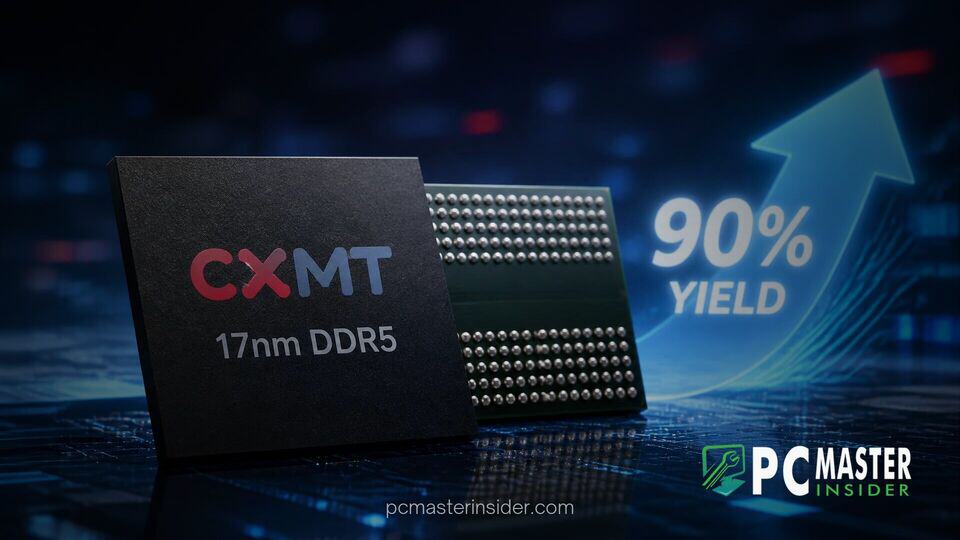
China's premier memory manufacturer, ChangXin Memory Technologies (CXMT), has reportedly achieved a manufacturing yield rate exceeding 90 percent on its 17nm-class DDR5 DRAM production line. This development marks a substantial step forward for the Chinese semiconductor industry, bringing its production efficiency remarkably close to established market leaders like Samsung Electronics, SK hynix, and Micron Technology.
By pushing yield rates beyond the 90 percent threshold, CXMT significantly reduces silicon waste and operational overhead per wafer, turning advanced memory fabrication from an experimental hurdle into an economically viable mass-production asset. Industry analysts note that this milestone represents one of the fastest efficiency ramps for a non-established memory maker, positioning CXMT to expand its market footprint at a time when global memory supply chains remain tight.
ChangXin Memory Reaches 90 Percent Yield on 17nm DDR5 Nodes
According to recent reports from industry supply chain sources, CXMT 17nm DDR5 DRAM yield rates have rapidly matured, jumping from around 80 percent in late 2024 to over 90 percent in recent production runs. Yield rate measures the percentage of functional, non-defective dies produced from a single silicon wafer. High yields are critical in semiconductor manufacturing, directly determining chip margins, commercial viability, and steady supply capability.
This surge in manufacturing performance places CXMT within striking distance of legacy DRAM powerhouses. Samsung, the current global leader in DRAM production, reportedly operates at a yield rate of 92 to 93 percent on its equivalent 10nm-class memory nodes. By narrowing the yield differential to just two or three percentage points, CXMT demonstrates that its fab optimization and cleanroom processes are operating at near top-tier international standards, despite ongoing geopolitical sanctions and lithography tool constraints.
Closing the Manufacturing Efficiency Gap with Samsung
While global competitors like Samsung and Micron have transitioned to denser process nodes using extreme ultraviolet (EUV) lithography, CXMT has relied heavily on deep ultraviolet (DUV) multi-patterning techniques for its 17nm class architecture. Achieving a 90 percent yield without access to the latest generation of EUV equipment highlights CXMT's ability to maximize output from mature and intermediate manufacturing toolsets.
The yield increase allows CXMT to drastically scale up its effective wafer volume. Reports indicate that the firm plans to reach a total capacity of roughly 350,000 DRAM wafers per month across its fab facilities, ensuring that higher yields translate directly into millions of usable consumer DDR5 modules.
Technical Specifications of CXMT Consumer DDR5 Chips
CXMT's DDR5 portfolio is no longer limited to entry-level memory products. The company's official engineering specifications highlight chip capacities ranging from 16Gb to 24Gb dies, featuring built-in on-die ECC (Error Correction Code) and roughly 20 percent lower power consumption compared to legacy DDR4 standards.
Motherboard partners and hardware vendors have actively begun validating CXMT memory chips. Board manufacturers including MSI and Colorful have successfully tested CXMT DDR5 modules, achieving transfer speeds exceeding 8000 MT/s and reaching up to 8800 MT/s under overclocked configurations on modern desktop platforms. These technical demonstrations prove that CXMT memory can deliver performance comparable to mainstream offerings from Western and South Korean manufacturers.
How Chinese DDR5 Expansion Could Impact Global RAM Supply
The commercial rollout of CXMT's high-yield DDR5 chips has triggered mixed reactions across global PC Original Equipment Manufacturers (OEMs). Brand strategies differ significantly based on geopolitical exposure and regional market priorities.
For example, US-based PC maker Dell has maintained a total ban on adopting CXMT components within its hardware ecosystem. HP has taken a selective approach, restricting the installation of CXMT memory modules exclusively to personal computers destined for sale within mainland China. Meanwhile, Taiwanese hardware brands like ASUS and Acer have integrated CXMT DDR5 chips into mid-range laptop lines aimed at both mainland China and select emerging markets across South Asia and Latin America.
Industry executives note that Tier-1 computer vendors remain cautious about shifting high-volume orders away from Samsung, SK hynix, and Micron, which collectively hold more than 90 percent of the global DRAM revenue share. Maintaining strong relationships with the big three memory vendors remains a top priority for global brands, particularly as enterprise demand for high-bandwidth memory (HBM) leaves standard DDR5 production tight across Western supply chains.
Future Roadmaps and Global Hardware Distribution Challenges
Despite reaching commercial viability on its 17nm node, CXMT faces persistent structural challenges in expanding its global market share. Advanced node scaling remains technically difficult without access to EUV tools, meaning CXMT will need to continually push DUV optimization to its absolute limits to move down toward 15nm or 14nm nodes.
Furthermore, much of CXMT's rising DDR5 volume is expected to be absorbed domestically. China's massive domestic technology sector, spanning personal computing, localized cloud data centers, and industrial automation, provides an eager consumer base for affordable, high-yield memory. This strong internal demand ensures that even if Western export markets remain largely restricted, CXMT can sustain high fab utilization rates and fund ongoing research and development.
In summary, ChangXin Memory Technologies achieving a 90 percent yield on 17nm DDR5 DRAM represents a vital milestone for China's chip self-sufficiency goals. While international adoption remains split due to geopolitical considerations, CXMT's technical achievements prove that the manufacturing gap in standard system memory is narrowing faster than many industry observers previously anticipated.