At the Hot Chips symposium, NVIDIA presented comprehensive technical specifications for its upcoming AI hardware infrastructure. The presentation focused on the Groq 3 LPX AI inference rack architecture, a system designed specifically to tackle high-throughput, low-latency machine learning inference tasks across enterprise clusters.
By integrating Deterministic Tensor Streaming technology directly into custom server configurations, the company aims to offer datacenter operators an optimized platform for large language model execution. This announcement highlights growing industry demand for specialized inference hardware that can keep pace with increasingly complex AI reasoning pipelines.
NVIDIA Unveils Groq 3 LPX Inference Rack at Hot Chips 2026
The announcement of the nvidia groq 3 lpx hot chips 2026 presentation marks a deliberate shift toward hardware tuned exclusively for real-time model execution. While primary training clusters rely on traditional monolithic GPU clusters, inference demands a balance of predictable latency and energy efficiency. The Groq 3 LPX system addresses these challenges through a modular chassis housing dedicated Language Processing Units that bypass typical memory bottleneck constraints.
During the session, engineering teams outlined how the system architecture eliminates dynamic execution overhead. Rather than relying on traditional hardware scheduling routines, the hardware utilizes compiler-driven instruction timing to deliver lockstep execution across thousands of compute cores. This deterministic model ensures that execution time for deep learning operations remains constant, regardless of concurrent request volume or complex batching conditions.
LP30 Architecture and Record Output Performance Benchmarks
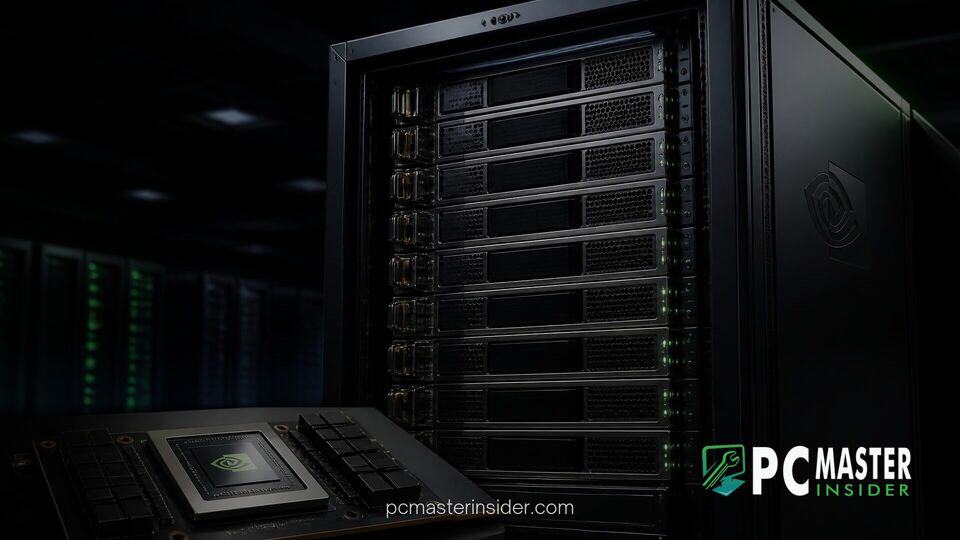
At the heart of the Groq 3 LPX rack configuration is the LP30 node board. Each rack unit scales to accommodate dozens of individual LP30 blade nodes, interconnected by a high-bandwidth, ultra-low-latency fabric. By keeping key neural network weights stored directly within massive banks of on-chip SRAM, the LP30 architecture delivers high data throughput without incurring the thermal and latency penalties associated with continuous external DRAM retrieval.
Benchmark data presented during the technical keynote showed significant performance advantages when running generative AI workloads. When handling heavy token generation tasks, the LP30 rack achieved record-breaking output token speeds compared to standard compute deployments. The continuous streaming design allows the chip architecture to sustain high computational density while operating within standard datacenter power budgets.
Integration of Groq Silicon into NVIDIA's Data Center Lineup
The technical disclosure outlines how specialized inference silicon will coexist with existing enterprise systems. While hardware systems like Nvidia's GB300 DGX Station workstation cater to local development and heavy parameter training, the Groq 3 LPX rack acts as an execution engine deployed at scale. This modular approach allows cloud infrastructure providers to assign heavy model training to conventional GPUs while offloading live inference requests to dedicated LPX nodes.
To support this hybrid deployment strategy, software stack updates were detailed during the presentation. Developers can deploy pre-trained models directly to LPX racks using standardized software frameworks, where the compiler automatically optimizes compute graphs for deterministic hardware. Enterprise customers operating large server deployments, who face expanding operating costs as detailed in analyses of Nvidia AI server prices rising due to memory costs, can leverage SRAM-centric architectures to minimize external memory dependencies.
Efficiency Gains for Long-Context AI Reasoning Workloads
Modern machine learning models increasingly rely on extended context windows and multi-step reasoning routines. Standard GPU architectures often encounter memory bandwidth throttling when maintaining immense key-value caches across long context lengths. The LP30 hardware design addresses this constraint by distributing context retention across a vast grid of high-speed memory blocks, allowing long-form query processing without sudden drops in generation speed.
The deterministic execution model also simplifies cluster management. Cloud platform operators can establish reliable Service Level Agreements for real-time applications, such as live voice translation, automated agentic coding, and instant document parsing. Eliminating unpredictable latency spikes ensures that multi-turn agentic workflows execute smoothly without unexpected server timeouts.
Production Timeline and Market Availability
Industry partners attending Hot Chips expressed strong interest in the technical metrics presented during the conference. The Groq 3 LPX architecture represents a deliberate push toward specialized data center infrastructure, joining other key enterprise disclosures at the event such as when Intel unveiled Diamond Rapids Xeon CPUs and when Arm detailed its AGI server processor architecture. As hardware vendors race to optimize every tier of the compute stack, dedicated inference racks are set to play a pivotal role in enterprise hardware strategies.
NVIDIA indicated that sample LP30 node boards are currently undergoing testing with select hyperscale cloud partners. Full production availability for the complete Groq 3 LPX inference rack is scheduled for deployment early next year, with initial units slated for major cloud platform centers and specialized enterprise research hubs.
As demand for real-time generative capabilities continues to grow, systems engineered around deterministic execution offer a clear path forward for sustainable compute expansion. By addressing memory bottlenecks and power constraints at the architecture level, the Groq 3 LPX framework provides the groundwork for high-efficiency AI infrastructure.