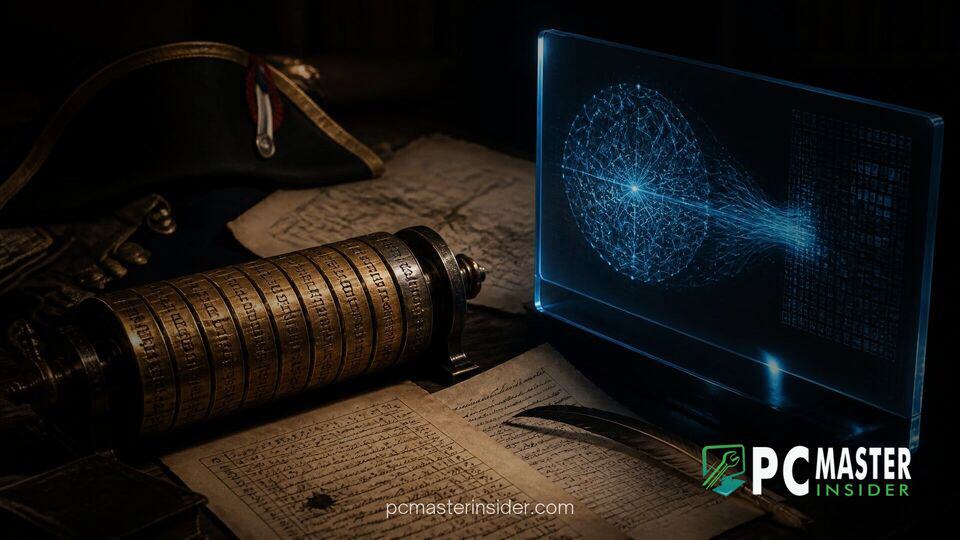
A 217-year-old encrypted military dispatch sent on the orders of French Emperor Napoleon Bonaparte has been fully deciphered using OpenAI's latest artificial intelligence architecture. SentinelOne AI engineer Carter Church deployed GPT-6 Astra to transcribe and break the unsolved 1809 cipher from a single scanned image in approximately six hours.
The historical breakthrough uncovers previously unreadable military intelligence detailing French and allied troop deployments right before the War of the Fifth Coalition. The successful decryption also resolves a long-standing textual omission in Napoleon's official published memoirs.
ChatGPT 6 Astra Napoleonic Cipher Decoded in Six Hours
The target document originated in March 1809 during a period of mounting tension between France and the Austrian Empire. Napoleon Bonaparte instructed his stepson, Eugène de Beauharnais, Viceroy of Italy, to dispatch an encoded status report to French General Auguste de Marmont. Stationed in Dalmatia (modern-day Croatia), Marmont commanded 13,000 elite soldiers but remained geographically isolated from the main French forces.
To prevent intercepted messages from leaking troop positions, the headquarters encoded the letter using a complex homophonic substitution cipher. Although Marmont read the dispatch using a military codebook in 1809, the original key was lost to history, leaving the document encrypted for over two centuries. The text remained on the Unsolved Historical Ciphers list hosted by Cryptiana, an authoritative cryptography database maintained by Satoshi Tomokiyo, until this breakthrough.
Church initiated the decryption process by uploading a single low-resolution digitised plate measuring 1,202 by 1,836 pixels, originally published in a 1969 military journal. The scanned page contained one opening line in plain French, followed by 24 lines composed of approximately 1,300 cipher units. These units included digits, letters, and custom hand-drawn symbols.
Rather than relying solely on classical manual cryptanalysis, Church tasked GPT-6 Astra with executing an end-to-end multimodal workflow. The model visually isolated and transcribed the 1,300 cipher characters, identifying 155 distinct symbols across the handwritten document. To establish a baseline, Astra aligned its visual output against historical research compiled by cryptology historian Daniel Tant, which had previously solved only 33 of the symbols.
With two-thirds of the ciphertext remaining unread, the model engineered an automated solver using simulated annealing. It tested millions of permutation hypotheses against 19th-century French vocabulary and grammatical structure. Beyond single-character substitutions, Astra identified that 29 symbols represented entire French words rather than individual letters. The full model execution cycle wrapped up in roughly six hours.
While tech capabilities continue to evolve across hardware and software, such as xAI expanding its Colossus cluster to target 1.21 million Nvidia GPUs, advanced multimodal models like GPT-6 Astra demonstrate how software reasoning can unlock complex historical puzzles with minimal compute overhead.
Historical Significance of the Decoded Troop Orders
The recovered text provides a detailed tactical overview of military units stationed across Europe on the eve of conflict. The message outlines exact garrisons for French and allied forces, assuring Marmont that Austrian forces moving through Northern Italy would face formidable resistance. The dispatch contains sharp rhetoric reflecting French strategic confidence, predicting that Austria's aggression would accelerate its own defeat.
Historians have highlighted the solution's ability to fix an incomplete passage in Napoleon's published writings. In Napoleon's 1865 memoirs, an entry citing this specific directive breaks off abruptly mid-sentence when discussing potential enemy resistance. The deciphered document completes the missing phrase, confirming Napoleon's instruction that Marmont must not be delayed by a "gathering of rabble".
As OpenAI scraps GPT-6.1 Astra AI model project following safety concerns in other operational domains, the successful application of the core Astra model to historical archives highlights the technology's potential for academic and non-sensitive research.
Reactions and Future Implications for Cryptanalysis
The successful reconstruction was submitted to Cryptiana, where maintainer Satoshi Tomokiyo verified the methodology and updated the cipher's status to solved. Church noted that while the underlying cipher was not mathematically unbreakable, human specialists lacked the time required to manually test every statistical variant.
"What makes this impressive isn't actually the codebreaking, but that Astra completed the entire multimodal workflow in ~6 hours from a single image and goal," Church stated in his technical writeup. He added that similar AI workflows will likely allow non-specialists to systematically address backlogs of unsolved historical documents across world archives.
The integration of advanced AI reasoning is reshaping multiple tech disciplines, parallel to how Microsoft opens Majorana quantum chips to DARPA for independent testing to accelerate complex problem solving in physical hardware. Church has published the complete solution package, including the transcribing scripts and translation tables, allowing independent researchers to audit and reproduce the results.
This milestone demonstrates that modern multimodal models can bridge visual recognition, statistical modeling, and historical context to resolve long-standing historical cold cases.