Elon Musk has unveiled the most detailed roadmap yet for xAI's flagship supercomputing footprint in Memphis, Tennessee. Under the aggressive scaling schedule, the startup intends to expand its Colossus 2 cluster to 1.21 million Nvidia GPUs by the end of the year.
The ambitious timeline underscores the unprecedented scale of artificial intelligence infrastructure spending, as leading labs race to secure raw compute capacity for training next-generation frontier models.
xAI Colossus 2 Nvidia GPU Expansion
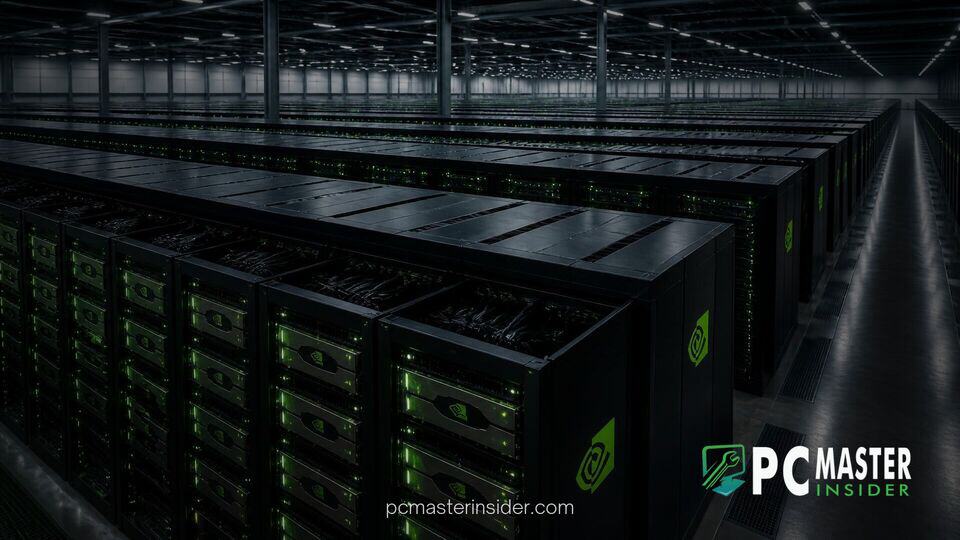
According to updates shared by Musk, the Colossus 2 facility currently houses roughly 550,000 active accelerators, comprising 110,000 Nvidia GB200 chips and 440,000 newer GB300 processors . To hit the target, xAI is executing three deployment phases of 220,000 GB300 units each, scheduled to bring total capacity above 1.2 million processors if hardware delivery and local power hookups remain on track .
xAI Details Aggressive Hardware Scaling for Colossus 2
The expansion marks a dramatic shift in how frontier AI labs procure and deploy enterprise hardware. While xAI's initial site, Colossus 1, relied heavily on older Hopper architecture GPUs like the H100 and H200, Colossus 2 is built almost entirely around Nvidia's high-density Blackwell platform . In addition to powering xAI's proprietary Grok models, parts of the massive Memphis compute footprint are being leveraged by corporate partners and external cloud clients seeking localized AI infrastructure .
This rapid hardware accumulation complements broader shifts across the semiconductor ecosystem, where high-end AI servers continue to command top-tier pricing and priority manufacturing slots AMD Raises GPU and Chipset Prices by 10 Percent While Holding Ryzen Flat. Hardware manufacturers have consistently prioritized high-margin enterprise orders as cloud providers aggressively scale their processing centers.
Breakdown of GB200 and GB300 Deployment Batches
The breakdown provided by Musk outlines a stepped deployment methodology designed to handle complex optical interconnects and network switching backbones :
- Colossus 1 Legacy Footprint: 150,000 H100s, 50,000 H200s, and 30,000 GB200s .
- Colossus 2 Base Lineup: 110,000 GB200s and 440,000 GB300s currently operating .
- Immediate Wave: 220,000 additional GB300 GPUs transitioning to fully operational status .
- November Target: Second wave adding 220,000 GB300 units .
- Late December Goal: Final conditional wave of 220,000 GB300 GPUs to reach the 1.21 million total for Colossus 2 .
Musk noted that the 220,000-unit increment is tied directly to network switch limitations, representing the total number of fiber optic cables capable of linking into a single central switch fabric . Connecting hundreds of thousands of Blackwell Ultra chips demands extreme liquid cooling and low-latency networking capabilities, making data center infrastructure as vital as the silicon itself .
Infrastructure Requirements and Power Demands in Memphis
Housing more than a million high-performance compute nodes presents severe logistical and environmental challenges. A single rack housing Blackwell architectures can require significant power allocations, multiplying the overall draw of the facility exponentially . The rapid growth of the Memphis campus previously relied on temporary natural-gas turbines to meet initial energy demands .
To support the target, xAI is actively transitioning toward a permanent 1.2-gigawatt power facility . Observers note that meeting the late-December target depends heavily on whether power distribution grid updates and cooling installations can keep pace with physical server rack deliveries .
Impact on Industry AI Hardware Competition and Compute Capacity
The scale of the Memphis cluster illustrates how central dedicated enterprise GPU clusters have become to software ecosystem development. While local hardware expansion continues to accelerate in consumer and workstation spaces NVIDIA Unveils RTX Pro 5500 Workstation GPU with 84GB GDDR7 Memory, hyperscale AI clusters operate at a level that redefines supply chain priorities across the entire tech sector.
Beyond training flagship models like Grok, high-density server clusters serve as testing grounds for specialized runtime extensions, developer toolkits, and low-level software stacks NVIDIA Extends CUDA Toolkit 13.4 to Windows on Arm. The sheer volume of compute being concentrated in single locations emphasizes how competitive advantage in the AI space relies heavily on raw hardware volume alongside algorithmic innovation.
If xAI achieves its late-December deployment targets, Colossus 2 will stand as one of the largest single-site GPU deployments in the world . The coming months will reveal whether regional energy infrastructure and optical network fabrics can support this aggressive expansion schedule without delays.