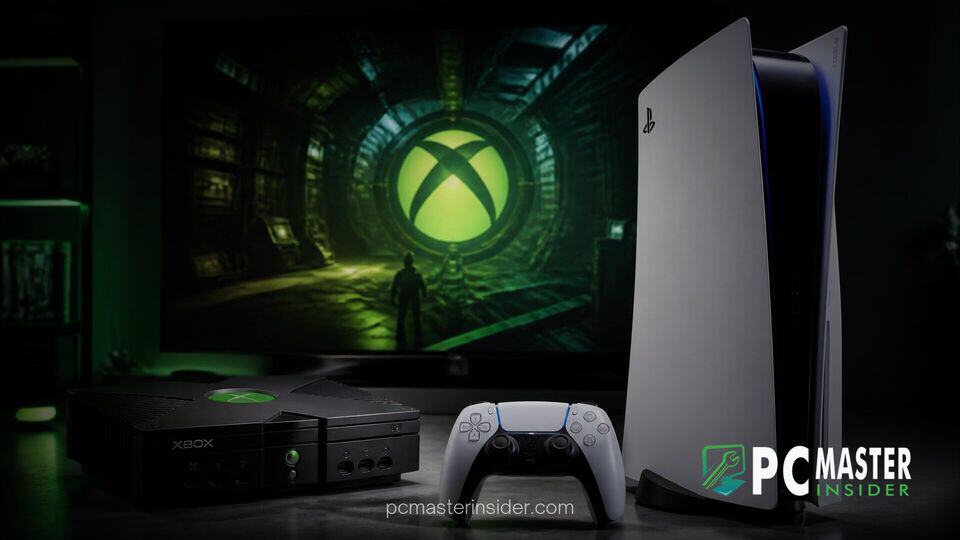
A new open-source software project has unlocked cross-platform retro gaming on Sony hardware, enabling PlayStation 5 consoles to execute software originally compiled for Microsoft's first-generation Xbox. The initial public build, released under the name XPSemu Alpha 1 by developer ZiZc3, allows homebrew enthusiasts to boot classic titles directly on modified PlayStation systems.
By leveraging custom execution environments and low-level graphics drivers, the project marks a significant milestone in console homebrew capabilities. While still in an early development phase, XPSemu demonstrates how modern console architecture can be adapted to run software from competing hardware ecosystems without relying on full-system Linux installations.
Open-Source XPSemu Brings Original Xbox Titles to PS5
The open-source xpsemu ps5 original xbox emulator is a specialized port of xemu, a widely used open-source Xbox emulator designed for desktop platforms. Rather than operating inside a secondary operating system or a general libretro wrapper, XPSemu executes as a native PlayStation 5 homebrew application. This native integration gives the software direct access to system memory and system-level graphics pipelines, significantly reducing overhead compared to virtualization approaches.
The Alpha 1 build includes a dedicated Xbox-style interface featuring cover-flow game selection, customizable per-game configurations, play-time tracking, and built-in memory patching capabilities. To maintain legal compliance, XPSemu does not ship with proprietary files. Users must supply their own dumped Xbox BIOS, MCPX boot ROM, hard drive image, and game backups formatted as XISO files. Software distribution on physical DVD discs is not supported, requiring all titles to reside directly on the PS5 internal SSD storage.
The project arrives alongside a broader surge in PlayStation 5 homebrew development following recent security exploits. Similar advances have recently been made in translation technologies, such as Open-Source AnyPS5 Translates PS5 Games for Native PC Play Without Emulation, demonstrating how cross-architecture compatibility layers are expanding across current-generation devices.
Technical Architecture and QEMU Vulkan Implementation
To recreate the original Xbox architecture, XPSemu handles central processing unit instructions via QEMU's Tiny Code Generator (TCG) just-in-time compiler. The emulated Xbox 733 MHz Intel Pentium III processor presents a unique technical hurdle when running on the PlayStation 5 AMD Zen 2 CPU architecture. Because QEMU relies on dynamic translation rather than hardware virtualization, processing demands are heavily concentrated on single-threaded execution performance.
For graphics rendering, XPSemu translates the original Nvidia NV2A graphics processor calls into Vulkan commands. This relies on Mesa's open-source RADV AMD driver, which was ported to PlayStation 5 hardware through the community-driven PS5_Vulkan initiative. The integration allows the system to utilize hardware-accelerated rendering pipelines, enabling features such as internal resolution scaling up to 4x native output without placing extra strain on the primary system processor.
Emulation Performance and Current Alpha 1 Compatibility
Performance within the Alpha 1 release varies across different software categories, reflecting the heavy CPU burden of instruction translation. Developer benchmarks reveal that the emulated Xbox CPU thread frequently operates at 85 to 97 percent capacity on its assigned core, whereas the PlayStation 5 GPU remains largely underutilized during gameplay.
- Halo 2: Maintains approximately 30 frames per second on default settings. Applying a community 60 FPS patch results in 51 to 60 FPS during initial cinematic sequences and 36 to 50 FPS during active gameplay.
- Crash Bandicoot: The Wrath of Cortex: Achieves stable, full-speed playback with minimal visual artifacts.
- Fable: The Lost Chapters: Delivers 22 to 30 FPS across standard areas, with drops to 10 to 20 FPS during complex graphical scenes.
- Forza Motorsport: Operates at a steady 30 FPS in main menus, but drops to 15 to 21 FPS during dense multi-car races.
Due to current performance constraints, advanced audio Digital Signal Processor (DSP) emulation remains disabled by default to save CPU cycles. Save state functionality is also currently absent from the initial build. However, because the system GPU is not fully utilized, players can upscale game resolutions to 1080p or 4K with virtually no impact on overall frame rates.
Future Development for Xbox 360 and PC Translation
The release of XPSemu reflects a rapidly maturing software ecosystem for unlocked PlayStation consoles. Developers are already exploring methods to optimize the pipeline, with roadmap goals including AMD FidelityFX Super Resolution (FSR) integration to generate frames and mitigate CPU bottlenecks.
Beyond original Xbox software, early experiments targeting other platform architectures are underway within the developer community. Parallel projects are investigating Xbox 360 compatibility via Xenia codebase adaptations, alongside Wine-based translation layers designed to execute Windows PC binaries. Hardware manufacturers continue to advance low-level driver integrations across platforms, similar to efforts seen when AMD Adds GDDR7 Memory Support in Linux Driver Ahead of Next-Gen GPUs.
As open-source contributors refine compiler paths and input mappings, projects like XPSemu continue to push the boundaries of cross-console interoperability. While setup requires strict adherence to security protocols and legally acquired system files, the project highlights the technical versatility of modern x86-based console hardware when released from software lockouts.