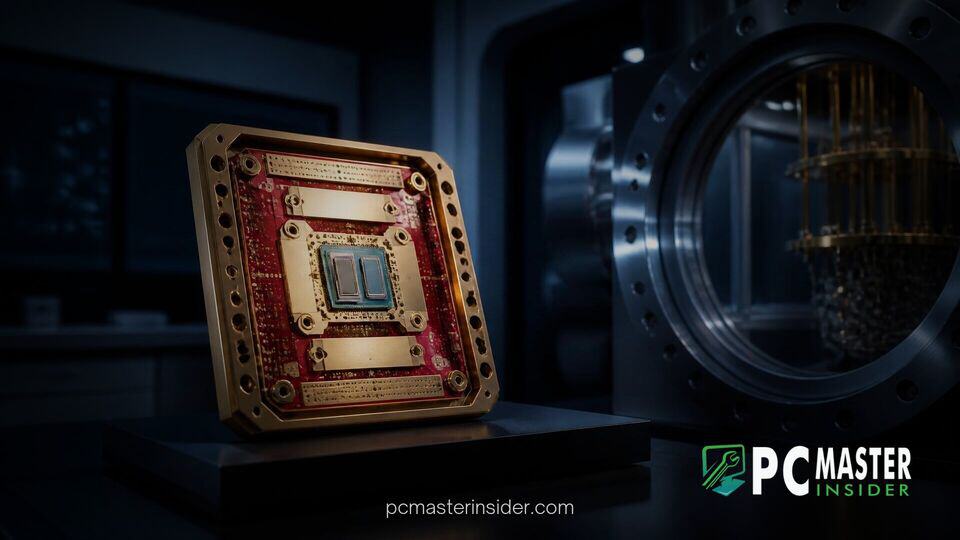
Microsoft has opened a new 15,000-square-foot quantum research facility in Maryland, granting direct physical access to government evaluators from the Defense Advanced Research Projects Agency (DARPA). The agency will independently test and evaluate systems powered by Microsoft's second-generation topological hardware, the Majorana 2 quantum chip.
The move represents a transition from remote cloud testing to direct physical hardware evaluation for federal oversight teams. Located in the University of Maryland's Discovery District, the research facility provides a dedicated workspace where DARPA researchers can directly load hardware and execute custom boot sequences on topological qubit systems.
microsoft majorana quantum darpa testing
The partnership between Microsoft and DARPA provides federal researchers with dedicated access to inspect, test, and benchmark topological quantum hardware under independent laboratory conditions. Moving beyond remote diagnostics, government evaluators will analyze the full execution stack, hardware stability, and system performance of the Majorana 2 chip on-site.
Microsoft Majorana Topological Hardware Sent to DARPA
The system provided for independent federal evaluation is built on the Majorana 2 architecture, Microsoft's proprietary topological quantum computing chip. The hardware utilizes an updated material stack that replaces aluminum with lead, designed to improve overall stability, performance, and qubit coherence.
Topological qubits differ fundamentally from alternative qubit designs, such as superconducting circuits or trapped ions. Rather than relying entirely on complex software redundancy to manage noise, topological architectures use physical properties to protect quantum information from environmental interference. If proven effective at scale, this approach could significantly lower the hardware overhead required for fault-tolerant quantum error correction.
To verify these performance characteristics, DARPA's evaluation team brings together technical experts from the Air Force Research Laboratory, Johns Hopkins University Applied Physics Laboratory, and four major national laboratories, including Los Alamos, Oak Ridge, Lawrence Berkeley, and Lawrence Livermore.
Independent Benchmarking at Maryland Research Center
Prior to the opening of the Maryland facility, federal researchers evaluated Microsoft's progress through remote connection models or visits to Microsoft labs in Redmond, Washington, and Europe. The dedicated space in Maryland now provides an environment where government personnel operate hardware directly in their own assigned lab modules.
The facility was constructed in collaboration with the University of Maryland and received backing from local economic initiatives. Beyond federal testing spaces, the center features shared hardware laboratories, funding for academic research, and collaborative spaces for industry partners including AMD, Intel, and Riverlane.
Executive leadership at Microsoft emphasized the significance of allowing external scrutiny. Speaking to Reuters about the initiative, Zulfi Alam, corporate vice president of Microsoft Quantum, noted that the access allows DARPA to directly evaluate the hardware, adding that external testing enforces engineering rigor that scientific teams normally do not experience.
Significance of Topological Qubits in Scalable Computing
Topological computing remains one of the most ambitious yet technically challenging avenues in physics. Conventional quantum processors require thousands of physical qubits to generate a single error-corrected logical qubit, creating enormous scaling challenges for commercial deployment. Topological qubits aim to drastically compress this ratio by encoding information into non-Abelian anyons, making the physical hardware inherently resilient against noise.
However, the underlying physics has faced scrutiny across the scientific community, with researchers demanding rigorous demonstration of topological states before accepting commercial viability claims. Independent verification by third-party government bodies serves to establish objective metrics regarding system performance and baseline stability.
The ongoing evaluation is part of DARPA's Quantum Benchmarking Initiative (QBI) and its predecessor program, Underexplored Systems for Utility-Scale Quantum Computing (US2QC). The overarching goal of the agency's benchmark is to verify whether any quantum architecture can reach utility scale, where the computational value produced by the system exceeds its operational costs, by 2033.
What External Validation Means for Microsoft Quantum Roadmap
For Microsoft, handing control of its physical hardware to government evaluators marks a crucial checkpoint in its commercial timeline. The company has targeted 2029 for delivering commercial quantum capabilities, an aggressive schedule compared to wider industry projections. Direct testing will help confirm whether the underlying topological architecture can support scaled commercial operations.
The results of DARPA's benchmarking will provide essential data on whether topological systems offer a realistic path to scalable, fault-tolerant quantum computing. As government evaluators begin running custom software and boot sequences on the Majorana 2 system, the industry moves closer to determining the viability of topological hardware in next-generation computing.