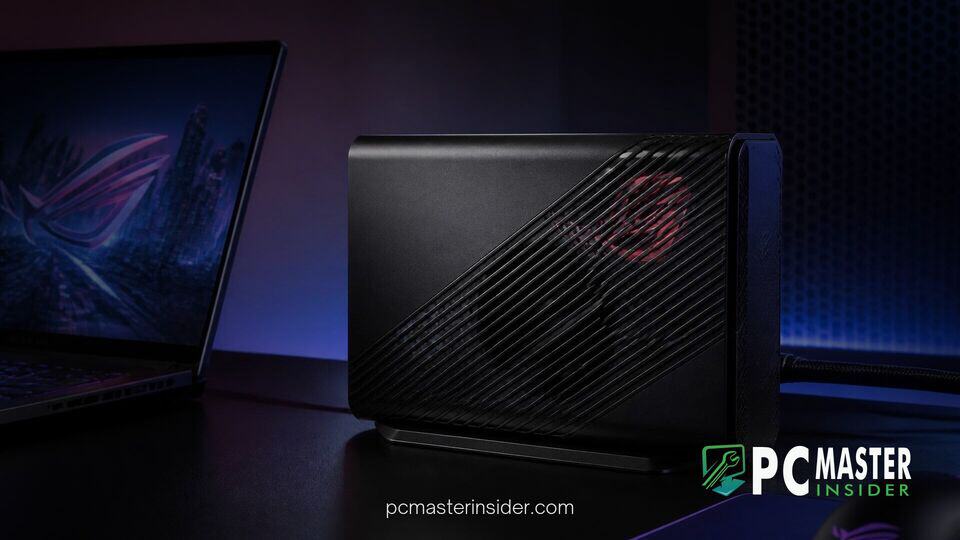
ASUS Republic of Gamers has officially announced the ROG XG Station 3 external graphics card dock, bringing next-generation Thunderbolt 5 connectivity to mobile gamers, creators, and workstation users . Built to unlock desktop-class graphics performance for lightweight laptops and handheld devices, the unit represents a major evolution over previous-generation eGPU solutions .
By harnessing the enhanced bandwidth of Thunderbolt 5, the new enclosure addresses historical eGPU performance bottlenecks while offering expanding expansion options for high-end desktop graphics cards . The design shifts away from traditional enclosed aluminum boxes in favor of an open-frame chassis designed to maximize ambient airflow and accommodate large modern GPUs .
ASUS Reveals ROG XG Station 3 eGPU Dock
Thunderbolt 5 Bandwidth and Connectivity
The core advantage of the asus rog xg station 3 thunderbolt 5 egpu dock lies in its interface technology . Moving past the 40 Gbps limit of Thunderbolt 4, the Thunderbolt 5 standard provides up to 80 Gbps of bidirectional data transmission over PCI Express tunneling . When driving high-resolution displays, the connection can leverage Bandwidth Boost mode to dynamically scale up to 120 Gbps for display-bound video streams .
This massive reduction in interface latency and throughput constraints allows external graphics cards to perform significantly closer to their desktop potential. Laptops equipped with compatible host ports can run demanding AAA titles or heavy compute workloads without the severe degradation seen in earlier external GPU setups.
For users seeking versatile desktop configurations, hardware setups like the ASUS ProArt GR1X mini PC demonstrate how specialized graphics acceleration is reshaping compact computing ecosystems. The addition of high-speed external GPU enclosures further expands how users balance desktop performance with mobility.
Key Features and Hardware Compatibility
Open-Frame Design and Multi-Display Support
ASUS designed the ROG XG Station 3 with an open-frame chassis constructed from polished metallic surfaces and structural accents . This layout eliminates thermal throttling caused by confined enclosures, ensuring that cooling fans maintain completely unobstructed airflow . The dock supports graphics cards measuring up to 361 x 139.3 x 93.9 mm, ensuring compatibility with massive multi-slot designs .
In addition to standard PCIe power connectors, the dock integrates a GC-HPWR high-power slot, allowing full support for Back-to-the-Future (BTF) motherboard ecosystem cards . Users can install BTF graphics cards to draw up to 600 watts of power directly through the slot without routing visible power cables, keeping desktop aesthetics clean .
To maintain flexible build options, ASUS does not include an integrated internal power supply in the retail package . Instead, the dock accepts standard SFX or SFX-L power supplies, allowing buyers to select a power supply tailored to their specific graphics card requirements . ASUS recommends a minimum 750W 80 Plus Gold certified power supply for high-tier card installations .
The unit doubles as a high-speed desktop hub . It provides up to 140W of Power Delivery over the main host connection to charge high-performance laptops while connected . The dock features a second Thunderbolt 5 downstream port with 36W charging, alongside two USB-C 10Gbps ports for external peripherals, keyboards, and mice , . Aura Sync lighting integration allows users to synchronize RGB lighting patterns across their compatible gaming hardware .
The system requires Windows 11 version 25H2 or higher to operate over Thunderbolt 5 host controllers, while macOS is explicitly unsupported due to platform driver limitations . The dock supports external displays directly through the installed GPU's DisplayPort and HDMI outputs, allowing configurations driving up to three 4K monitors simultaneously .
Market Impact and Availability Outlook
The announcement comes at a time of significant hardware expansion across high-performance gaming and computing markets. Demand for modular graphics solutions continues to grow alongside portable computing devices and compact desktop environments. Mobile devices like those highlighted in Microsoft's Surface Pro and Laptop updates emphasize how fast mobile platforms are evolving, creating new demand for versatile docking ecosystems.
Hardware enthusiasts have noted that modular power supply configurations offer greater longevity compared to previous-generation eGPU enclosures with non-replaceable internal power units. System builders can upgrade the power supply independently when transitioning to higher-wattage graphics architectures in future product cycles.
Similar trends are visible across prebuilt desktop systems, as seen in setups like the ASUS ROG G1000 gaming desktop, where optimized thermal management and isolated component layouts are prioritized to sustain peak computational output.
While ASUS has confirmed the hardware specifications and physical layout of the ROG XG Station 3, official pricing details and specific regional release dates have not yet been announced . Additional details regarding global availability are expected from ASUS in upcoming regional launch updates .
With its high-speed 80Gbps Thunderbolt 5 link, BTF card compatibility, and flexible power supply configuration, the ROG XG Station 3 represents a significant step forward for external graphics performance, giving mobile users a path toward uncompromised desktop-grade gaming and compute power .