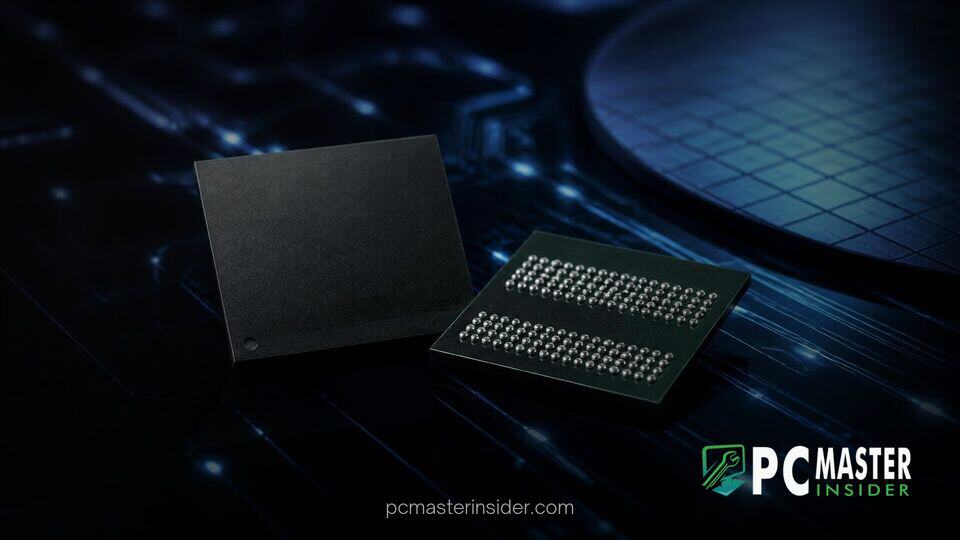
Semiconductor memory manufacturer Winbond Electronics Corporation has officially expanded its advanced 16nm DRAM portfolio with new 8Gb LPDDR4 (x16), 16Gb LPDDR4 (x32), and 16Gb DDR4 memory products . The launch expands Winbond's overall density coverage across mainstream and low-power memory categories, providing hardware engineers with flexible configuration options tailored for modern data-heavy workloads .
As operating systems expand their memory footprints and computing environments demand higher throughput, system designers face increasing challenges matching memory capacities to specific product price tiers . The newly introduced 16Gb components directly resolve density gaps in Winbond's existing memory catalog, enabling device makers to double the capacity per package without incurring severe physical space or thermal penalties .
Winbond Launches 16Gb DDR4 and LPDDR4 Components
Winbond's latest memory release leverages its proprietary 16nm process node to deliver higher density, improved power efficiency, and optimized die sizes . The expansion focuses heavily on filling key gaps in the winbond 16nm ddr4 lpddr4 memory lineup, offering hardware manufacturers scalable choices across basic, mid-range, and flagship product tiers . By utilizing a single advanced process node for multiple form factors, Winbond streamlines system-level integration for hardware vendors building long-lifecycle platforms .
The addition of 16Gb LPDDR4 in a x32 bus configuration and 8Gb LPDDR4 in a x16 bus configuration gives mobile and embedded system builders precise options to target latency and bandwidth requirements . Meanwhile, the new 16Gb DDR4 memory components cater to classic system architectures that require steady, high-capacity system memory while operating under mature and stable infrastructure standards .
Density Upgrades for Enterprise and Embedded Systems
The transition to 16Gb monolithic dies represents a doubling in device density compared to legacy 8Gb solutions . By adopting higher-density chips, hardware engineers can satisfy rising memory demands in edge devices without redesigning system motherboards or adding extra memory IC slots . This density boost is crucial for applications where physical space and bill-of-materials costs are tightly constrained .
Impact on System Board Space and Component Efficiency
Higher memory density directly translates to physical layout efficiency on modern printed circuit boards . Utilizing 16Gb chips allows system designers to hit target RAM capacities using fewer individual integrated circuits . Reducing the component count on a circuit board simplifies trace routing, lowers parasitic capacitance, and improves overall power consumption across thermal design limits .
Furthermore, Winbond's 16nm process node provides improved signal integrity and reduced current leakage compared to older process technologies . System developers can achieve higher operational stability at elevated data rates without triggering aggressive thermal throttling or requiring complex active cooling solutions .
Availability and Industry Applications
Winbond tailored these memory components for distinct commercial and industrial ecosystems . The new 16Gb DDR4 products are targeted at enterprise networking hardware, high-density network switches, and server peripherals where persistent reliability and high data throughput are critical . As many top-tier semiconductor fabs shift production capacity toward DDR5 and High Bandwidth Memory, Winbond's commitment to mature memory tech provides crucial long-term stability for long-lifecycle industrial systems .
The 16Gb LPDDR4 offerings focus heavily on automotive platforms and edge artificial intelligence systems, such as AI Image Signal Processors used in autonomous drones and smart video surveillance setups . In these real-time environments, local high-speed memory ensures low latency for image processing algorithms and sensor fusion tasks .
While cutting-edge desktop and server hardware continues moving toward DDR5, the specialty DRAM market remains essential for industrial, networking, and embedded ecosystems . Winbond's expansion of its 16nm manufacturing capabilities ensures that system builders retain access to high-density, power-efficient DDR4 and LPDDR4 memory solutions for years to come .