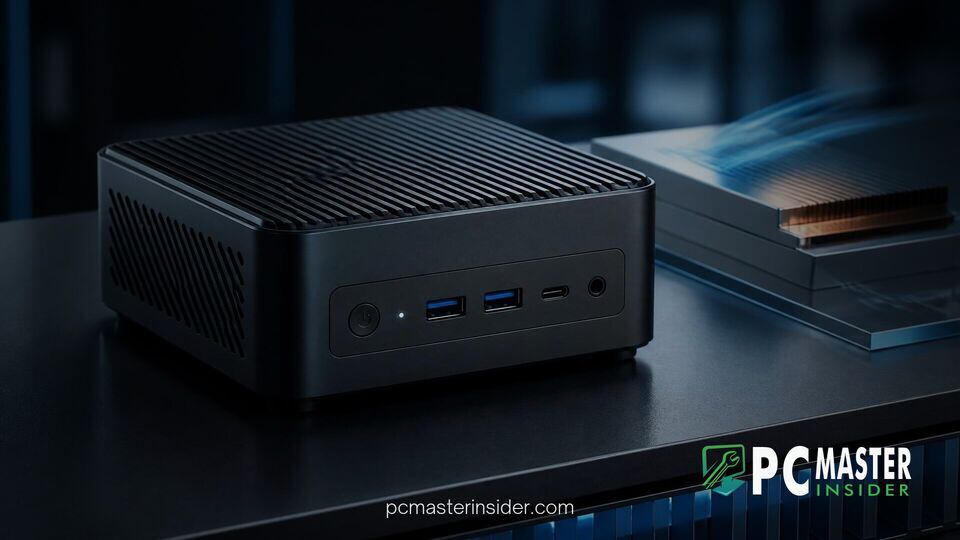
Industrial computing specialist Aaeon has officially introduced its latest embedded compact system, combining next-generation silicon with novel thermal management technology. Powered by Intel Core Ultra Series 3 processors, the system delivers high performance in an ultra-slim chassis designed specifically for space-constrained deployments.
By integrating Frore Systems' AirJet solid-state cooling modules, the device removes traditional motorized fans to deliver high-capacity active heat dissipation. This mechanical reduction drastically slashes acoustic output and form-factor thickness while maintaining the processing throughput necessary for local artificial intelligence and robotics operations.
Aaeon UP Xtreme PTL Edge Air Features Panther Lake and AirJet Cooling
The aaeon up xtreme ptl edge airjet mini pc represents a major evolutionary step for fanless active cooling in industrial computing. Built around Intel's Panther Lake architecture, the compact system replaces bulky extruded copper or aluminum heatsinks with ultrasonic-frequency membrane technology. These vibrating membranes force pulsating, high-speed airflow across thermal dissipators without requiring a traditional motorized hub or rotating fan blades.
Thanks to this solid-state thermal mechanism, Aaeon successfully trimmed the physical footprint of the mini PC compared to standard active-cooled industrial platforms. The new unit measures just 35.8 mm in height and weighs 1.57 lbs, making it approximately 35 percent thinner and 43 percent lighter than its conventional fan-cooled counterpart, the standard UP Xtreme PTL Edge.
Solid-State AirJet Membrane Technology and Acoustic Performance
Frore Systems' AirJet modules work by taking in ambient air and creating tiny high-pressure jets via ultrasonic membranes. These jets sweep heat away from internal components with minimal kinetic energy loss. Because the technology operates at frequencies far above human hearing thresholds, acoustic noise generated by the chassis stays below 21 dBA under normal operating parameters.
For industrial operators and hardware integrators, silent operation is only part of the appeal. Standard cooling fans introduce rotary vibration, which can negatively affect nearby sensitive electronic instrumentation, precision cameras, or motion sensors. Removing rotational mass eliminates fan-induced mechanical jitter, offering a significantly more stable chassis environment for delicate edge equipment.
Intel Core Ultra Series 3 Specifications and Industrial Design
Under the hood, the system is configurable with multiple options from the Intel Core Ultra Series 3 processor stack, including the Core Ultra X7 358H, Core Ultra 7 356H, and Core Ultra 5 325. Higher-tier configurations harness integrated Intel Arc Xe3-based graphics alongside Intel's fifth-generation Neural Processing Unit (NPU 5.0). Together, the combined compute architecture provides up to 180 TOPs of total system AI performance for local inferencing tasks.
Memory and storage support remain robust despite the slim chassis design. Integrators can equip the unit with up to 128GB of dual-channel DDR5-7200 system memory via two SODIMM slots. Storage expansion is handled through dual M.2 2280 slots supporting PCIe 5.0 and PCIe 4.0 NVMe drives, ensuring high bandwidth for dataset reads and video logging. Similar to specialized desktop hardware such as the Gigabyte AI TOP 100 B850 desktop, local compute platforms are increasingly tailored to manage heavy data workloads natively without sending information back to external cloud servers.
Thermal Efficiency and Industrial Integration Options
While solid-state cooling significantly reduces physical volume, it introduces minor power trade-offs. Preliminary data indicates the system draws roughly 5 percent more power on average during active cooling cycles compared to passive fanless blocks, though it maintains safe operating temperatures across demanding compute workloads.
To support varied field deployment requirements, Aaeon fitted the mini PC with an extensive array of industrial I/O ports:
- Display Outputs: Two HDMI 2.1 ports and two DisplayPort 2.1 outputs over USB4, supporting up to four simultaneous 8K displays.
- Connectivity: Dual 2.5 GbE LAN ports, two USB 4.0 Type-C ports, and two USB 3.2 Gen 2 Type-A ports.
- Legacy & Embedded I/O: Dual RS-232/422/485 COM ports for serial device communication and a 40-pin GPIO header for microcontrollers, actuators, or external relays.
- Wireless Expansion: M.2 2230 E-key slot to add optional Wi-Fi and Bluetooth module cards.
Power delivery relies on a wide-range DC input supporting 19V to 36V, making the device compatible with industrial power supply units, vehicular electrical architectures, and mobile robotics battery systems. Hardware security is addressed through an onboard TPM 2.0 module. Operating system support covers both 64-bit Windows 11 IoT Enterprise and Ubuntu 24.04 LTS.
Availability and Deployment Scenarios
Aaeon is targeting this ultra-thin mini PC directly at space-constrained applications where low vertical clearance or acoustic sensitivity prevents the use of traditional desktop computers. Key commercial deployment targets include slim interactive digital kiosks, low-clearance Autonomous Mobile Robot (AMR) internal housings, automated guided vehicles (AGVs), and compact mobile medical carts.
As specialized hardware solutions expand across AI edge hardware like the ASUS Ascent QN10 mini PC and high-capacity system modules like the GMKtec EVO-X5 Pro mini PC, solid-state thermal dissipation presents a compelling alternative to mechanical fans. The reduction in physical torque around moving robot joints, paired with vibration-free operation, makes the UP Xtreme PTL Edge Air a versatile platform for precision vision-guided systems.
The system is currently listed through Aaeon's official distribution channels and partner network. Pricing varies depending on CPU configuration, RAM capacity, and pre-installed NVMe storage options.