
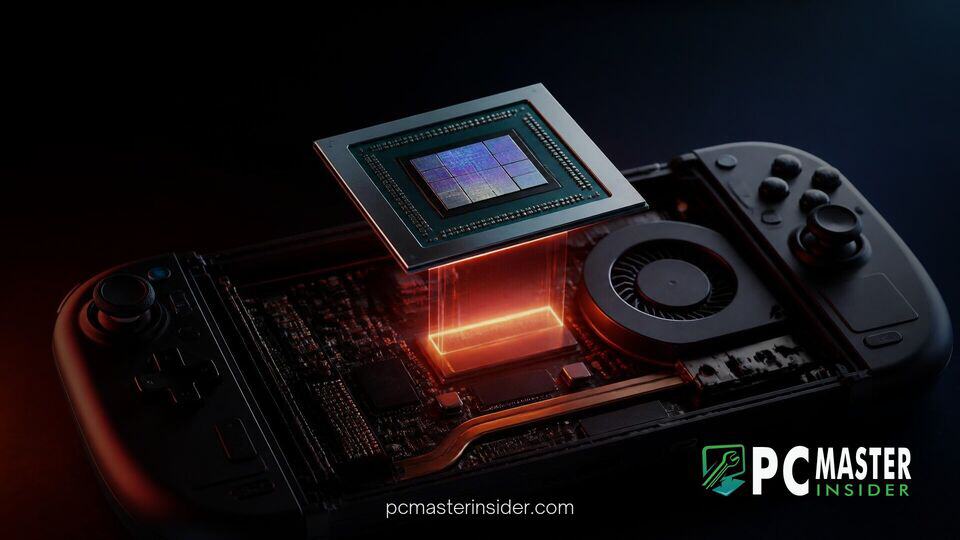
Leaked specifications for AMD's unannounced Ryzen Z3 processor suggest a significant architectural pivot for next-generation portable gaming systems. According to details shared by tech hardware leakers, the new chip combines a semi-custom Zen 6 CPU configuration with 12 RDNA4m graphics compute units aimed at optimizing gaming performance on handheld devices.
amd ryzen z3 specs leak
Early details regarding the upcoming handheld processor surfaced online, detailing AMD's intent to rebalance hardware resources for smaller form factors. The recent amd ryzen z3 specs leak indicates that AMD is moving toward a highly customized layout, shifting power allocation and die space away from high CPU core counts and directly into integrated graphics capabilities. Designed on a compact 25x25mm FF6 package, the processor aims to balance strict thermal limitations with modern gaming requirements.
AMD Next-Gen Handheld Silicon Architecture Leaked
According to reports from industry tipster Gotou_3rd on X, the Ryzen Z3 series is based on AMD's upcoming Medusa Point IP block, but reconfigured specifically for mobile gaming applications. Unlike standard mobile chips that balance productivity and multi-threaded performance, this semi-custom design targets low-power efficiency. By reducing overall socket size compared to current-generation APUs, the chip allows handheld manufacturers to design sleeker chassis or accommodate larger battery modules.
Leaked Core Configurations and Zen 6 Architecture Details
The leaked specifications describe a hybrid CPU cluster featuring a 4+2 core structure. This includes four primary Zen 6 performance cores alongside two low-power efficiency cores. Standard desktop and laptop variants of the Medusa Point platform are expected to carry larger core counts, including dense Zen 6c cores. By removing dense CPU cores, AMD appears to be saving valuable die area specifically for the GPU and system memory controllers.
The inclusion of Next-Gen Zen 6 architecture introduces instruction set improvements and IPC (instructions per cycle) gains that compensate for the lower total core count. Games running on handheld platforms rarely utilize more than six CPU cores effectively, making this asymmetric configuration an ideal trade-off for gaming workloads.
RDNA4m Graphics Upgrades for Handheld Gaming
On the graphics side, the Ryzen Z3 leak points to 12 RDNA4m Compute Units (CUs). The RDNA4m graphics architecture acts as a refined derivative of RDNA 3.5, introducing hardware capabilities borrowed from full RDNA 4 desktop GPUs. Notably, this includes enhanced matrix instruction support for native hardware accelerated upscaling. Competitors like Intel are also ramping up mobile graphics efficiency, forcing chipmakers to optimize integrated graphics pipelines aggressively.
The inclusion of updated matrix operations suggests better performance when running modern temporal and spatial AI upscalers, allowing games to run at lower native rendering resolutions while retaining high visual fidelity on small displays.
Power Efficiency and Thermal Targets for Next-Gen Handhelds
Thermal management remains the primary bottleneck for portable gaming devices. Leaked documentation suggests AMD is targeting two distinct operating profiles for the new lineup:
- Standard Ryzen Z3: Optimized for a baseline envelope of 15W, targeting silent operation and extended battery life.
- Ryzen Z3 Extreme: Tuned for higher sustained workloads with a 25W target power limit.
Recent shifts across hardware manufacturing have made power efficiency a critical priority. As component pricing across chipsets shifts, manufacturers are seeking silicon designs that deliver higher efficiency without requiring overly complex, expensive cooling solutions.
Market Impact and Expected Availability
If these preliminary specifications hold true through production, the Ryzen Z3 family could form the backbone of next-generation portable gaming systems from major hardware vendors. Devices like the ASUS ROG Ally and Lenovo Legion Go lines could benefit significantly from the reduced package size and improved GPU layout.
However, analysts caution that early architectural leaks are subject to revision as AMD finalizes tape-outs and firmware configurations. With broader supply chain factors impacting memory availability—as highlighted by industry warnings surrounding DRAM supplies—system integrators will need to carefully balance processor costs against overall device pricing.
While AMD has not officially confirmed the existence or launch window for the Ryzen Z3 series, hardware enthusiasts expect further details to emerge as next-generation mobile architectures approach formal announcement windows.