ASUS has officially launched the Ascent QN10, introducing its first compact desktop engineered specifically to handle local agentic AI automation and background intelligent workloads. Equipped with Qualcomm's Snapdragon X2 Elite platform, the mini PC pairs an 18-core Qualcomm Oryon CPU with a dedicated Hexagon NPU capable of delivering up to 80 TOPS of AI processing performance.
ASUS Ascent QN10 Mini PC Bridges Local Performance and Compact Design
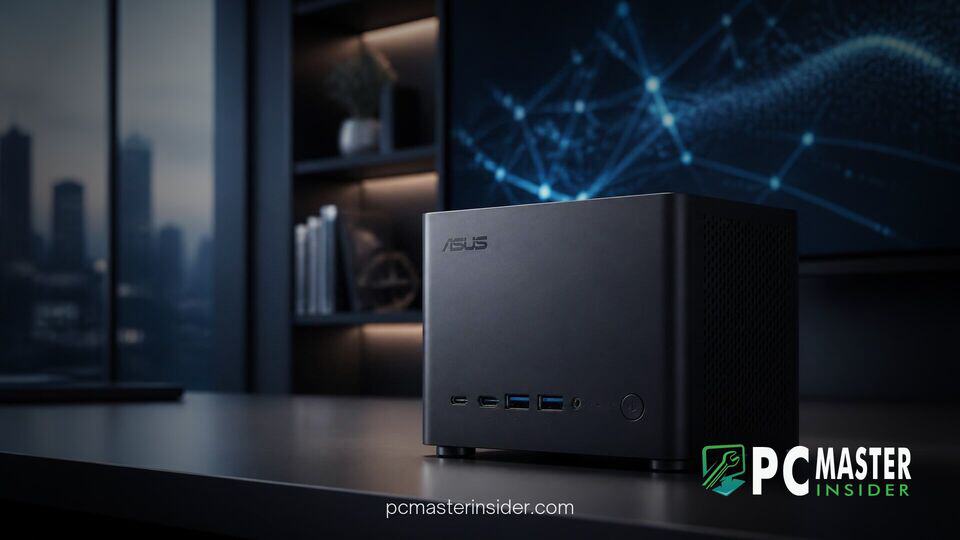
The launch of the ASUS Ascent QN10 mini PC marks a significant shift in small-form-factor computing. While previous Windows on Arm desktop offerings were largely restricted to developer kits or plastic reference enclosures, the Ascent QN10 arrives as a consumer-ready system encased in a premium anodized aluminum body. Measuring under 0.7 liters in volume, the device is engineered to fit into tight workspaces without sacrificing connectivity or expansion options.
As computing requirements shift toward localized processing to reduce reliance on cloud infrastructure, hardware manufacturers are rushing to integrate higher-capacity neural units directly into desktop hardware. Other brands have similarly expanded their workstation lineups for high-density compute tasks; for example, Minisforum debuted AI Agent NAS N5 and MS-S1 Workstation at IFA 2026 to address growing demand for localized intelligence. The Ascent QN10 targets a similar intersection of compact sizing and edge compute capacity.
ASUS Ascent QN10 Hardware and Form Factor Overview
Qualcomm Oryon Architecture and Hexagon NPU Specs
At the center of the Ascent QN10 is Qualcomm's third-generation Snapdragon X2 Elite system-on-chip. The processor features an 18-core Qualcomm Oryon CPU architecture alongside an integrated Qualcomm Adreno X2-90 GPU. These compute elements are supported by high-speed memory options, with configurations supporting up to 32GB of LPDDR5x RAM operating at up to 9600 MHz to provide fast bandwidth across concurrent tasks.
The primary highlight of the internal architecture is the upgraded Qualcomm Hexagon Neural Processing Unit (NPU). Capable of reaching 80 TOPS of dedicated AI compute, the NPU nearly doubles the performance headroom seen in earlier Copilot+ PC hardware. This increased throughput allows the hardware to execute complex matrix calculations, real-time context parsing, and generative execution pipelines locally without introducing heavy loads to the main CPU cores.
Ultra-Compact Chassis and Connectivity Options
Despite its footprint measuring 130 x 130 x 39.96 mm and weighing just 0.75 kg, the Ascent QN10 incorporates a broad range of input and output ports. The front panel features two high-speed USB4 Type-C ports, two USB Type-A ports, and a 3.5 mm combo audio jack for convenient peripheral access. The rear I/O layout adds an additional USB4 Type-C port, two USB 3.2 Gen 2 Type-A ports, an HDMI output, and a 2.5 Gigabit Ethernet port.
The system is capable of driving up to four 4K displays simultaneously using its USB4 and HDMI connectivity options. Wireless communications are handled via an integrated Wi-Fi 7 module and Bluetooth 6.0 support. Internal storage configs rely on M.2 PCIe 4.0 NVMe SSDs ranging from 512GB up to 2TB. Enterprise security feature integration includes the Qualcomm Secure Processing Unit (SPU) with Microsoft Pluton integration enabled at the hardware level.
Agentic AI Capabilities and Target Workloads
The designation of the Ascent QN10 as an agentic AI mini PC reflects its focus on autonomous local software agents. Unlike basic generative tools that only respond to single prompts, agentic AI frameworks run multi-step planning tasks, handle file orchestration, perform context tracking, and automate background routines continuously. Running these background tasks locally requires substantial inference headroom, low memory latency, and consistent power efficiency.
Developers working on localized software agents can access the Qualcomm AI Hub directly through the Ascent QN10. This ecosystem provides pre-optimized machine learning models and fine-tuning tools configured to leverage the Hexagon NPU. Beyond agentic workflows, the hardware accelerates daily productivity tools like real-time language transcription, local code completion, video enhancements, and on-device computer vision tasks.
This push toward dedicated hardware for localized AI models spans multiple form factors across the PC market. In mobile enterprise systems, COLORFIRE unveiled a high-end Ryzen AI Max workstation mini PC and laptop to serve similar processing demands on x86 platforms. Meanwhile, developers looking to build local assistant infrastructure can take advantage of tools like the standalone Gemini desktop app for Windows 11 and 10 to integrate localized AI environments into daily software stacks.
Market Positioning and Availability Details
ASUS has positioned the Ascent QN10 as a versatile workstation for developers, remote professionals, and enterprise deployments seeking low-power desktop performance. The base configuration, featuring 16GB of LPDDR5x RAM and a 512GB PCIe 4.0 SSD, carries a retail price of $1,349. A higher-end configuration equipped with 32GB of memory and 512GB of internal storage is available for $1,699. Both variants ship pre-configured with Windows 11 for ARM64.
The product launch comes alongside broader shifts in the personal computer market, where average hardware pricing has adjusted upward due to advanced memory configurations and specialized processing blocks. As noted in recent retail monitoring, US PC average selling prices exceeded $1,000 for the first time in Q2 2026, driven in part by the adoption of dedicated NPU silicon and premium compact chassis designs.
The ASUS Ascent QN10 demonstrates how ARM-based silicon and specialized neural units are shaping modern desktop form factors. By packing 80 TOPS of NPU processing into a 0.7-liter chassis, the mini PC establishes a functional platform for users looking to run continuous AI agents and automated workflows locally.